 Jean-Paul BoerekampsCC0 · iNaturalist
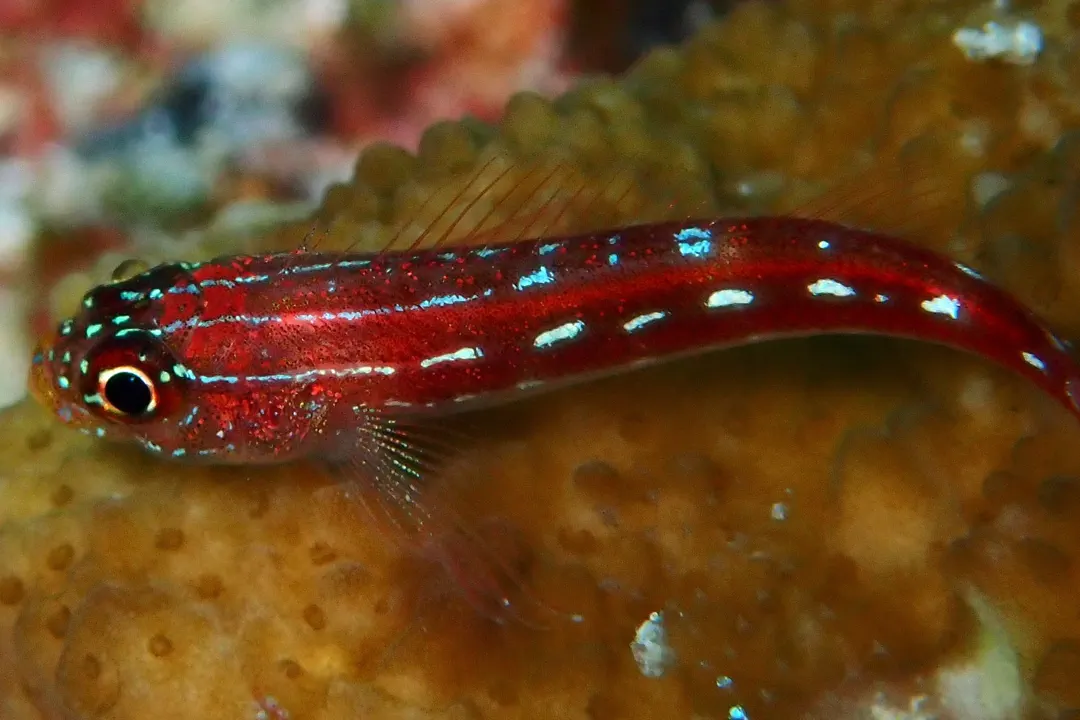
Maldives Triplefin
Helcogramma maldivensis
Tripterygion delaisi
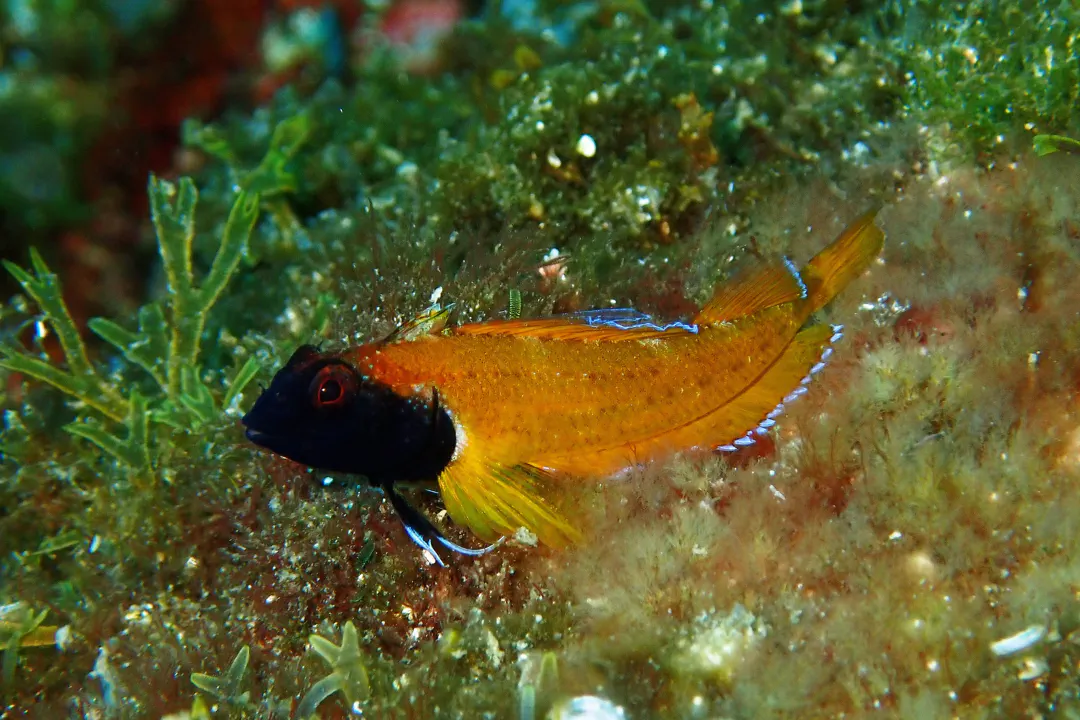
Tripterygion delaisi is a species of fish in the family Tripterygiidae, the threefin blennies. It is widespread in the eastern Atlantic Ocean and the Mediterranean Sea from the English Channel to the coast of western Africa as far south as Senegal. It lives in crevices at depths of 5 to 40 meters. It feeds on micro-crustaceans. When threatened it freezes rather than swimming away, relying on its cryptic color patterning to disguise it against the substrate.
Like all triplefin-blennies, T. delaisi has three dorsal fins and can hence easily be distinguished from members of the families Blenniidae (1 dorsal fin) and Gobiidae (2 dorsal fins) that have a similar live-style and general appearance. It has a peaked head and short tentacles above the eyes.
The common name yellow black-faced blenny derives from the colouration of territorial males during the breeding season: their body becomes yellow and their head turns black; during a territorial fight the colouration of the head changes to a grey colour as a sign of aggression. Non-territorial males, females, and juveniles are cryptically coloured and are grey-brown with five dark and broad dorso-ventral bands between the head and the tail. Outside the breading season, males and females can only be told apart with certainty by dissection.
The black-faced blenny can grow up to 8 centimetres (3.1 in) long. On average, territorial males (6.1 centimetres (2.4 in)) are slightly larger than non-territorial males (4.7 centimetres (1.9 in)) and females (5.0 centimetres (2.0 in)). Individuals caught in deeper water are generally larger than those captured in shallow waters.
Territorial males are distinctive and can hardly be confounded with any other species. Non-territorial males, females, and juveniles, are very similar in T. delaisi and Tripterygion tripteronotus. They can be told apart by a dark spot on the basis of the tail of T. delaisi, which is absent in T. tripteronotus. Additionally, the largest spine of the first dorsal fin is the first one in T. delaisi, whereas the 2nd spine is of equal length (in some individuals even larger) in T. tripteronotus.
The iris of T. delaisi produces a fluorescent red signal. This signal is effected by guanine crystals in iridophores located in the stratum argentum, a reflective silvery, cellular layer external to the iris. These guanine crystals absorb a large part of the ambient light (400-580 nm, peak at 540 nm) and re-emit it at longer wavelengths with a peak emission of 600 nm (perceived as red by humans). On the posterior side of the stratum argentum lays a layer of melanophores with finger-like extensions that reach above the iridophore layer of the stratum argentum. The fish controls the brightness of its fluorescence through aggregation (brighter) and disaggregation (duller) of pigmented melanosomes in these finger-like expansions. The transport of the melonosomes is K⁺-dependent and thus likely to be neurally controlled. When stressed or inactive the fluorescence decreases in intensity, but gets brighter when foraging.
Additional to the fast change in brightness, a long-time adaptation to the light environment has been described for the fluorescence of T. delaisi: The fluorescence of animals caught at 20 metres (66 ft) is significantly more efficient than in animals caught at 5 metres (16 ft). Experiments have shown that this long-time adaptation is controlled by the ambient brightness and not by the ambient spectrum.
T. delaisi has three cone types in its retina: two single cones (maximal photon absorption at 481 nm and 500 nm respectively) and a double cone (maximal photon absorption at 518 and 531 nm). The absorption rate of the double cone overlaps with the fluorescence emission; T. delaisi is hence physiologically capable of detecting its own fluorescence. Behavioural experiments have shown that T. delaisi can distinguish between grey cues and cues matching the colour of its fluorescence and is therefore capable of perceiving its own fluorescence.
T. delaisi inhabits 2 disjunct areas: 1. the western Mediterranean Sea and adjacent parts of the Atlantic Oceans from north to the British Isles and south of Casablanca and Morocco, 2. western tropical Africa north to Senegal and the Macaronesian islands.
It lives at depths between 3 and 40 metres (120 and 1,570 in) but is most common at depths between 6 and 25 metres (20 and 82 ft). It prefers shaded, dark areas, such as shady rock faces, overhangs and crevices. In the Atlantic Ocean T. delaisi can be observed without cover even in shallow waters, but in the Mediterranean Sea it can only be seen without cover below depths of 10 metres (33 ft). This phenomenon can be explained through a lack of competition: In the Mediterranean Sea T. tripteronotus occurs in depth from 0 to 5 metres (0 to 16 ft) whereas in the Atlantic Ocean, where T. tripteronotus is absent, this niche is free to occupy.
The territorial males of T. tripteronotus and T. melanurus both have a red body with a black head, a signal that is strong in shallow waters where red light is still abundant, but becomes less and less striking with increasing depth due to the high absorption of long wavelengths in water. This might explain why T. delaisi only occurs below 5 metres (16 ft) in depth, whereas T. tripteronotus lives between 0 and 5 metres (0 and 16 ft): Males with a primarily red colouration can only successfully court for females where red light is present in the environment but in these shallow waters red is a stronger signal than yellow. Yellow males however, still exhibit a relatively striking colouration even at larger depths where they can successfully court for females.
T. delaisi is a carnivore that mainly feeds on small crustaceans, such as Harpacticoids, Tanaidaceans, Caprellidae, and Amphipods. It cannot bite pieces out of its prey and thus cannot eat prey larger than its mouth. Defecation takes 1 to 2 s.
Prior to the capture, T. delaisi looks at the prey item for several seconds; meanwhile the first dorsal fin rhythmically twitches about twice per second. The capture is achieved by a sudden inhaling movement, which sucks the prey into the mouth. If the prey is attached to the substrate, it is torn loose by a sideward movement of the head.
Jean-Paul BoerekampsCC0 · iNaturalist 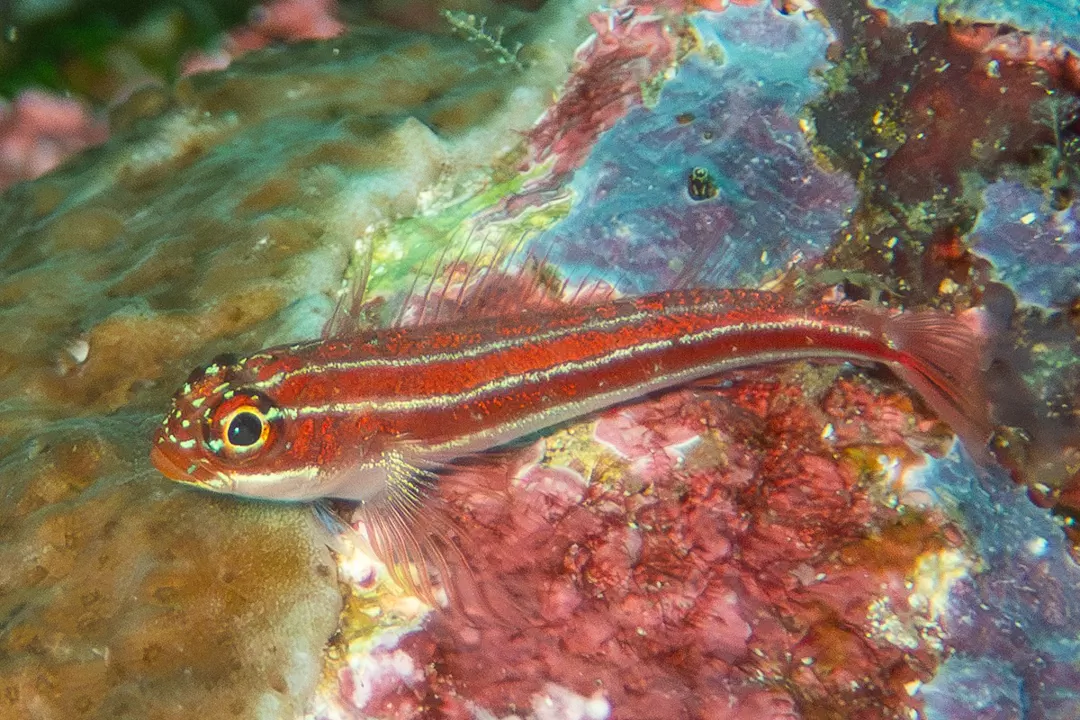 © Piotr LukasikCC BY 4.0 · iNaturalist
 Black-faced Blenny has no known danger to humans. However, always observe marine life responsibly.
Black-faced Blenny can be found at depths of up to 40 meters.
Download Seabook free for iOS and Android.