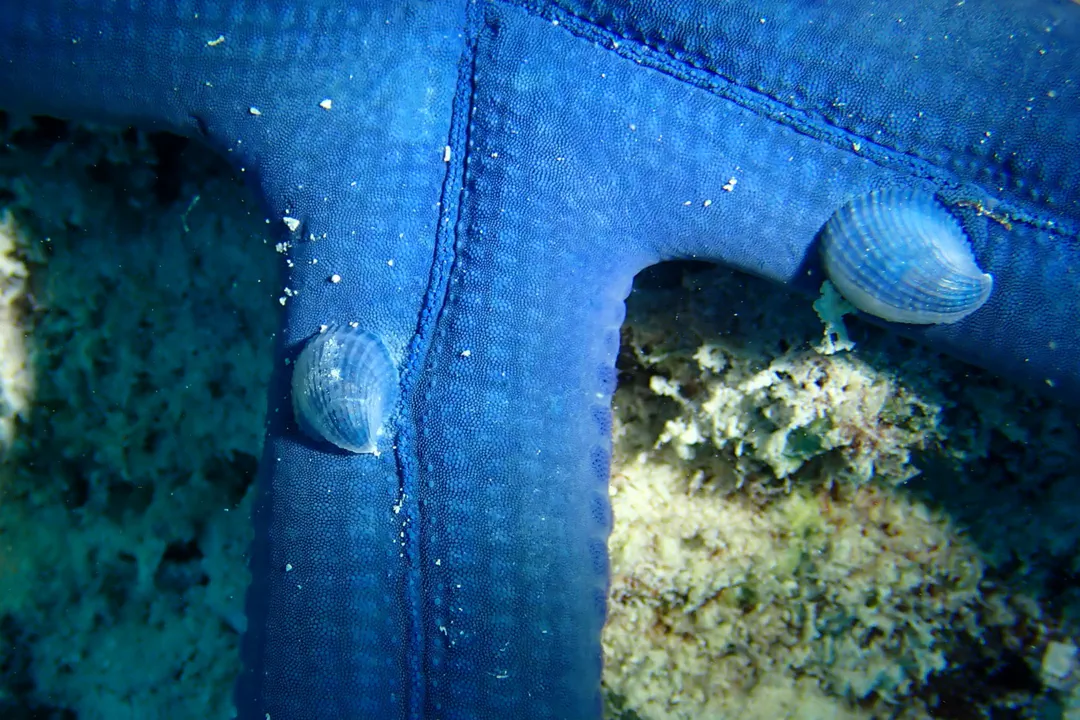
Crystalline Sea Star Snail
Thyca crystallina
- Found in
- 68 regions
How to recognise it
- Colours
- whitebrownblue
Thyca crystallina is a species of sea snail, a marine gastropod mollusc in the family Eulimidae. It is one of nine species within the genus Thyca, all of which are parasitic on starfish in the Indo-Pacific Ocean. This species was first described in 1846 by the American conchologist Augustus Addison Gould as Pileopsis crystallina but was later transferred to Thyca.
Description
The shell of T. crystallina is conical, transparent and slightly curved, and is sculptured with longitudinal grooves. The colour is variable and may be tan or bluish; the colouring does not necessarily resemble that of the host starfish.
Distribution
The species is located in the Indian Ocean and western Pacific Ocean, ranging from Madagascar to Hawaii.
Ecology
Thyca crystallina is an ectoparasite of a starfish, often the blue starfish Linckia laevigata or the multicolour Linckia multifora. The mollusc larvae tend to settle on the upper side of one of the arms of the starfish, usually near its attachment to the disc. As they grow, they migrate to the underside of the arm, settling on the right side of the starfish's ambulacral groove, and orientating themselves towards its mouth, and here they become firmly attached. All the larger molluscs are female, and the larger of these have dwarf males attached to the starfish living under the front end of their mantles. This mollusc is at an early stage of becoming parasitic and has relatively few modifications to adopt this lifestyle. The ventral surface has a central mouth and adheres to the starfish by suction created by the muscular pharynx. Nourishment is derived from grazing the host's tissues and the suction eventually forms a lesion. On larger individuals, a proboscis is inserted deeper into the host's tissues.
Questions
Is Crystalline Sea Star Snail dangerous?
Crystalline Sea Star Snail has no known danger to humans. However, always observe marine life responsibly.