 Chris SpainCC0 · iNaturalist
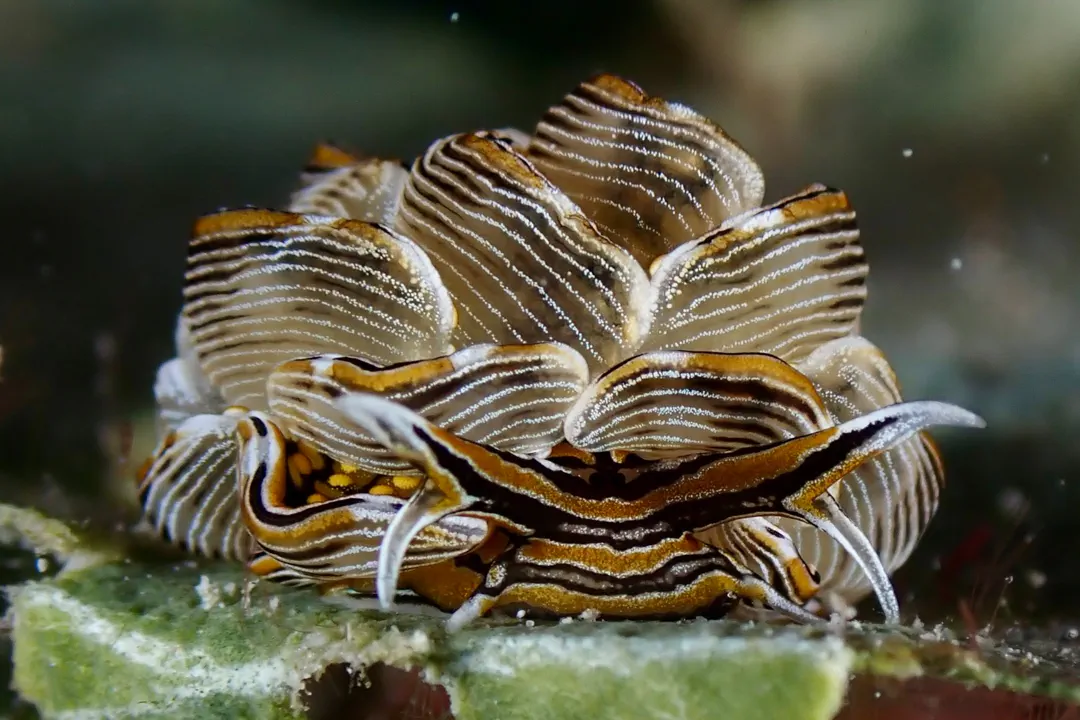
Black-and-gold Sapsucking Slug
Cyerce nigra
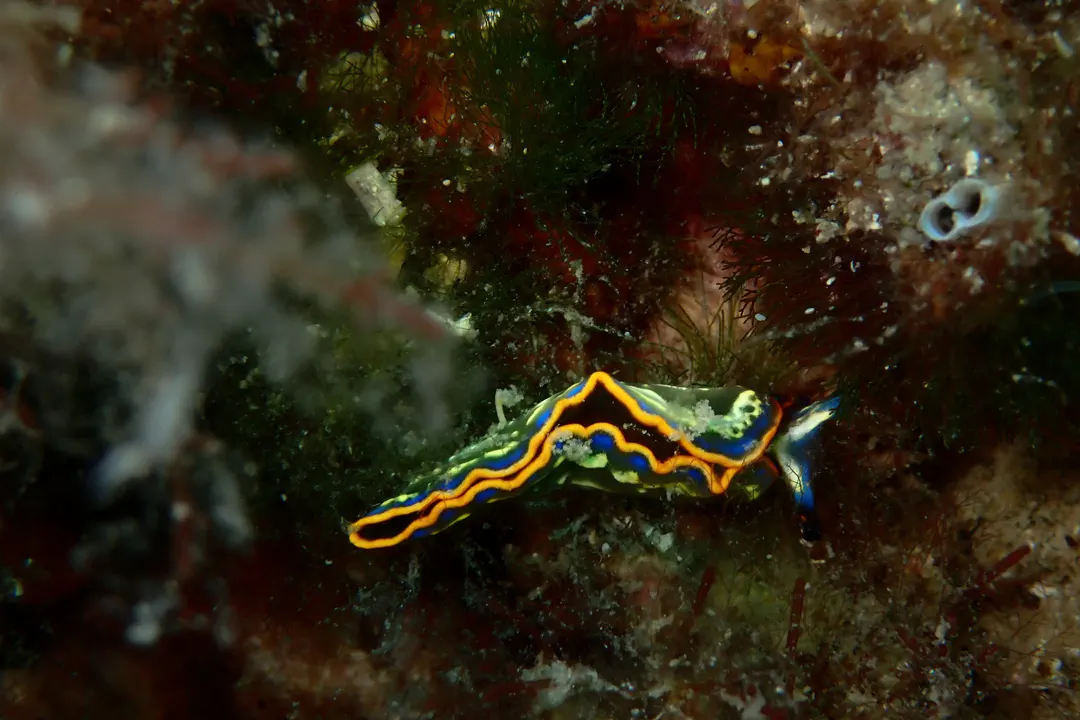
Thuridilla hopei
Thuridilla hopei is a species of sacoglossan sea slug, a shell-less marine opisthobranch gastropod mollusks in the family Plakobranchidae.
This mollusk has a long, smooth and thin body, varying in length from 10 to 25 mm. On each side of its body, Thuridilla hopei has parapodia, lateral extensions united to the back, coming to fold and join on the back of the animal. Concerning the general appearance of this species, the parapodia form an elongated sheath from which the head emerges.
The color of Hope’s Elysia is, most often, blue to violet. However, it can also be found in other shades such as green and dark gray, almost black. It always shows several bands (generally 3) of variable colors in the upper parapodia, in the axis of the back where these parapodia meet. The border line, the outermost, is almost always yellow or orange (rare individuals have a white band). The presence of this line is constant.
Two other colored bands are visible:
- An intermediate line, parallel to the yellow border, is generally blue to turquoise and may optionally be discontinuous. - The last parallel band, the innermost, is white or yellow, a shade that may be unrelated to that of the border.
On the flanks of the animal, on the lower part of the parapodia, one can sometimes observe yellow or white punctuations under the colored lines. The base of the foot is often white as well. These different variations make it possible to encounter individuals that are quite diverse in terms of coloring.
Like all the sacoglosses, Thuridilla hopei does not have a branchial plume, nor any shell (internal or external). Breathing is through the integument.
In front of the parapodia, the head bears two rhinophores. These are quite long (up to 4 mm), robust and widened at the top, rolled up on themselves. One can observe a white ‘V’ shaped mark, opening from the parapodia’s cover and extending to the rhinophores. At the base of the rhinophores, bordering the white mark, one can easily notice two small black dots. These are the eye spots.
The type locality for this marine species is Nice, France, in the Mediterranean Sea. This species is also found off Spain, Portugal and Greece.
Hope’s Elysia can be found up to depths of 40 metres, is mostly seen in very shallow waters. It is often found near brown or green algae, frequenting rocky and well-lit sea-beds where these algae grow.
It is often found on green algae (including Cladophora vagabunda, Derbesia tenuissima, etc …) which it actually feeds on. Like most of the sacoglossus, Thuridilla hopei perforates the cells of the prey algae, thanks to its radula, acting like a saw, a knife, so as to suck the contents.
Chris SpainCC0 · iNaturalist  © Robin WhiteCC BY 4.0 · iNaturalist
  © Stas KuryanAll rights reserved
 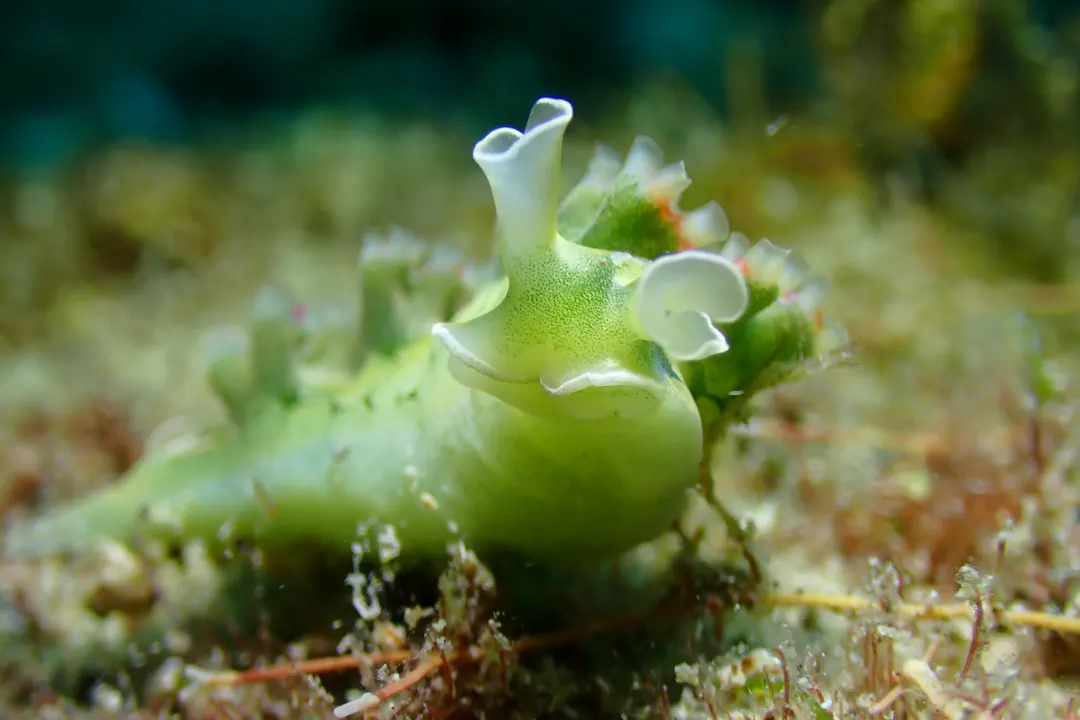 © Robin WhiteCC BY 4.0 · iNaturalist
 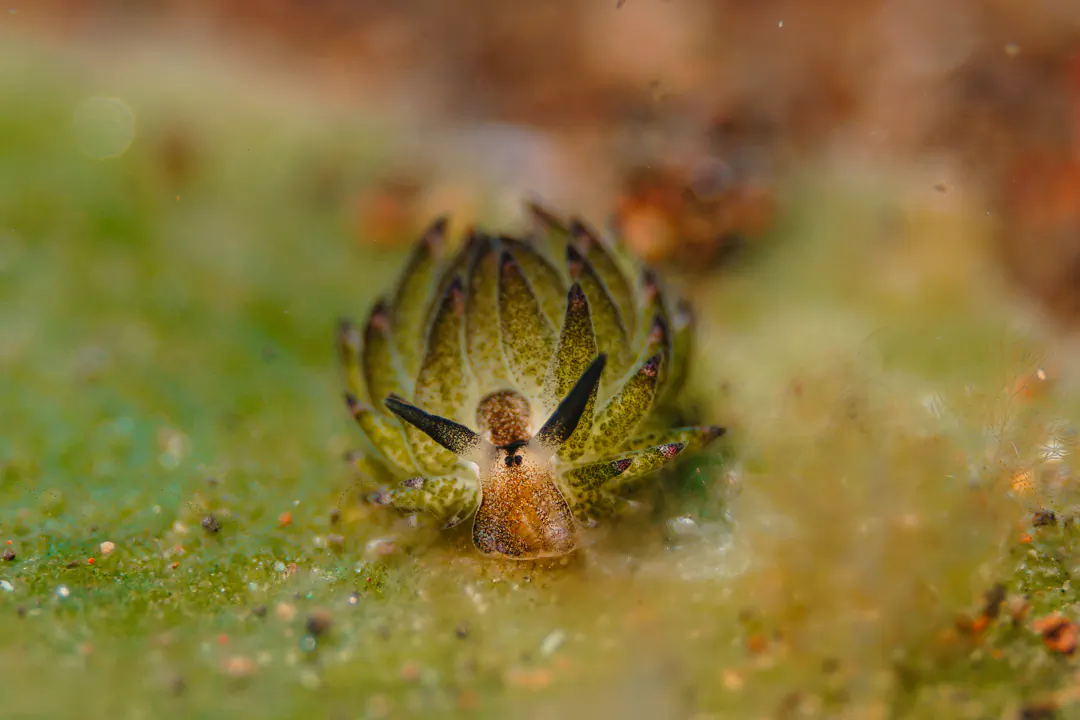 © Stas KuryanAll rights reserved
 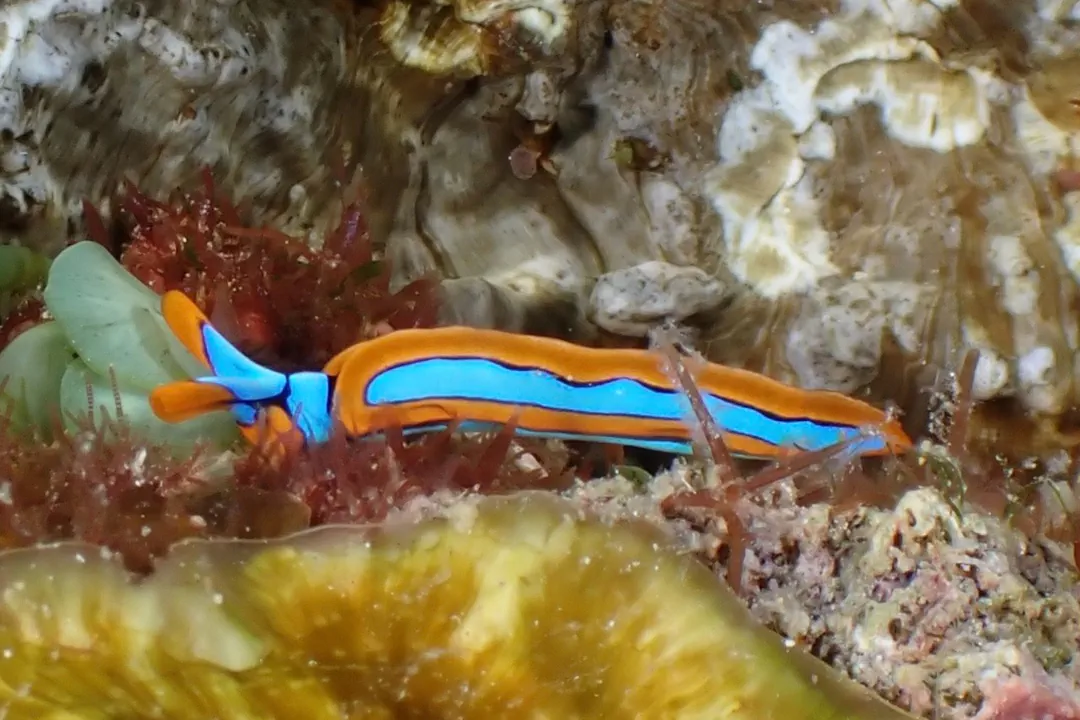 Chris SpainCC0 · iNaturalist
 Hope’s Elysia has no known danger to humans. However, always observe marine life responsibly.
Hope’s Elysia can be found at depths of up to 40 meters.
Download Seabook free for iOS and Android.