 © seabook.appAll rights reserved
Sperm Whale
Physeter macrocephalus
- Max size
- View in app
- Max weight
- View in app
- Max depth
- 2250 m
- Found in
- 194 regions
How to recognise it
- Colours
- blackgrey
Physeter macrocephalus is the largest of the toothed whales and the largest toothed predator. It is the only living member of genus Physeter, and one of three extant species in the sperm whale family, along with the pygmy sperm whale and dwarf sperm whale of the genus Kogia.
Biology
External appearance
The sperm whale is the largest toothed whale, with adult males measuring up to 20.7 metres (68 ft) long and weighing up to 80 tonnes (79 long tons; 88 short tons). By contrast, the second largest toothed whale (Baird's beaked whale) measures 12.8 metres (42 ft) and weighs up to 14 tonnes (15 short tons). The sperm whale is among the most sexually dimorphic of all cetaceans. At birth both sexes are about the same size, but mature males are typically 30% to 50% longer and three times as massive as females. Newborn sperm whales are usually between 3.7 to 4.3 meters (12 to 14 ft) long in length. Female sperm whales are physically mature at about 10.6 to 11 meters (35 to 36 ft) in length and generally don't grow much larger than about 12 metres (39 ft). Male sperm whales are physically mature at about 16 metres (52 ft) in length and generally reaching a maximum of about 18 to 19 meters (59 to 62 ft).
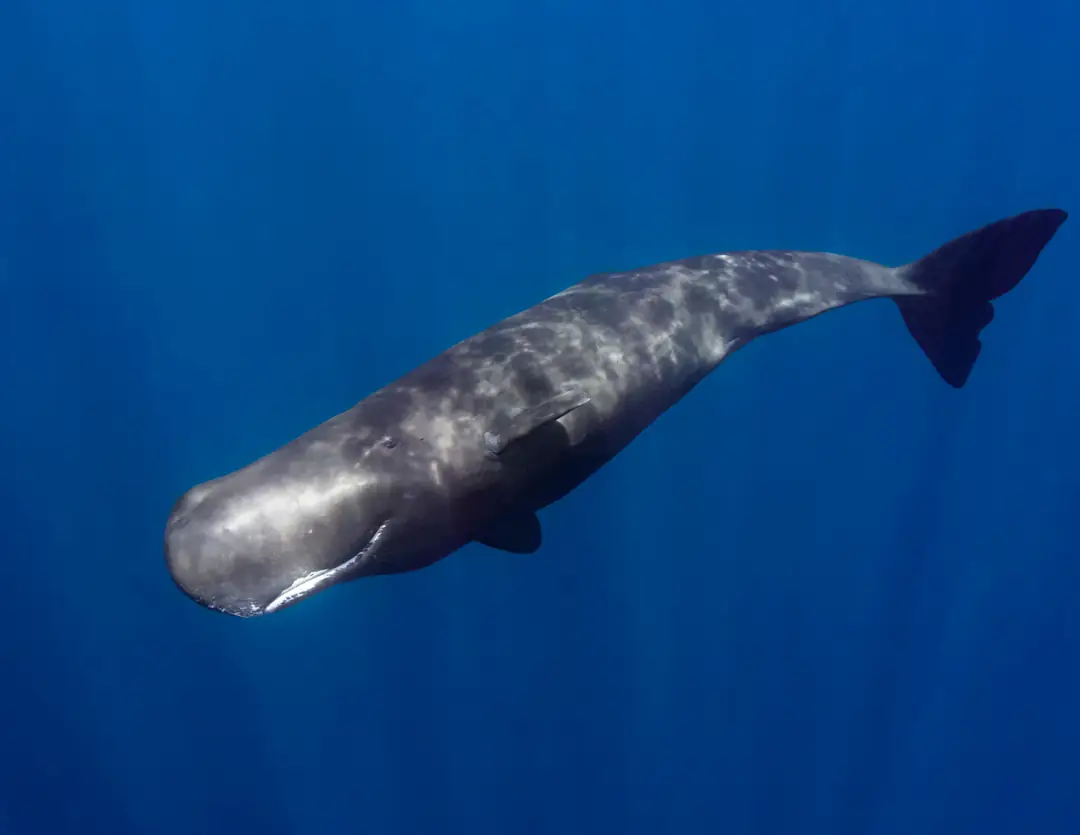
The sperm whale's unique body is unlikely to be confused with any other species. The sperm whale's distinctive shape comes from its very large, block-shaped head, which can be one-quarter to one-third of the animal's length. The S-shaped blowhole is located very close to the front of the head and shifted to the whale's left. This gives rise to a distinctive bushy, forward-angled spray.
The sperm whale's flukes (tail lobes) are triangular and very thick. Proportionally, they are larger than that of any other cetacean, and are very flexible. The whale lifts its flukes high out of the water as it begins a feeding dive. It has a series of ridges on the back's caudal third instead of a dorsal fin. The largest ridge was called the 'hump' by whalers, and can be mistaken for a dorsal fin because of its shape and size. In contrast to the smooth skin of most large whales, its back skin is usually wrinkly and has been likened to a prune by whale-watching enthusiasts. Albinos have been reported.
Skeleton
The ribs are bound to the spine by flexible cartilage, which allows the ribcage to collapse rather than snap under high pressure. While sperm whales are well adapted to diving, repeated dives to great depths have long-term effects. Bones show the same pitting that signals decompression sickness in humans. Older skeletons showed the most extensive pitting, whereas calves showed no damage. This damage may indicate that sperm whales are susceptible to decompression sickness, and sudden surfacing could be lethal to them.
Like that of all cetaceans, the spine of the sperm whale has reduced zygapophysial joints, of which the remnants are modified and are positioned higher on the vertebral dorsal spinous process, hugging it laterally, to prevent extensive lateral bending and facilitate more dorso-ventral bending. These evolutionary modifications make the spine more flexible but weaker than the spines of terrestrial vertebrates.
Like that of other toothed whales, the skull of the sperm whale is asymmetrical so as to aid echolocation. Sound waves that strike the whale from different directions will not be channeled in the same way. Within the basin of the cranium, the openings of the bony narial tubes (from which the nasal passages spring) are skewed towards the left side of the skull.
Jaws and teeth
The sperm whale's lower jaw is very narrow and underslung. The sperm whale has 18 to 26 teeth on each side of its lower jaw which fit into sockets in the upper jaw. The teeth are cone-shaped and weigh up to 1 kilogram (2.2 lb) each. The teeth are functional, but do not appear to be necessary for capturing or eating squid, as well-fed animals have been found without teeth or even with deformed jaws. One hypothesis is that the teeth are used in aggression between males. Mature males often show scars which seem to be caused by the teeth. Rudimentary teeth are also present in the upper jaw, but these rarely emerge into the mouth. Analyzing the teeth is the preferred method for determining a whale's age. Like the age-rings in a tree, the teeth build distinct layers of cementum and dentine as they grow.
Brain
The sperm whale brain is the largest known of any modern or extinct animal, weighing on average about 7.8 kilograms (17 lb) (with the smallest known weighing 6.4 kilograms (14 lb) and the largest known weighing 9.2 kilograms (20 lb)), more than five times heavier than a human's, and has a volume of about 8,000 cm3. Although larger brains generally correlate with higher intelligence, it is not the only factor. Elephants and dolphins also have larger brains than humans. The sperm whale has a lower encephalization quotient than many other whale and dolphin species, lower than that of non-human anthropoid apes, and much lower than humans'.
The sperm whale's cerebrum is the largest in all mammalia, both in absolute and relative terms. The olfactory system is reduced, suggesting that the sperm whale has a poor sense of taste and smell. By contrast, the auditory system is enlarged. The pyramidal tract is poorly developed, reflecting the reduction of its limbs.
Biological systems
The sperm whale respiratory system has adapted to cope with drastic pressure changes when diving. The flexible ribcage allows lung collapse, reducing nitrogen intake, and metabolism can decrease to conserve oxygen. Between dives, the sperm whale surfaces to breathe for about eight minutes before diving again. Odontoceti (toothed whales) breathe air at the surface through a single, S-shaped blowhole, which is extremely skewed to the left. Sperm whales spout (breathe) 3–5 times per minute at rest, increasing to 6–7 times per minute after a dive. The blow is a noisy, single stream that rises up to 2 metres (6.6 ft) or more above the surface and points forward and left at a 45° angle. On average, females and juveniles blow every 12.5 seconds before dives, while large males blow every 17.5 seconds before dives. A sperm whale killed 160 km (100 mi) south of Durban, South Africa, after a 1-hour, 50-minute dive was found with two dogfish (Scymnodon sp.), usually found at the sea floor, in its belly.
The sperm whale has the longest intestinal system in the world,exceeding 300 m in larger specimens. Similar to ruminants the sperm whale has a four-chambered stomach. The first secretes no gastric juices and has very thick muscular walls to crush the food (since whales cannot chew) and resist the claw and sucker attacks of swallowed squid. The second chamber is larger and is where digestion takes place. Undigested squid beaks accumulate in the second chamber – as many as 18,000 have been found in some dissected specimens. Most squid beaks are vomited by the whale, but some occasionally make it to the hindgut. Such beaks precipitate the formation of ambergris.
In 1959, the heart of a 22 metric-ton (24 short-ton) male taken by whalers was measured to be 116 kilograms (256 lb), about 0.5% of its total mass. The circulatory system has a number of specific adaptations for the aquatic environment. The diameter of the aortic arch increases as it leaves the heart. This bulbous expansion acts as a windkessel, ensuring a steady blood flow as the heart rate slows during diving. The arteries that leave the aortic arch are positioned symmetrically. There is no costocervical artery. There is no direct connection between the internal carotid artery and the vessels of the brain. Their circulatory system has adapted to dive at great depths, as much as 2,250 metres (7,382 ft) for up to 120 minutes. More typical dives are around 400 metres (1,310 ft) and 35 minutes in duration. Myoglobin, which stores oxygen in muscle tissue, is much more abundant than in terrestrial animals. The blood has a high density of red blood cells, which contain oxygen-carrying haemoglobin. The oxygenated blood can be directed towards only the brain and other essential organs when oxygen levels deplete. The spermaceti organ may also play a role by adjusting buoyancy (see below). The arterial retia mirabilia are extraordinarily well-developed. The complex arterial retia mirabilia of the sperm whale are more extensive and larger than those of any other cetacean.
Senses
Spermaceti organ and melon
Atop the whale's skull is positioned a large complex of organs filled with a liquid mixture of fats and waxes called spermaceti. The purpose of this complex is to generate powerful and focused clicking sounds, which the sperm whale uses for echolocation and communication.
The spermaceti organ is like a large barrel of spermaceti. Its surrounding wall, known as the case, is extremely tough and fibrous. The case can hold within it up to 1,900 litres of spermaceti. It is proportionately larger in males. This oil is a mixture of triglycerides and wax esters. The proportion of wax esters in the spermaceti organ increases with the age of the whale: 38–51% in calves, 58–87% in adult females, and 71–94% in adult males. The spermaceti at the core of the organ has a higher wax content than the outer areas. The speed of sound in spermaceti is 2,684 m/s (at 40 kHz, 36 °C), making it nearly twice as fast as in the oil in a dolphin's melon.
Below the spermaceti organ lies the "junk" which consists of compartments of spermaceti separated by cartilage. It is analogous to the melon found in other toothed whales. The structure of the junk redistributes physical stress across the skull and may have evolved to protect the head during ramming.
Running through the head are two air passages. The left passage runs alongside the spermaceti organ and goes directly to the blowhole, whilst the right passage runs underneath the spermaceti organ and passes air through a pair of phonic lips and into the distal sac at the very front of the nose. The distal sac is connected to the blowhole and the terminus of the left passage. When the whale is submerged, it can close the blowhole, and air that passes through the phonic lips can circulate back to the lungs. The sperm whale, unlike other odontocetes, has only one pair of phonic lips, whereas all other toothed whales have two, and it is located at the front of the nose instead of behind the melon.
At the posterior end of this spermaceti complex is the frontal sac, which covers the concave surface of the cranium. The posterior wall of the frontal sac is covered with fluid–filled knobs, which are about 4–13 mm in diameter and separated by narrow grooves. The anterior wall is smooth. The knobbly surface reflects sound waves that come through the spermaceti organ from the phonic lips. The grooves between the knobs trap a film of air that is consistent whatever the orientation or depth of the whale, making it an excellent sound mirror.
The spermaceti organs may also help adjust the whale's buoyancy. It is hypothesized that before the whale dives, cold water enters the organ, and it is likely that the blood vessels constrict, reducing blood flow, and, hence, temperature. The wax therefore solidifies and reduces in volume. The increase in specific density generates a down force of about 392 newtons (88 lbf) and allows the whale to dive with less effort. During the hunt, oxygen consumption, together with blood vessel dilation, produces heat and melts the spermaceti, increasing its buoyancy and enabling easy surfacing. However, more recent work has found many problems with this theory including the lack of anatomical structures for the actual heat exchange.
Herman Melville's fictional story Moby-Dick suggests that the "case" containing the spermaceti serves as a battering ram for use in fights between males. A few famous instances include the well-documented sinking of the ships Essex and Ann Alexander by attackers estimated to weigh only one-fifth as much as the ships.
Eyes and vision
The sperm whale's eye does not differ greatly from those of other toothed whales except in size. It is the largest among the toothed whales, weighing about 170 g. It is overall ellipsoid in shape, compressed along the visual axis, measuring about 7×7×3 cm. The cornea is elliptical and the lens is spherical. The sclera is very hard and thick, roughly 1 cm anteriorly and 3 cm posteriorly. There are no ciliary muscles. The choroid is very thick and contains a fibrous tapetum lucidum. Like other toothed whales, the sperm whale can retract and protrude its eyes, thanks to a 2-cm-thick retractor muscle attached around the eye at the equator, but are unable to roll the eyes in their sockets.
According to Fristrup and Harbison (2002), sperm whale's eyes afford good vision and sensitivity to light. They conjectured that sperm whales use vision to hunt squid, either by detecting silhouettes from below or by detecting bioluminescence. If sperm whales detect silhouettes, Fristrup and Harbison suggested that they hunt upside down, allowing them to use the forward parts of the ventral visual fields for binocular vision.
Sleeping
For some time researchers have been aware that pods of sperm whales may sleep for short periods, assuming a vertical position with their heads just below or at the surface. A 2008 study published in Current Biology recorded evidence that whales may sleep with both sides of the brain. It appears that some whales may fall into a deep sleep for about 7 percent of the time, most often between 6 p.m. and midnight.
Vocalization complex
Capable of emitting sounds at a volume of 230 decibels—more than an airplane jet engine at takeoff—the sperm whale is the loudest animal in the world. Sperm whale vocalization is a learned behavior that is clan specific.
Mechanism
When echolocating, the sperm whale emits a directionally focused beam of broadband clicks. Clicks are generated by forcing air through a pair of phonic lips (also known as "monkey lips" or "museau de singe") at the front end of the nose, just below the blowhole. The sound then travels backwards along the length of the nose through the spermaceti organ. Most of the sound energy is then reflected off the frontal sac at the cranium and into the melon, whose lens-like structure focuses it. Some of the sound will reflect back into the spermaceti organ and back towards the front of the whale's nose, where it will be reflected through the spermaceti organ a third time. This back and forth reflection which happens on the scale of a few milliseconds creates a multi-pulse click structure. This multi-pulse click structure allows researchers to measure the whale's spermaceti organ using only the sound of its clicks. Because the interval between pulses of a sperm whale's click is related to the length of the sound producing organ, an individual whale's click is unique to that individual. However, if the whale matures and the size of the spermaceti organ increases, the tone of the whale's click will also change. The lower jaw is the primary reception path for the echoes. A continuous fat-filled canal transmits received sounds to the inner ear.
The source of the air forced through the phonic lips is the right nasal passage. While the left nasal passage opens to the blow hole, the right nasal passage has evolved to supply air to the phonic lips. It is thought that the nostrils of the land-based ancestor of the sperm whale migrated through evolution to their current functions, the left nostril becoming the blowhole and the right nostril becoming the phonic lips.
Air that passes through the phonic lips passes into the distal sac, then back down through the left nasal passage. This recycling of air allows the whale to continuously generate clicks for as long as it is submerged.
Distribution
Sperm whales are among the most cosmopolitan species. They prefer ice-free waters over 1,000 metres (3,300 ft) deep. Although both sexes range through temperate and tropical oceans and seas, only adult males populate higher latitudes. Among several regions, such as along coastal waters of southern Australia, sperm whales have been considered to be locally extinct.
They are relatively abundant from the poles to the equator and are found in all the oceans. They inhabit the Mediterranean Sea, but not the Black Sea, while their presence in the Red Sea is uncertain. The shallow entrances to both the Black Sea and the Red Sea may account for their absence. The Black Sea's lower layers are also anoxic and contain high concentrations of sulphur compounds such as hydrogen sulphide. The first ever sighting in Pakistan was made in 2017. The first ever record on the west coast of the Korean Peninsula (Yellow Sea) was made in 2005, followed by one on Ganghwa Island in 2009.
Populations are denser close to continental shelves and canyons. Sperm whales are usually found in deep, off-shore waters, but may be seen closer to shore, in areas where the continental shelf is small and drops quickly to depths of 310 to 920 metres (1,020 to 3,020 ft). Coastal areas with significant sperm whale populations include the Azores and Dominica. In Asian waters, whales are also observed regularly in coastal waters in places such as the Commander and Kuril Islands, Shiretoko Peninsula which is one of few locations where whales can be observed from shores, off Kinkasan, vicinity to Tokyo Bay and the Bōsō Peninsula to the Izu and the Izu Islands, the Volcano Islands, Yakushima and the Tokara Islands to the Ryukyu Islands, Taiwan, the Northern Mariana Islands, and so forth. Historical catch records suggest there could have been smaller aggression grounds in the Sea of Japan as well. Along the Korean Peninsula, the first confirmed observation within the Sea of Japan, eight animals off Guryongpo, was made in 2004 since after the last catches of five whales off Ulsan in 1911, while nine whales were observed in the East China Sea side of the peninsula in 1999.
Grown males are known to enter surprisingly shallow bays to rest (whales will be in state of rest during these occasions). There are unique, coastal groups reported from various areas among the globe such as Scotland, and Shiretoko Peninsula, off Kaikoura, in the Davao Gulf. Such coastal groups were more abundant in pre-whaling days.
Genetic analysis indicates that the world population of sperm whales originated in the Pacific Ocean from a population of about 10,000 animals around 100,000 years ago, when expanding ice caps blocked off their access to other seas. In particular, colonization of the Atlantic was revealed to have occurred multiple times during this expansion of their range.
Diet
Sperm whales usually dive between 300 to 800 metres (980 to 2,620 ft), and sometimes 1 to 2 kilometres (3,300 to 6,600 ft), in search of food. Such dives can last more than an hour. They feed on several species, notably the giant squid, but also the colossal squid, octopuses, and fish such as demersal rays, but their diet is mainly medium-sized squid. Some prey may be taken accidentally while eating other items. Most of what is known about deep-sea squid has been learned from specimens in captured sperm whale stomachs, although more recent studies analysed faeces. One study, carried out around the Galápagos, found that squid from the genera Histioteuthis (62%), Ancistrocheirus (16%), and Octopoteuthis (7%) weighing between 12 and 650 grams (0.026 and 1.433 lb) were the most commonly taken. Battles between sperm whales and giant squid or colossal squid have never been observed by humans; however, white scars are believed to be caused by the large squid. One study published in 2010 collected evidence that suggests that female sperm whales may collaborate when hunting Humboldt squid. Tagging studies have shown that sperm whales hunt upside down at the bottom of their deep dives. It is suggested that the whales can see the squid silhouetted above them against the dim surface light.
An older study, examining whales captured by the New Zealand whaling fleet in the Cook Strait region, found a 1.69:1 ratio of squid to fish by weight. Sperm whales sometimes take sablefish and toothfish from long lines. Long-line fishing operations in the Gulf of Alaska complain that sperm whales take advantage of their fishing operations to eat desirable species straight off the line, sparing the whales the need to hunt. However, the amount of fish taken is very little compared to what the sperm whale needs per day. Video footage has been captured of a large male sperm whale "bouncing" a long line, to gain the fish. Sperm whales are believed to prey on the megamouth shark, a rare and large deep-sea species discovered in the 1970s. In one case, three sperm whales were observed attacking or playing with a megamouth.
Sperm whales have also been noted to feed on bioluminescent pyrosomes such as Pyrosoma atlanticum. It is thought that the foraging strategy of sperm whales for bioluminescent squids may also explain the presence of these light-emitting pyrosomes in the diet of the sperm whale.
The sharp beak of a consumed squid lodged in the whale's intestine may lead to the production of ambergris, analogous to the production of pearls in oysters. The irritation of the intestines caused by squid beaks stimulates the secretion of this lubricant-like substance. Sperm whales are prodigious feeders and eat around 3% of their body weight per day. The total annual consumption of prey by sperm whales worldwide is estimated to be about 91 million tonnes (100 million short tons). In comparison, human consumption of seafood is estimated to be 115 million tonnes (127 million short tons).
Sperm whales hunt through echolocation. Their clicks are among the most powerful sounds in the animal kingdom (see above). It has been hypothesised that it can stun prey with its clicks. Experimental studies attempting to duplicate this effect have been unable to replicate the supposed injuries, casting doubt on this idea.
It has been stated that sperm whales, as well as other large cetaceans, help fertilise the surface of the ocean by consuming nutrients in the depths and transporting those nutrients to the oceans' surface when they defecate, an effect known as the whale pump. This fertilises phytoplankton and other plants on the surface of the ocean and contributes to ocean productivity and the drawdown of atmospheric carbon.
Life cycle
Sperm whales can live 70 years or more. They are a prime example of a species that has been K-selected, meaning their reproductive strategy is associated with stable environmental conditions and comprises a low birth rate, significant parental aid to offspring, slow maturation, and high longevity.
How they choose mates has not been definitively determined. Bulls will fight with each other over females, and males will mate with multiple females, making them polygynous, but they do not dominate the group as in a harem. Bulls do not provide prenatal care to their offspring but rather play a fatherly role to younger bulls to show dominece.
Females become fertile at around 9 years of age.The oldest pregnant female ever recorded was 41 years old. Gestation requires 14 to 16 months, producing a single calf. Sexually mature females give birth once every 4 to 20 years (pregnancy rates were higher during the whaling era). Birth is a social event, as the mother and calf need others to protect them from predators. The other adults may jostle and bite the newborn in its first hours.
Lactation proceeds for 19 to 42 months, but calves, rarely, may suckle up to 13 years. Like that of other whales, the sperm whale's milk has a higher fat content than that of terrestrial mammals: about 36%, compared to 4% in cow milk. This gives it a consistency similar to cottage cheese, which prevents it from dissolving in the water before the calf can eat it. It has an energy content of roughly 3,840 kcal/kg, compared to just 640 kcal/kg in cow milk. Calves may be allowed to suckle from females other than their mothers.
Males become sexually mature at 18 years. Upon reaching sexual maturity, males move to higher latitudes, where the water is colder and feeding is more productive. Females remain at lower latitudes. Males reach their full size at about age 50.
Social behaviour
Relations within the species
Like elephants, females and their young live in matriarchal groups called pods, while bulls live apart. Bulls sometimes form loose bachelor groups with other males of similar age and size. As they grow older, they typically live solitary lives, only returning to the pod to socialize or to breed. Bulls have beached themselves together, suggesting a degree of cooperation which is not yet fully understood. The whales rarely, if ever, leave their group.
A social unit is a group of sperm whales who live and travel together over a period of years. Individuals rarely, if ever, join or leave a social unit. There is a huge variance in the size of social units. They are most commonly between six and nine individuals in size but can have more than twenty. Unlike killer whales, sperm whales within a social unit show no significant tendency to associate with their genetic relatives. Females and calves spend about three-quarters of their time foraging and a quarter of their time socializing. Socializing usually takes place in the afternoon.
When sperm whales socialize, they emit complex patterns of clicks called codas. They will spend much of the time rubbing against each other. Tracking of diving whales suggests that groups engage in herding of prey, similar to bait balls created by other species, though the research needs to be confirmed by tracking the prey.
Relations with other species
The most common natural predator of sperm whales is the killer whale, but pilot whales and false killer whales sometimes harass them. Killer whales prey on target groups of females with young, usually making an effort to extract and kill a calf. The females will protect their calves or an injured adult by encircling them. They may face inwards with their tails out (the 'marguerite formation', named after the flower). The heavy and powerful tail of an adult whale is potentially capable of delivering lethal blows. Alternatively, they may face outwards (the 'heads-out formation'). Other than sperm whales, southern right whales had been observed to perform similar formations. However, formations in non-dangerous situations have been recorded as well. Early whalers exploited this behaviour, attracting a whole unit by injuring one of its members.
If the killer whale pod is large, its members may sometimes be able to kill adult female sperm whales and can at least injure an entire pod of sperm whales. Bulls have no predators, and are believed to be too large, powerful and aggressive to be threatened by killer whales. Solitary bulls are known to interfere and come to the aid of vulnerable groups nearby. However, the bull sperm whale, when accompanying pods of female sperm whales and their calves as such, may be reportedly unable to effectively dissuade killer whales from their attacks on the group, although the killer whales may end the attack sooner when a bull is present. However, male sperm whales have been observed to attack and intimidate killer whale pods in competitive feeding instances. An incident was filmed from a long-line trawler: a killer whale pod was systematically taking fish caught on the trawler's long lines (as the lines were being pulled into the ship) when a male sperm whale appeared to repeatedly charge the killer whale pod in an attempt to drive them away; it was speculated by the film crew that the sperm whale was attempting to access the same fish. The killer whales employed a tail outward and tail-slapping defensive position against the bull sperm whale similar to that used by female sperm whales against attacking killer whales. However, at some potential feeding sites, the killer whales may prevail over sperm whales even when outnumbered by the sperm whales. Some authors consider the killer whales "usually" behaviorally dominant over sperm whales but express that the two species are "fairly evenly matched", with the killer whales' greater aggression, more considerable biting force for their size and predatory prowess more than compensating for their smaller size.
Sperm whales are not known for forging bonds with other species, but it was observed that a bottlenose dolphin with a spinal deformity had been accepted into a pod of sperm whales. They are known to swim alongside other cetaceans such as humpback, fin, minke, pilot and killer whales on occasion.
Watching sperm whales
Sperm whales are not the easiest of whales to watch, due to their long dive times and ability to travel long distances underwater. However, due to the distinctive look and large size of the whale, watching is increasingly popular. Sperm whale watchers often use hydrophones to listen to the clicks of the whales and locate them before they surface. Popular locations for sperm whale watching include the town of Kaikoura on New Zealand's South Island, Andenes and Tromsø in Arctic Norway; as well as the Azores, where the continental shelf is so narrow that whales can be observed from the shore, and Dominica where a long-term scientific research program, The Dominica Sperm Whale Project, has been in operation since 2005.
Questions
Is Sperm Whale dangerous?
Sperm Whale has no known danger to humans. However, always observe marine life responsibly.
Where can you find Sperm Whale?
How deep does Sperm Whale live?
Sperm Whale can be found at depths of up to 2250 meters.