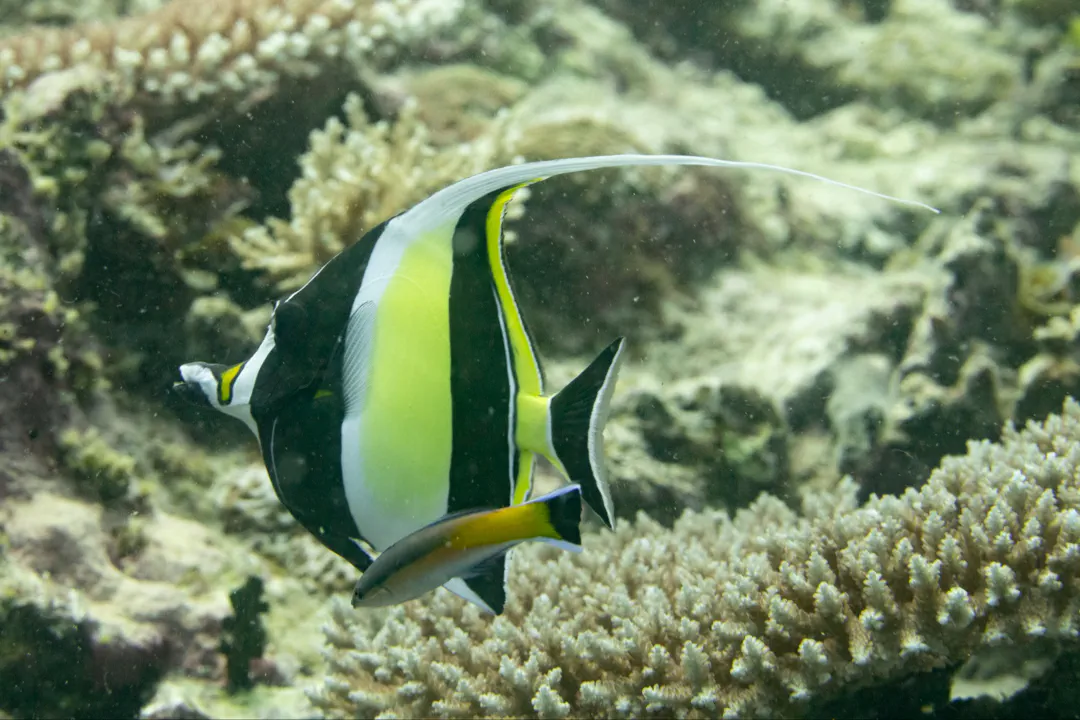
Moorish Idol
Zanclus cornutus
- Max size
- View in app
- Max depth
- 182 m
- Found in
- 95 regions
How to recognise it
- Colours
- whiteblackyelloworange
- Body shape
- Standard, Compressed
- Pattern
- Vertical markings
Zanclus cornutus is a marine fish species, the sole extant representative of the family Zanclidae (from the Greek ζαγκίος, zagkios, "oblique") in order Perciformes. A common inhabitant of tropical to subtropical reefs and lagoons, the Moorish idol is notable for its wide distribution throughout the Indo-Pacific. A number of butterflyfishes (genus Heniochus) closely resemble the Moorish idol. It is closely related to, if not a direct descendant of, the extinct Eozanclus brevirostris, from the Middle Eocene of Monte Bolca.
The Moorish idol got its name from the Moors of Africa, who purportedly believed the fish to be a bringer of happiness. Moorish idols are also a coveted aquarium fish but, despite their abundance and wide array of habitats, they are notoriously finicky and hard to adjust to captivity. Their omnivorous diet can be extremely difficult to replicate in aquaria, as the vegetation which they live on is normally exterminated and they unfortunately have a habit of snacking on corals and sponges which are extremely expensive.
Description
With distinctively compressed and disk-like bodies, Moorish idols stand out in contrasting bands of black, white, and yellow, which makes them attractive to aquarium keepers. The fish have relatively small fins, except for the dorsal fin, whose six or seven spines are dramatically elongated to form a trailing, sickle-shaped crest called the philomantis extension. Moorish idols have small terminal mouths at the end of long, tubular snouts; many long bristle-like teeth line the mouth. The Moorish idol differs from butterflyfish in having a prominent black, triangular anal fin.
The eyes are set high on the fish's deeply keeled body; in adults, perceptible bumps are located above each. The anal fin may have two or three spines. Moorish idols reach a maximum length of 23 cm (9.1 in). The sickle-like dorsal spines shorten with age.
Distribution and habitat
Generally denizens of shallow waters, Moorish idols prefer flat reefs. This fish may be found at depths from 3 to 180 m (9.8 to 590.6 ft), in both murky and clear conditions. Their range includes East Africa, the Indian Ocean and the Ducie Islands; Hawaii, southern Japan, and all of Micronesia; they are also found from the southern Gulf of California south to Peru.
Feeding
Sponges, coral polyps, tunicates, and other benthic invertebrates constitute the bulk of the Moorish idol's diet.
Behavior
Often seen alone, Moorish idols also form pairs or occasionally small schools, especially as juveniles. They are diurnal fish, sticking to the bottom of the reef at night, adopting a drab coloration. Like butterfly fish, they mate for life. Adult males display aggression toward one another.
Reproduction
Moorish idols are pelagic spawners; that is, they release eggs and sperm in the water column, leaving fertilized eggs to drift away with the currents. The range of these fish may be explained by the unusually long larval stage. The fish reach a length of 7.5 cm (3.0 in) before becoming free-swimming juveniles.
In the aquarium
Moorish idols are notoriously difficult to maintain in captivity. They require large tanks, often exceeding 100 US gal (380 l; 83 imp gal), are voracious eaters, and can become destructive.
Some aquarists prefer to keep substitute species that look very similar to the Moorish idol. These substitutes are all butterflyfishes of the genus Heniochus, and include the pennant coralfish, H. acuminatus; threeband pennantfish, H. chrysostomus; and the false Moorish idol, H. diphreutes.
Moorish idols typically are very picky eaters. They will either eat nothing (common) and perish or eat everything (uncommon).
Questions
Is Moorish Idol dangerous?
Moorish Idol has no known danger to humans. However, always observe marine life responsibly.
Where can you find Moorish Idol?
How deep does Moorish Idol live?
Moorish Idol can be found at depths of up to 182 meters.