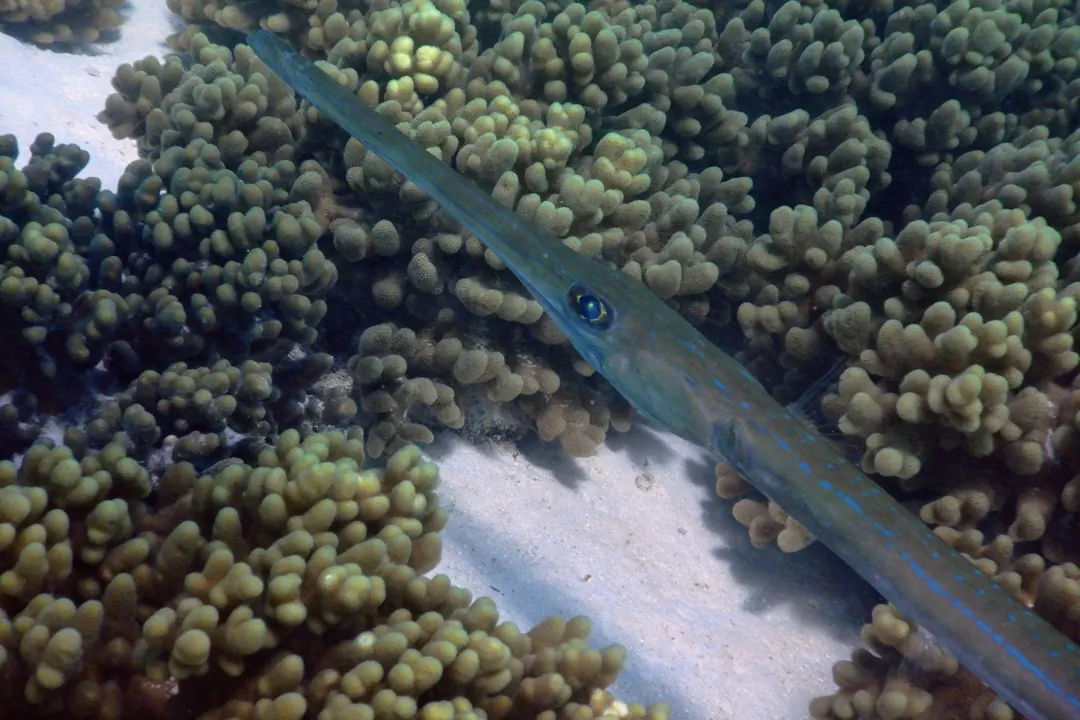
Bluespotted Cornetfish
Fistularia commersonii
- Max size
- View in app
- Max depth
- 132 m
- Found in
- 129 regions
How to recognise it
- Colours
- browngreysilvergreenblue
- Body shape
- Elongated
- Pattern
- Horizontal markings
Fistularia commersonii is a marine fish which belongs to the family Fistulariidae. This very long and slender reef-dweller belongs to the same order as the pipefishes and seahorses, called Syngnathiformes. It is widespread in the tropical and sub-tropical waters of the Indo-Pacific, including the Red Sea. In 2000 its presence was reported in the Mediterranean Sea, since when it has continued to disperse and is now well-established in some areas. This species is considered as part of the Lessepsian migration.
The fish is of minor importance commercially, mostly being sold as fish meal but also fresh and preserved. It is also sold as an aquarium fish.
Description
The bluespotted cornetfish is notable for its unusually long, slender body shape. It has a tubular snout, large eyes and a long tail filament lined with sensory pores which may help with detecting prey. Its body is greenish-grey to brown with two thin blue stripes or lines of dots on the back and lighter on the front. It grows to a length of 1.6 m (5.2 ft), but the average is around 1 m (3.3 ft).
Distribution
It is widespread in the tropical and subtropical waters of the Indo-Pacific as far north as Japan and east to the coasts of the Americas, including the Red Sea. In 2000, its presence was reported in the Mediterranean Sea; since then, it has continued to disperse and is now well established in some areas. This species is considered as part of the Lessepsian migration. It has spread rapidly through the Mediterranean from its origin in the Suez Canal, the first records being off Israel in 2000 and it had reached the southern coast of Spain and as far north as the Gulf of Lions by 2007. Scientists have determined that the fish in the Mediterranean are all descended from a small number of ancestors, possibly as a result of a single invasion event, and are not as genetically variable as their conspecifics in the Red Sea.
Biology
The bluespotted cornetfish is usually a solitary predator, stalking and feeding on small fishes, crustaceans and squid. Sometimes they feed in small groups along the bottom on small bottom-dwelling fish which their long snouts are very efficient at sucking up.
Reproduction is oviparous- the large eggs hatch and develop outside of the body. Larvae hatch at 6-7 mm.
Questions
Is Bluespotted Cornetfish dangerous?
Bluespotted Cornetfish is classified as poisonous. Always exercise caution and keep a safe distance.
Where can you find Bluespotted Cornetfish?
How deep does Bluespotted Cornetfish live?
Bluespotted Cornetfish can be found at depths of up to 132 meters.