 © Heather Dawnstar SabinCC BY 4.0 · iNaturalist
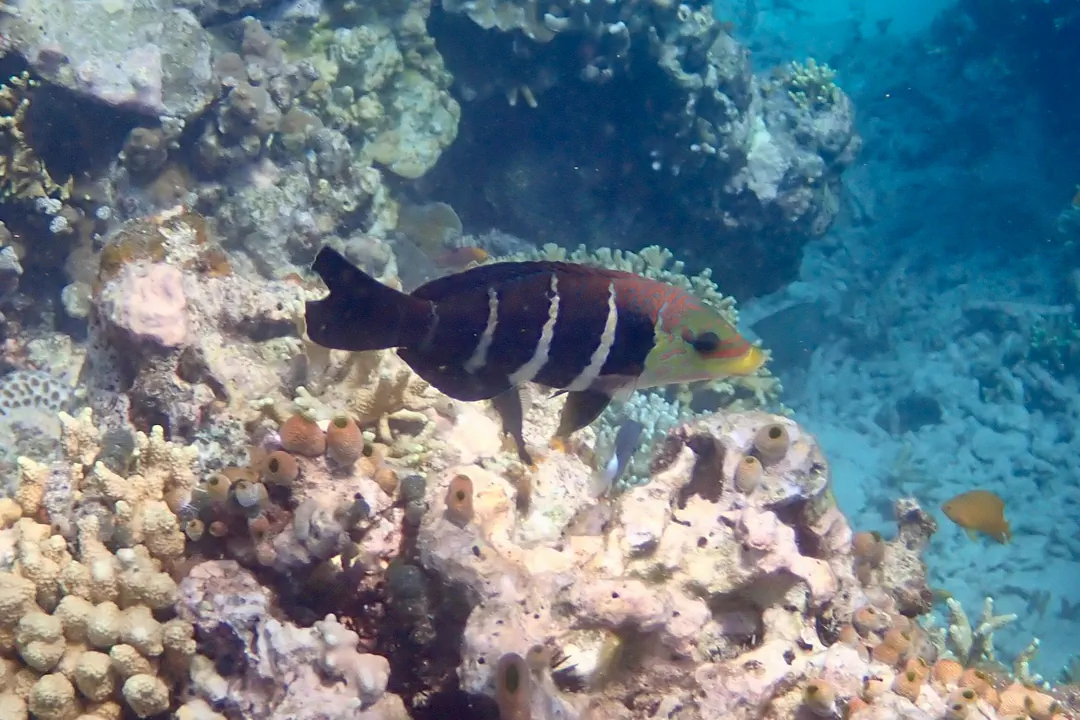
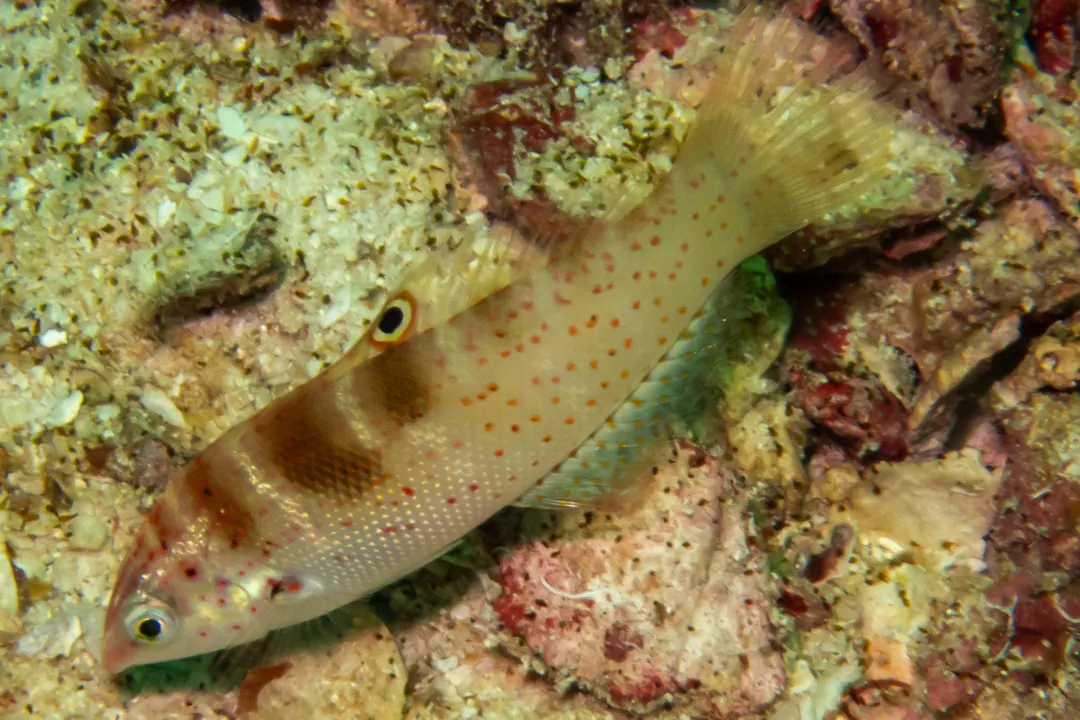
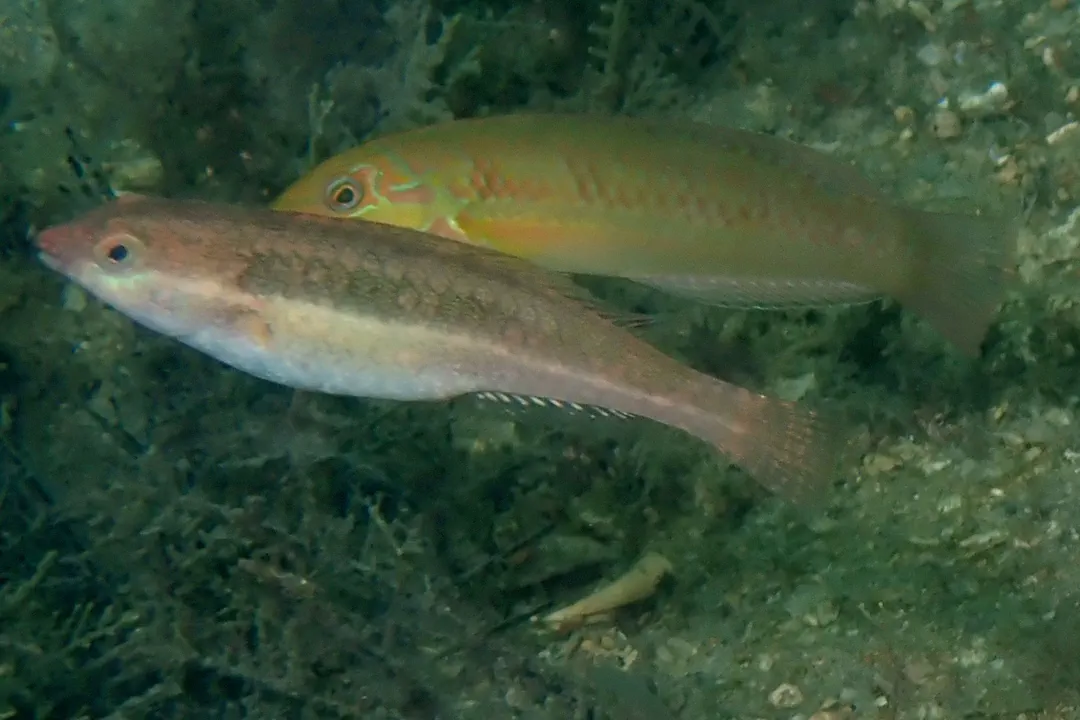
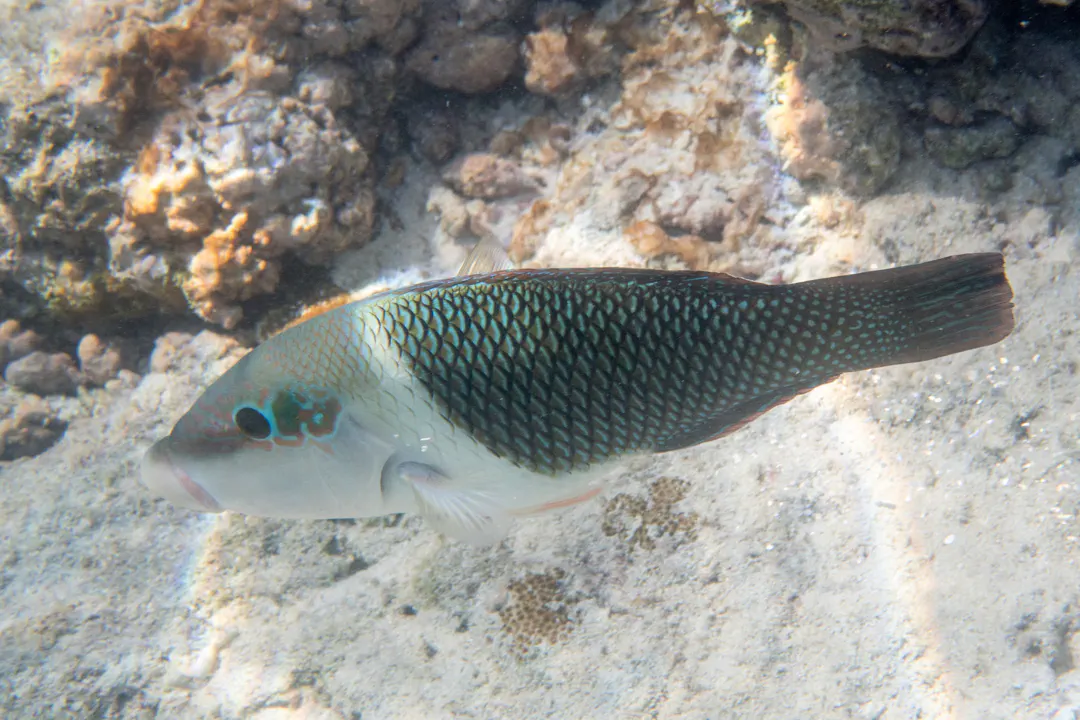
Barred Thicklip (female)
Hemigymnus fasciatus
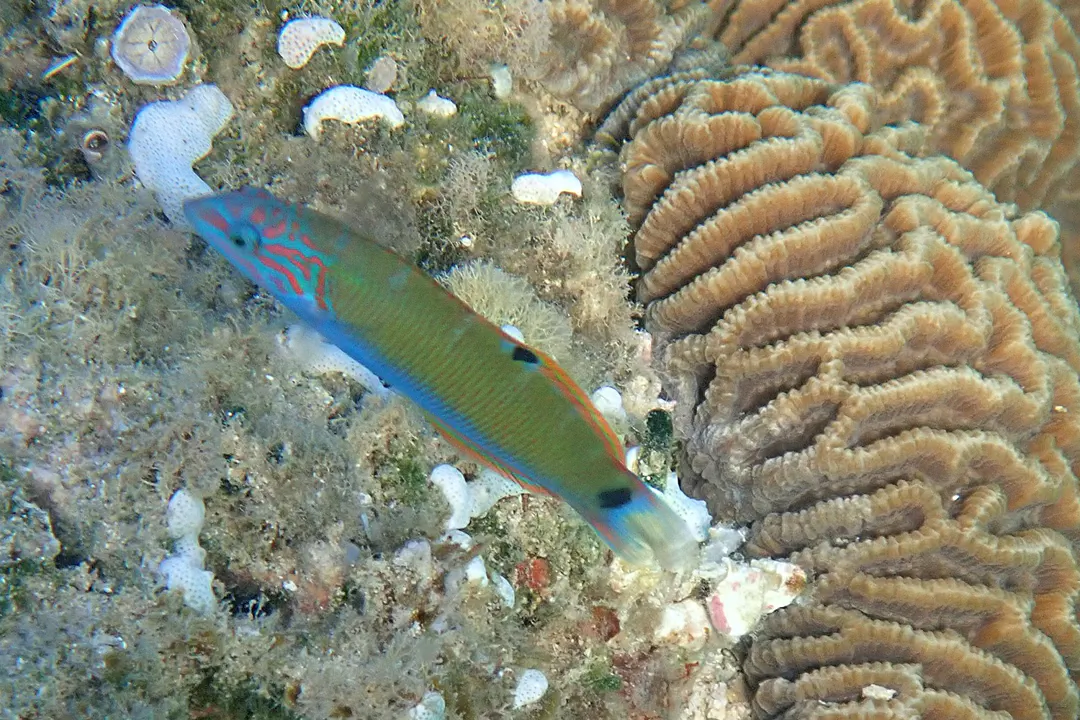
Thalassoma lunare
The moon wrasse (Thalassoma lunare) is a species of wrasse native to the Indian Ocean and the western Pacific Ocean. It is an inhabitant of coral reefs and surrounding areas at depths from 1 to 20 m (3.3 to 65.6 ft). Moon wrasses are carnivorous and tend to prey on fish eggs and small sea-floor dwelling invertebrates. This species can reach 45 cm (18 in) in total length. It is of minor importance to local commercial fisheries and can also be found in the aquarium trade.
It is also known as Crescent Wrasse.
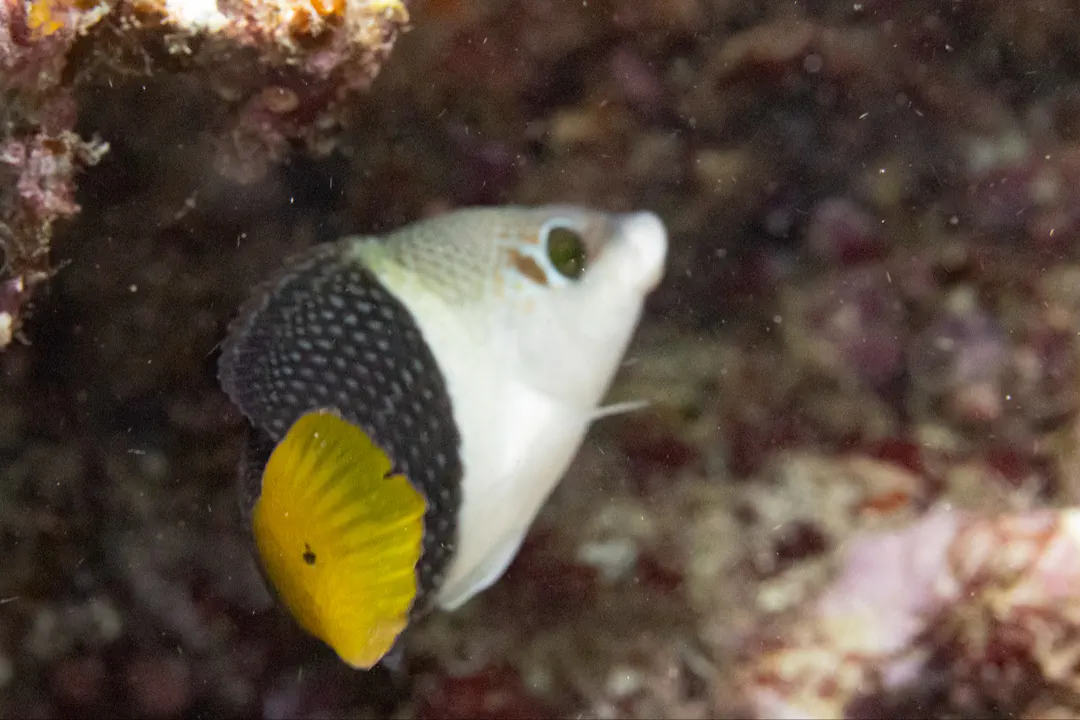
Adults are identified by the yellow lunate tail. Large males turn blue on the head that grades to green towards the tail. Body dark green to blue with vertical red to purplish red lines. Head green to blue with irregular pink to violet bands. Adults with large yellow crescent posteriorly in caudal fin and blue pectoral fins with a large elongate pink area distally. Juveniles with a large dark spot in middle of dorsal fin and a large diffuse black spot at base of caudal fin.
Indo-Pacific: Red Sea and East Africa to the Line Islands, north to southern Japan, south to Lord Howe Island and northern New Zealand.
Moon wrasses are active fish, said to be moving all day long. They are also territorial, nipping, chasing, and otherwise harassing fish that get in their way.
Being diurnal, wrasses have strong vision, although they also have a decent sense of smell. At night, they rest in niches often under rocks or other such structures. If needed, a moon wrasse may dig out a space under a rock by repeatedly swimming through it until it fits without struggle.
They are protogynous hermaphrodites, all starting off as females and changing to males, a process which, for the moon wrasse, takes only 10 days. Some moon wrasses live in groups consisted of a dominant male, and a "harem" of about a dozen other wrasses, some female and some male. The alpha male is more brightly colored, and at every low tide hour, changes from green to blue, and goes into a show of attacking and nipping all the other wrasses. This is his way of showing his dominance to the rest of the males and keeping the females in check. During breeding season and before high tide, the alpha male turns completely blue, gathers up every single female, and the spawning frenzy begins.
Moon wrasses may live up to a decade in captivity, although this is shorter in the wild. They are popular fish in the aquarium trade, due to their hardiness, bright colors, and engaging behavior. They are renowned for their ability to tolerate spikes in nitrite, and eat bristle worms, a fish keeper's pest.
© Heather Dawnstar SabinCC BY 4.0 · iNaturalist 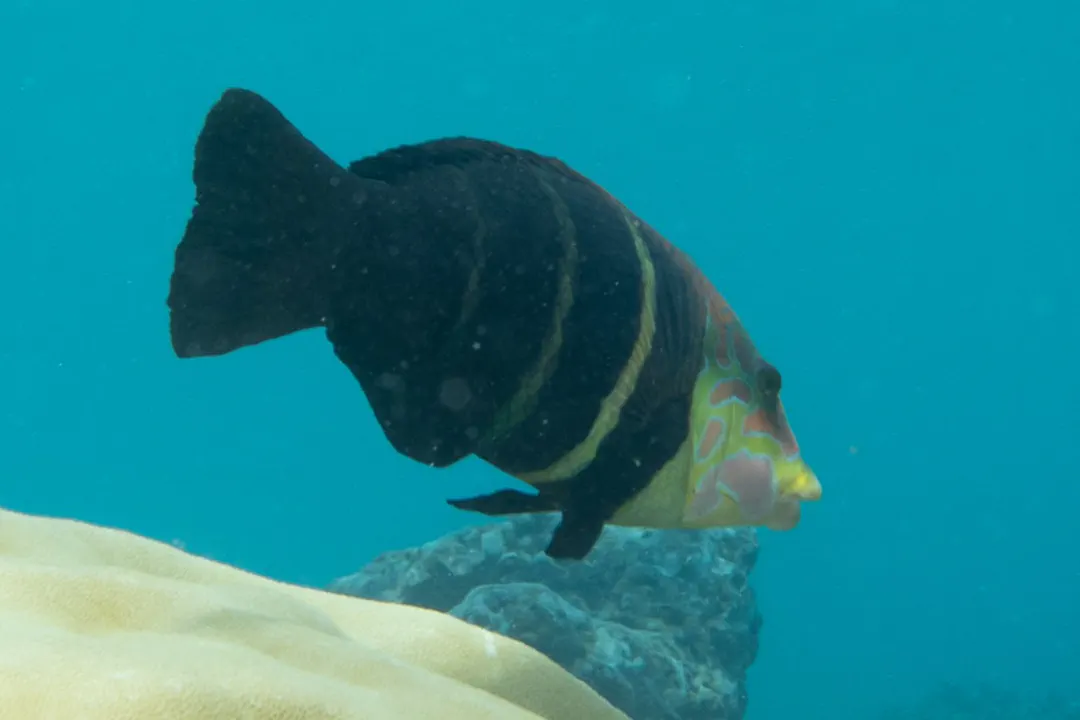 © Storm MartinCC BY 4.0 · iNaturalist
  © portioidCC BY 4.0 · iNaturalist
  © jeyreCC BY 4.0 · iNaturalist
  © Emanuele SantarelliCC BY-SA 4.0 · iNaturalist
  © cello caruso-turielloCC BY 4.0 · iNaturalist
 Moon Wrasse (juvenile) has no known danger to humans. However, always observe marine life responsibly.
Moon Wrasse (juvenile) can be found at depths of up to 20 meters.
Download Seabook free for iOS and Android.