 © seabook.appAll rights reserved
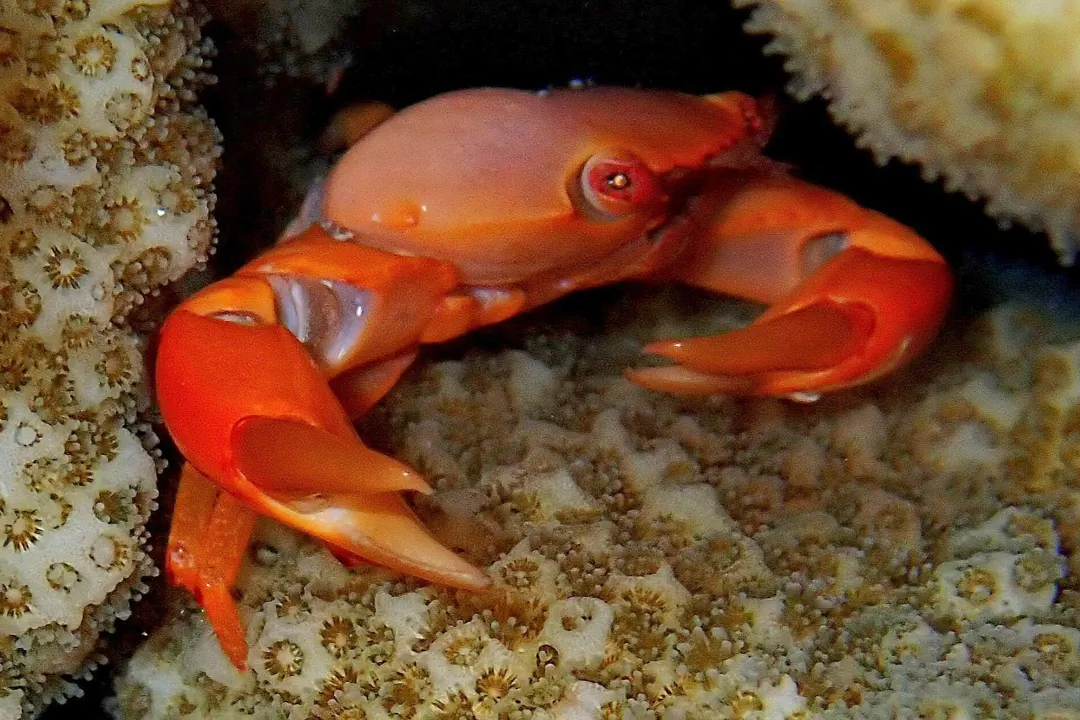
Crowned Coral Crab
Quadrella coronata
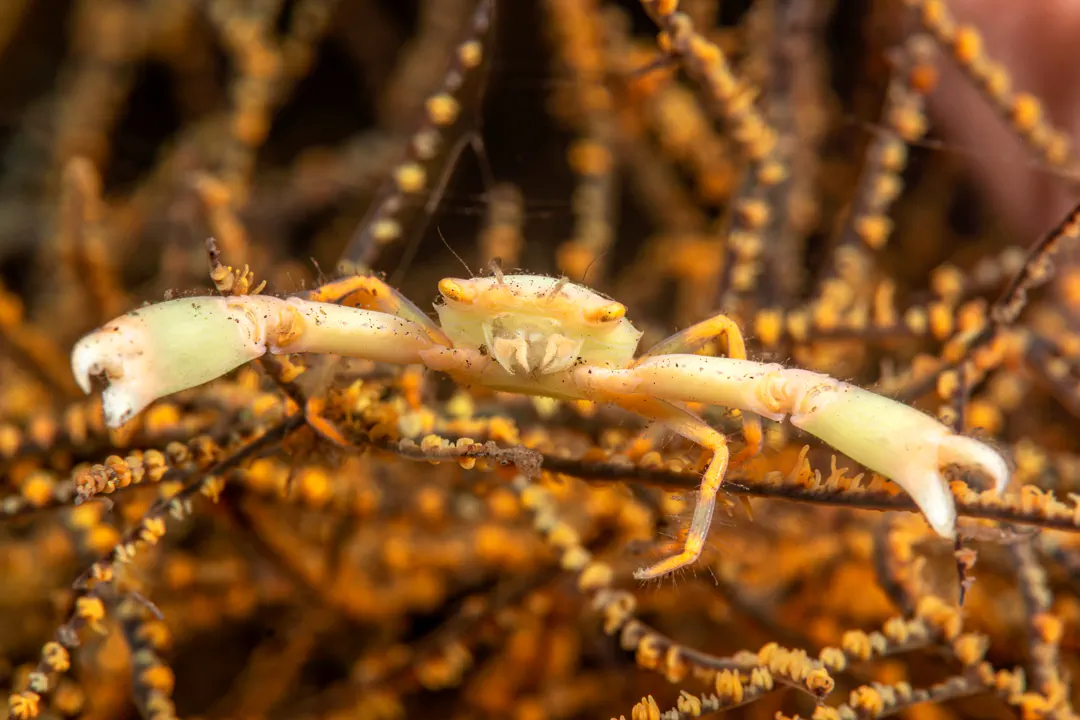
Trapezia bidentata
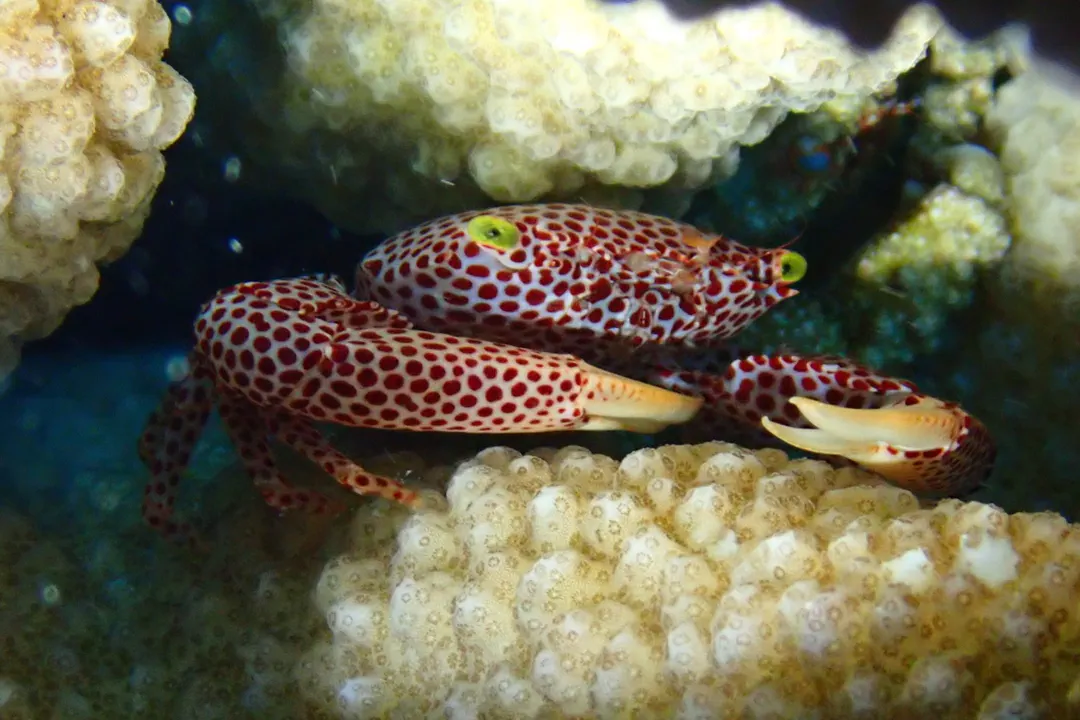
Trapezia bidentata is species of a Trapeziidae family, commonly known as Coral crabs. They spend their entire adult lives living between the branches of corals of the Pocillopora and Acropora families. They have a mutualistic relationship with these corals and guard them against predators hence the name guard crabs.
The Rusty Guard Crab have an orange colored body with red brown marks on the leg joints and on the claws. The body is roughly trapezoidal in shape and the claws are proportionally fairly large. The eyes are a reddish color with black pupils. They grow to a maximum width of 5 cm in width. The crabs in the image in the post were all in the 2 cm range.
Rusty Guard Crab are extremely shy and are very difficult to photograph. Usually they will retreat into the branches of their host coral at the approach of a diver. They are quick to put their claws up towards any threat to them or the coral and even a diver as they retreat into their hiding spots. The best time to photograph them is at night when they seem more protective of the corals. They actively advance to the edges of the coral waving their claws but are quick to retreat if one gets too close.
Experiments have shown that the Rusty Guard Crab is more effective against smaller predators such as the Horn drupe (Drupella cornus) than against the Crown of Thorns Starfish (Acanthaster planci) and the Cushion Starfish (Culcita novaeguinea)
Scientists refer to this type of relationship as mutualism. Both species benefit from being together. There are several different species of guard crabs and in the larger corals one will often see more than one species. There will however only be one pair from each species. At night there are often Hawkfish sleeping in the corals with the crabs scuttling around them. The crabs do not seem to mind them being in the corals and seem to be able to distinguish that they are not a threat.
One would assume that they would be quite safe from any predator in their coral home, however one night I viewed a Cuttlefish pulling Hawkfish and the crabs out the coral one by one. The cuttlefish felt around the coral with his arms and then extracted them with his tentacles.
The Rusty Guard Crab are found on coral reefs across the Indo Pacific area. The range from South Africa in the south, up the east coast of Africa across to Southern Japan and as far west as Hawaii. They are only found in Pocillopora and Acropora small polyp stony corals.
Rusty Guard Crab feed only on mucus and polyps from the host coral. They massage the coral polyps with their legs until the polyps release a slimy mucus which the crabs eat. The mucus is collected by hairs on the lower part of the legs and passed to the mouth parts.
As with most crustaceans, the eggs are fertilised by the male and are carried under the body of the female. Once they hatch the larvae go through a planktonic stage before settling down and growing into their adult form.
Rusty Guard Crab can be kept in an aquarium and if one has large enough Pocillopora or Acropora corals and they can be an attractive addition to a tank. They have been found to be good for the health of the corals. Do not expect to see much of them, they are very shy and seldom if ever venture out the coral. It is possible to keep a mated pair in one piece of coral.
© seabook.appAll rights reserved 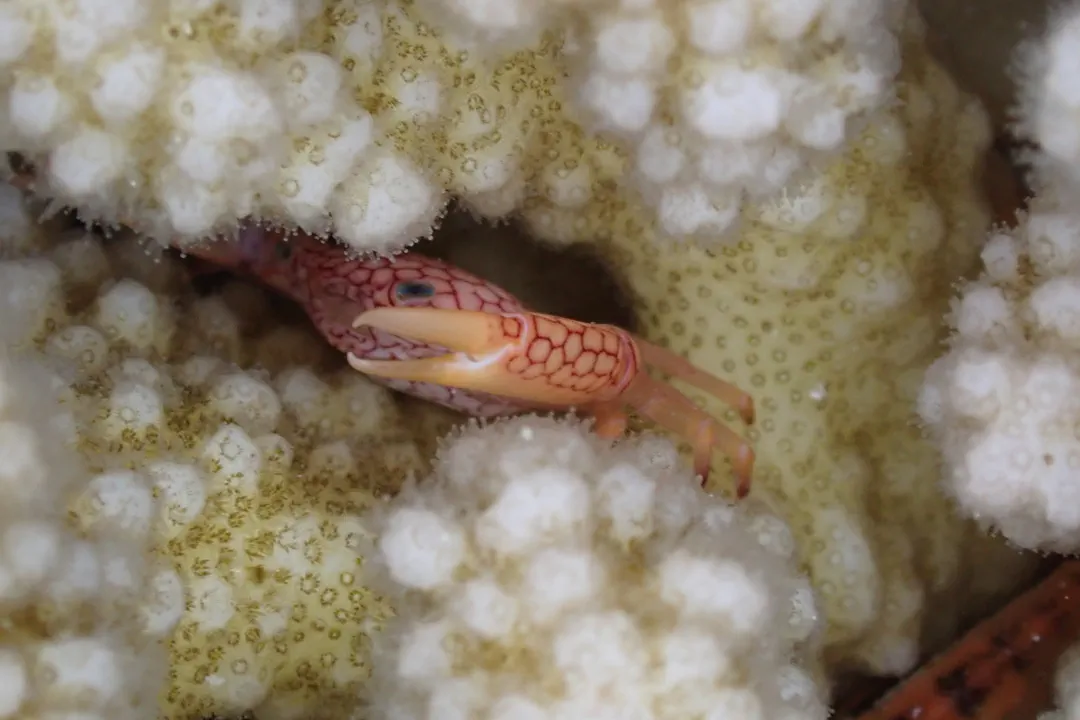 © Daniel EisenhauerCC BY 4.0 · iNaturalist
  © Debra BakerCC BY 4.0 · iNaturalist
 Rusty Guard Crab has no known danger to humans. However, always observe marine life responsibly.
Rusty Guard Crab can be found at depths of up to 54 meters.
Download Seabook free for iOS and Android.