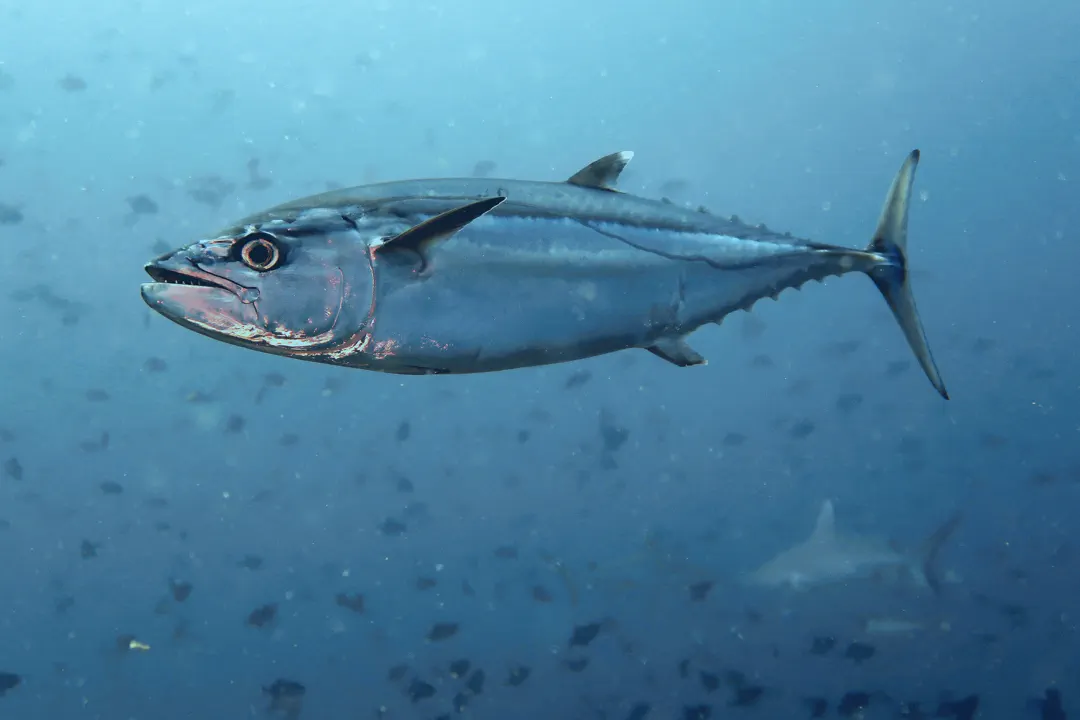
 © Daniel BenákCC BY 4.0 · iNaturalist
Dogtooth Tuna
Gymnosarda unicolor
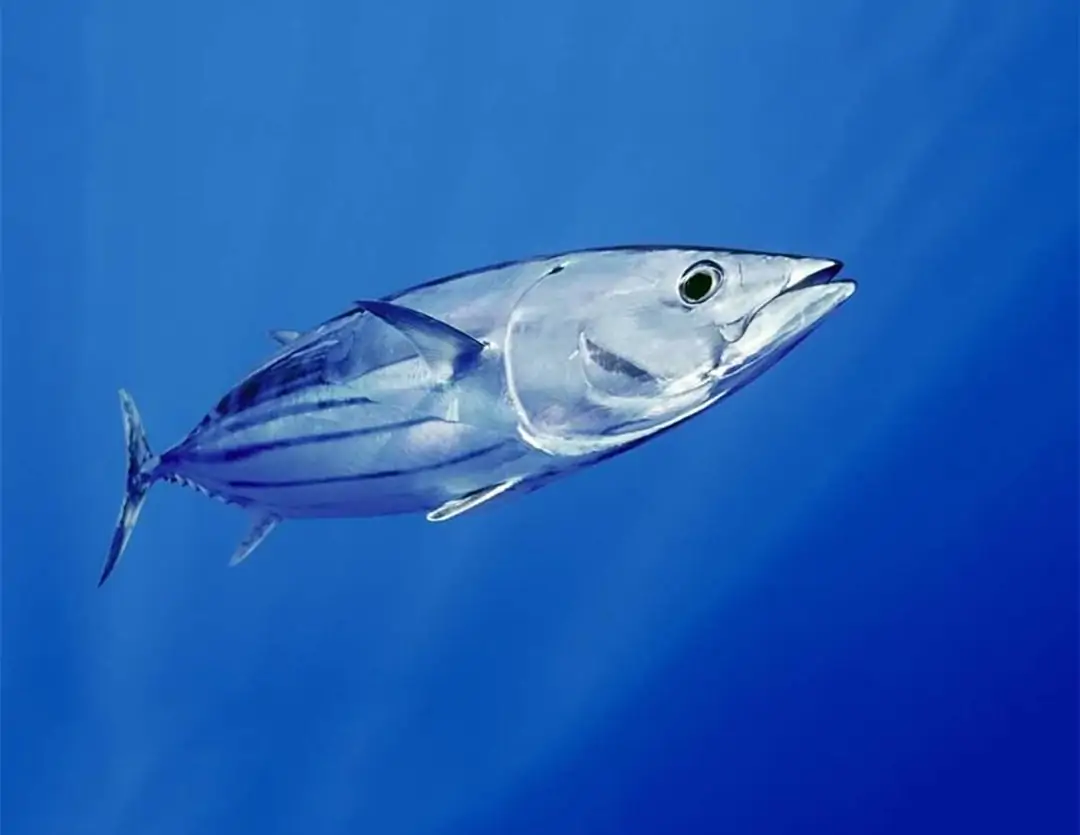
Katsuwonus pelamis
Katsuwonus pelamis is a medium-sized perciform fish in the tuna family, Scombridae. It grows up to 1 m (3 ft) in length. It is a cosmopolitan pelagic fish found in tropical and warm-temperate waters. It is a very important species for fisheries.
It is a streamlined, fast-swimming pelagic fish. Colour of back dark purplish blue, lower sides and belly silvery, with 4-6 very conspicuous longitudinal dark bands which in live specimens may appear as discontinuous lines of dark blotches. It has no scales, except on the lateral line and the corselet (a band of large, thick scales forming a circle around the body behind the head). It commonly reaches fork lengths up to 80 cm (31 in) and a weight of 8–10 kg (18–22 lb). Its maximum fork length is 108 cm (43 in) and maximum weight is 34.5 kg (76 lb). Ageing skipjack tuna is difficult, and the estimates of its potential lifespan range between 8 and 12 years.
Cosmopolitan in tropical and warm-temperate waters. Not found in the Black Sea. Highly migratory species.
Found in offshore waters; larvae restricted to waters with surface temperatures of 15°C to 30°C. Exhibit a strong tendency to school in surface waters with birds, drifting objects, sharks, whales and may show a characteristic behavior like jumping, feeding, foaming, etc. Feed on fishes, crustaceans, cephalopods and mollusks; cannibalism is common. Spawn throughout the year in the tropics, eggs released in several portions. Eggs and larvae are pelagic.
It is an important prey species for large pelagic fishes and sharks.
Skipjack tuna is a batch spawner. Spawning occurs year-round in equatorial waters, but it gets more seasonal further away from the equator. Fork length at first spawning is about 45 cm (18 in). It is also known for its potent smell.
It is an important commercial and game fish, usually caught using purse seine nets, and is sold fresh, frozen, canned, dried, salted, and smoked. With reported landings of almost 2.6 million tonnes, it was second only to the Peruvian anchoveta as the world's most important capture fish species in 2009. Countries recording large amounts of skipjack catches include the Maldives, France, Spain, Malaysia, Sri Lanka (බලයා), and Indonesia.
Skipjack is the most fecund of the main commercial tunas, and its population is considered sustainable against its current consumption. Its fishing is still controversial due to the methodology, with rod and reel or fishery options being promoted as ecologically preferable.Purse seine methods are considered unsustainable by some authorities due to excess bycatch, although bycatch is said to be much reduced if fish aggregation devices are not used. These considerations have led to the availability of canned skipjack marked with the fishing method used to catch it.
Skipjack is considered to have "moderate" mercury contamination. As a result, pregnant women are advised against eating large quantities. In addition, skipjack's livers were tested globally for tributyltin contamination. TBT is an organotin compound introduced into marine ecosystems through antifouling paint used on ship hulls, and has been determined to be very toxic. About 90% of skipjack tested positive for contamination, especially in Southeast Asia, where regulations of TBT use are less rigorous than in Europe or the US.
Skipjack tuna is used extensively in Japanese cuisine, where it is known as katsuo (鰹 or かつお). Besides being eaten seared (katsuo tataki, 鰹のタタキ) and raw in sushi (寿司 or すし) and sashimi (刺身 or さしみ), it is also smoked and dried to make katsuobushi (鰹節 or かつおぶし), the central ingredient in dashi (出汁 or だし) (a common Japanese fish stock). It is also a key ingredient in katsuo no shiokara (塩辛 or しおから).
In Indonesian cuisine, skipjack tuna is known as cakalang. The most popular Indonesian dish made from skipjack tuna is cakalang fufu from Minahasa. It is a cured and smoked skipjack tuna dish, made by cooking the fish after clipping it to a bamboo frame. Skipjack is also integral to Maldivian cuisine.
© Daniel BenákCC BY 4.0 · iNaturalist 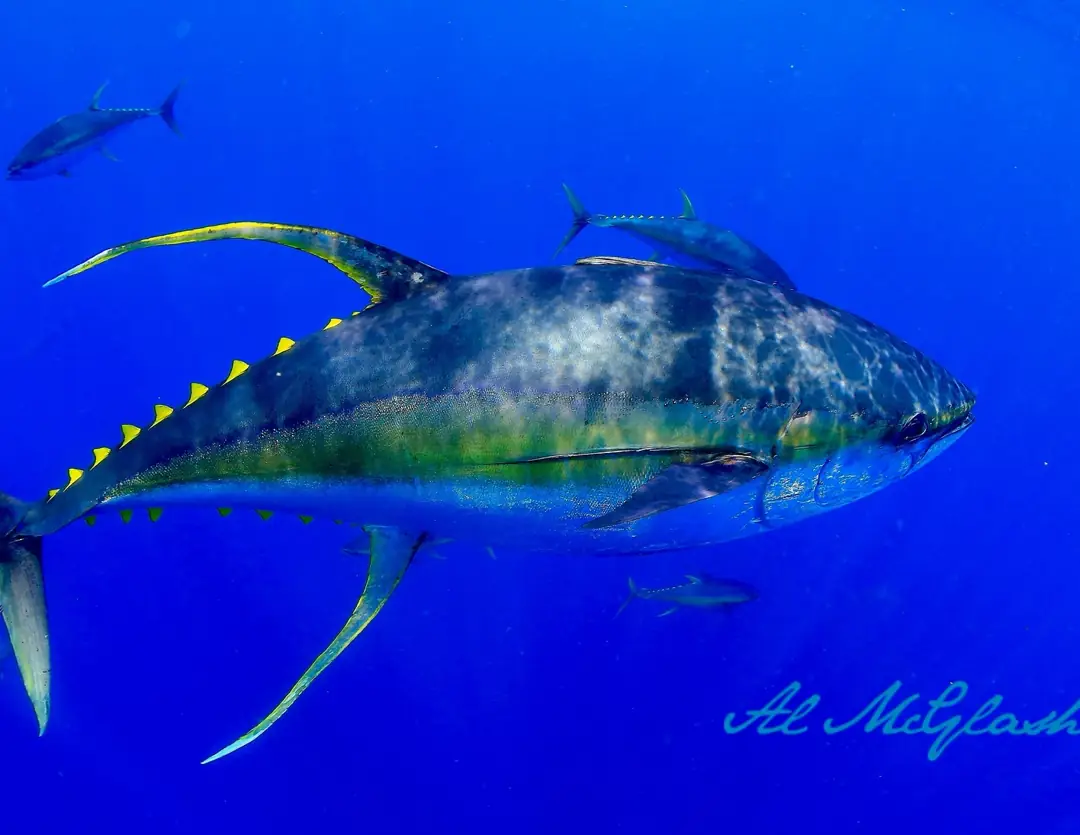 © AlmcglashanCC BY-SA 4.0
 Skipjack Tuna is classified as poisonous. Always exercise caution and keep a safe distance.
Skipjack Tuna can be found at depths of up to 260 meters.
Download Seabook free for iOS and Android.