 © Holly ShawAll rights reserved
Spotted Wobbegong
Orectolobus maculatus
Eucrossorhinus dasypogon
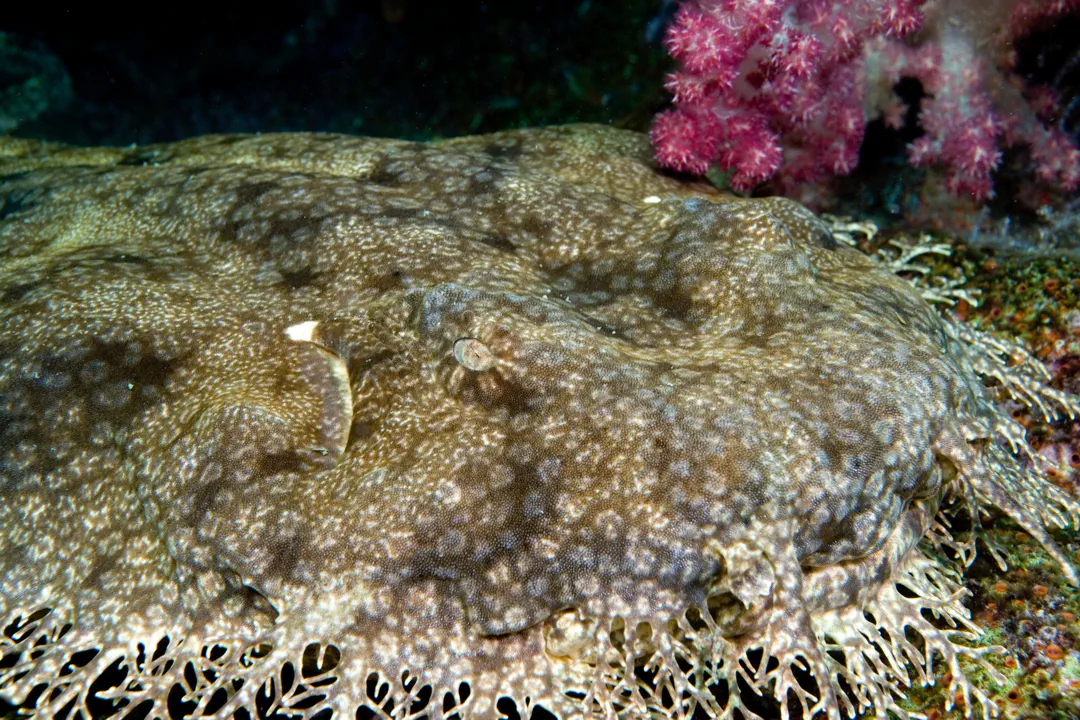
Eucrossorhinus dasypogon is a species of carpet shark in the family Orectolobidae and the only member of its genus. It inhabits shallow coral reefs off northern Australia, New Guinea, and adjacent islands. Reaching 1.8 m (5.9 ft) in length, this species has a broad and flattened body and head. Its most distinctive trait is a fringe of branching dermal flaps around its head, which extends onto its chin. The fringe, along with its complex color pattern of small blotches and reticulations, enable it to camouflage itself against the reef environment.
The tasselled wobbegong is a very broad, moderately flattened shark. The head is wider than long, with a distinctive fringe of branching dermal lobes running almost continuously from the snout tip to the origins of the pectoral fins, including a "beard" on the chin. The nostrils bear long, branching barbels, and have grooves surrounding them and connecting them to the mouth. There are tubercles above the eyes but not elsewhere, and behind the eyes are larger spiracles. The large mouth is positioned ahead of the eyes, almost at the end of the head. There are furrows on the lower jaw extending from the mouth corners and along the jaw median. There are 23–26 upper and 19 lower tooth rows; each tooth has a single slender, pointed cusp. The three upper and two lower rows of symphysial (central) teeth are especially long and fang-like. The five pairs of gill slits are short.
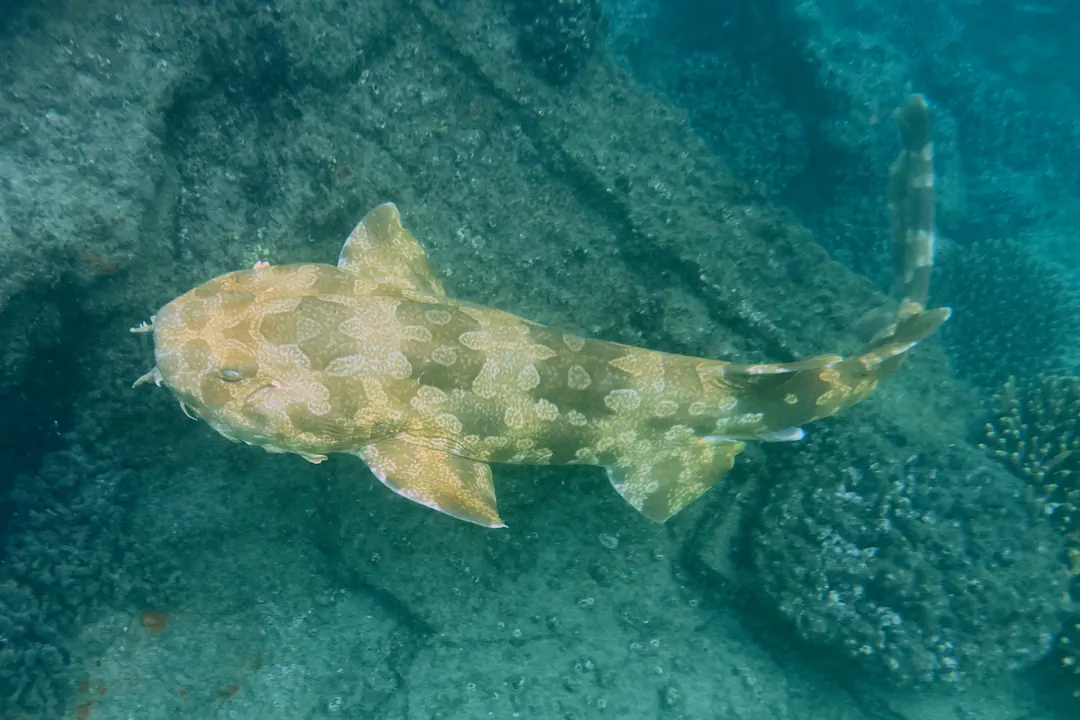
The pectoral and pelvic fins are large and rounded. The dorsal fins are short-based and fairly tall; the first is slightly larger than the second and originates over the latter quarter of the pelvic fin bases. Behind the pelvic fins, the body rapidly tapers to the short caudal peduncle. The anal fin originates behind the midpoint of the second dorsal fin and is no more than half its size. The caudal fin is short, with no lower lobe and an upper lobe bearing a strong ventral notch near the tip. This species has a mosaic-like dorsal color pattern consisting of numerous small, dark blotches and lines on a gray- or yellow-brown background; there may also be darker bands. The pattern extends to the underside of the tail and the ventral pectoral and pelvic fin margins. The ventral surface is otherwise white. The tasselled wobbegong is reliably known to reach a length of 1.8 m (5.9 ft).
The range of the tasselled wobbegong encompasses the continental shelf of northern Australia from Ningaloo Reef in the west to Bundaberg in the east, as well as New Guinea, Waigeo, and the Aru Islands. Additional records from Malaysia are unconfirmed. This common bottom-dweller inhabits coral reefs, perhaps exclusively, in both inshore and offshore waters from the intertidal zone to around 50 m (160 ft) deep. It is most often encountered in reef channels and faces, or atop coral heads.
During the day, the solitary tasselled wobbegong can generally be found lying inside caves or under ledges with its tail curled. Individual sharks tend to remain within a local area and have favored resting spots. While resting, it opportunistically ambushes nearby fishes and invertebrates, and also lures in prey by waving its tail to mimic the appearance of a small fish. At night, it emerges and actively forages for food. This species is aplacental viviparous, though little is known of its life history. The tasselled wobbegong has been reported to bite humans unprovoked; attacks may result from people accidentally disturbing the shark or being misperceived as prey. The International Union for Conservation of Nature (IUCN) has listed this species as Near Threatened, as outside of Australia it is threatened by fisheries and habitat degradation.
Considered the most specialized member of its family, the tasselled wobbegong's ornate coloration and complex dermal fringe grants it excellent camouflage, while it is probably a slower swimmer than related species. It is solitary and spends most of the day lying motionless inside caves or under ledges with its tail curled up. Individual sharks have a small home range, containing several preferred resting spots that are used repeatedly. This species becomes more active at night, swimming onto the reef to hunt.
The tasselled wobbegong feeds on bony and cartilaginous fishes, crustaceans, and cephalopods. Its capacious mouth allows sizeable prey to be swallowed, with one documented case of a 1.3 m (4.3 ft) long individual consuming a 1.0 m (3.3 ft) long brownbanded bamboo shark (Chiloscyllium punctatum). During daytime, this species is an opportunistic ambush predator. It preys upon schooling nocturnal fishes such as squirrelfishes, soldierfishes, and sweepers that often shelter in the same cave. Tiny fishes and crustaceans have been seen settling atop the resting wobbegong's head, attracting larger fishes that are in turn attacked by the wobbegong. Observations in captivity have further revealed that this species seems to engage in active luring behavior. When it perceives food nearby, it begins to slowly wave its tail back and forth; its caudal fin resembles a small fish, complete with a dark eyespot at the base. The shark typically rests with its head elevated, which places it within striking distance of any prey drawn by its tail.
The tapeworm Parachristianella monomegacantha is a known parasite of the tasselled wobbegong. This species has been observed being attended by cleaner shrimp (Leander urocaridella, Stenopus hispidus) and bluestreak cleaner wrasse (Labroides dimidiatus). Reproduction is presumably aplacental viviparous like other wobbegongs, with the developing embryos sustained by yolk. There is a report of mating being observed inside a cave at night. Newborns measure approximately 20 cm (7.9 in) long. Size at sexual maturity is uncertain; one recorded male was found to be adult at 1.2 m (3.9 ft) long.
With several records of apparently unprovoked attacks on people, the tasselled wobbegong has a reputation beyond other wobbegongs for aggressive behavior.Gilbert Whitley even wrote in 1940 that it "attacks and generally kills the natives" of Papua New Guinea. Though Whitley's claim is questionable, this species is certainly capable of inflicting severe wounds. Conversely, the tasselled wobbegong is also an ecotourism attraction and many divers have approached it without incident. Given this shark's cryptic appearance and poor vision, humans should exercise caution to avoid accidentally harassing it or causing it to mistake a hand or foot for prey. This species adapts well to captivity and is occasionally found in the home aquarium trade.
The tasselled wobbegong has little economic value, though its attractive skin is occasionally used for leather. In Australian waters, it is not fished and faces minimal threats. However, elsewhere in its range it may be negatively affected by extensive fishery activity and habitat degradation from pollution, blast fishing, and coral removal. Because of these concerns, the International Union for Conservation of Nature (IUCN) has assessed this species as Near Threatened.
Dutch ichthyologist Pieter Bleeker originally described the tasselled wobbegong in an 1867 volume of Archives Néerlandaises des Sciences Exactes et Naturelles. His account was based on two Indonesian specimens, one caught off Waigeo and the other off Aru. He gave it the name dasypogon, from the Greek dasys ("hairy") and pogon ("beard"), and assigned it to the genus Crossorhinus (a synonym of Orectolobus). In 1908, Charles Tate Regan created the new genus Eucrossorhinus for this species, derived from the Greek eu ("good"), krossoi ("tassel") and rhinos ("nose"). Regan subsequently reconsidered the main trait he used to separate Eucrossorhinus (the spacing of the fourth and fifth gill slits) and synonymized it with Orectolobus. Later authors have placed the tasselled wobbegong either in its own genus or in Orectolobus. Other common names for this species are bearded wobbegong and Ogilby's wobbegong.
Morphological studies have been inconclusive about the evolutionary relationships of the tasselled wobbegong, but overall have gauged it to be among the more derived wobbegong (Orectolobidae) species. A 2009 phylogenetic analysis based on mitochondrial and nuclear DNA found otherwise, that this species was in fact basal to all other wobbegongs except the northern wobbegong (O. wardi). This result supports the synonymization of Eucrossorhinus with Orectolobus. Molecular clock estimation placed the speciation of the tasselled wobbegong at 11–6 Ma, coinciding with a period of significant geological rearrangement and the formation of coral reef habitats in the region
Wobbegong is the common name given to the 12 species of carpet sharks in the family Orectolobidae. They are found in shallow temperate and tropical waters of the western Pacific Ocean and eastern Indian Ocean, chiefly around Australia and Indonesia, although one species (the Japanese wobbegong, Orectolobus japonicus) occurs as far north as Japan. The word wobbegong is believed to come from an Australian Aboriginal language, meaning "shaggy beard", referring to the growths around the mouth of the shark of the western Pacific.
Wobbegongs are bottom-dwelling sharks and spend much of their time resting on the sea floor. Most species have a maximum length of 1.25 m (4.1 ft) or less, but the largest, the spotted wobbegong, Orectolobus maculatus, and banded wobbegong, O. halei, reach about 3 m (9.8 ft) in length.
Wobbegongs are well camouflaged with a symmetrical pattern of bold markings which resembles a carpet. Because of this striking pattern, wobbegongs and their close relatives are often referred to as carpet sharks. The camouflage is improved by the presence of small weedlike whisker lobes surrounding the wobbegong's jaw, which help to camouflage it and act as sensory barbs. Wobbegongs make use of their relative invisibility to hide among rocks and catch smaller fish which swim too close, typical of ambush predators.
Wobbegongs are generally not dangerous to humans. However they have bitten people who accidentally step on them in shallow water or SCUBA divers who poke or touch them. Unprovoked, they may also bite scuba divers, surfers, or snorkellers who swim near their hiding spot. Wobbegongs are very flexible and can easily bite a hand holding on to their tail.
They have many small but sharp teeth and their bite can be severe, even through a wetsuit; having once bitten, they have been known to hang on and can be very difficult to remove.
In Australia, the flesh of wobbegongs and other shark species is called flake and it is often the "fish" component of fish and chips. Wobbegong skin is also used to make leather.
Although most wobbegong species are unsuitable for home aquaria due to their large adult size, this has not stopped some of the larger species from being sold in the aquarium trade. Small wobbegong species, such as the tasselled wobbegong and Ward's wobbegong, are "ideal" sharks for home aquarists to keep because they are an appropriate size and are lethargic, enabling them to be accommodated within the limited space of home aquaria, although they will consume tankmates, even quite large ones. Some aquarists, by contrast, see the lack of activity to be a drawback to keeping wobbegongs and prefer more active sharks. Wobbegongs are largely nocturnal and, due to their slow metabolism, do not have to be fed as often as other sharks. Most do well on two feedings weekly. Underfed wobbegongs can be recognised by visibly atrophied dorsal musculature.
The 12 living species of wobbegong, in three genera, are:
Fossil genera include:
© Holly ShawAll rights reserved Tasselled Wobbegong is classified as dangerous to humans. Always exercise caution and keep a safe distance.
Tasselled Wobbegong can be found at depths of up to 50 meters.
Download Seabook free for iOS and Android.