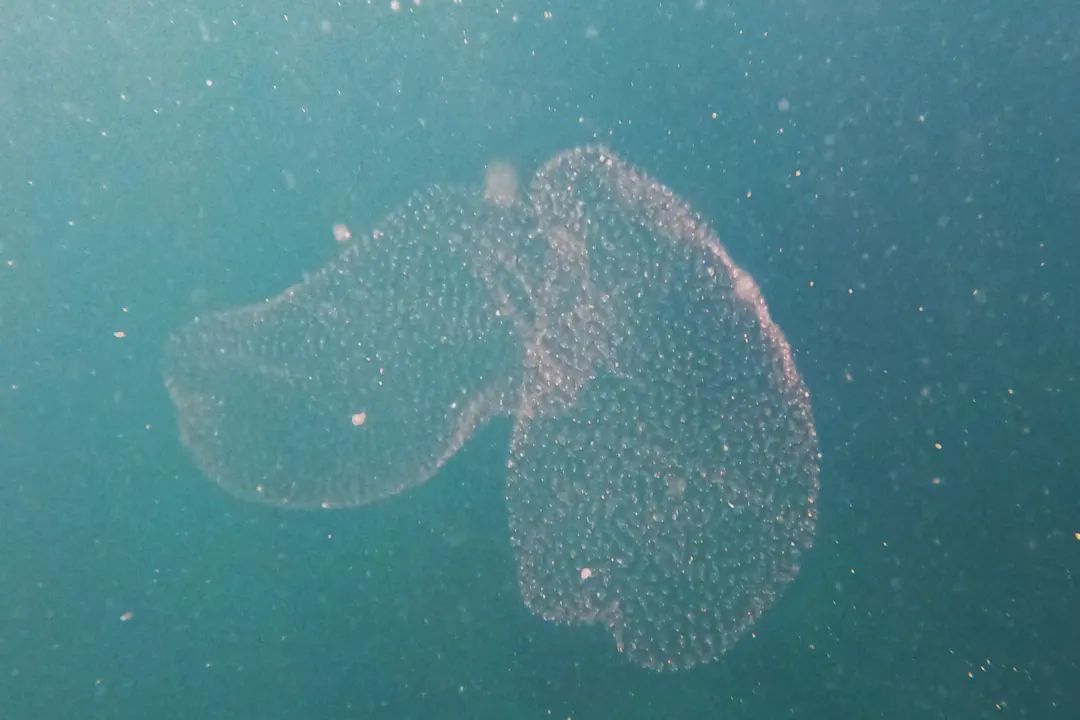
Giant Salp
Pyrostremma spinosum
- Max size
- View in app
- Max depth
- 40 m
- Found in
- 7 regions
How to recognise it
- Colours
- transparentred
Description
Forms tubular colonies that can exceed 20 m in length. The open side of the tube is the posterior end (the common cloaca) and in a 10.2 m long colony, was measured at 1.2. m in diameter. It often has a very long tail projecting from the rim of the opening that can be as long as the colony. The colony tapers to the anterior end, which is closed and pointed. The wall of the tube is made up of individual animals (zooids) that are embedded in a gelatinous test. The external surface of the test is covered with blunt, spine-like pyramids of fairly rigid jelly, with one pyramid next to the oral siphon of each zooid. These projections are about 5 mm apart and 2-3 mm high. The oral (inhalent) siphon of each zooid is on the outside of the colony and the atrial (exhalent) siphon on the inside of the tube. The combined filtering of water from the outside to the inside of the tube by these thousands of zooids helps to keep the tube cylindrical in shape. It actually is quite fragile and if it is taken out of the water it collapses.
Zooids are up to 14.3 mm long, with the oral siphon 0.5 mm long and the cloacal siphon 5.2 mm long. Zooids of the other species in the genus, Pyrostremma agassizi, are only 8 - 10 mm long. The greater length of Pyrostremma spinosum zooids is mainly because of the long cloaca.
Distribution
The southern Atlantic Ocean and Indo-Pacific
Biology
Depth based from type locality. Marine, planktonic. Members of the order Pyrosomatida includes clonal and sexual phases in its life cycle.
Life cycle: Eggs develop into lecithotrophic oozooid (cyathozooid) which undergo budding to form four blastozooids. The oozoid degenerates and the colony is formed from the blastozooids.
Habitat
As these colonies are very fragile, they can get broken up by surface waves. Observations of the larger colonies have been at depths below the level of strong wave action, to as deep as 40 m
Questions
Is Giant Salp dangerous?
Giant Salp has no known danger to humans. However, always observe marine life responsibly.
Where can you find Giant Salp?
How deep does Giant Salp live?
Giant Salp can be found at depths of up to 40 meters.