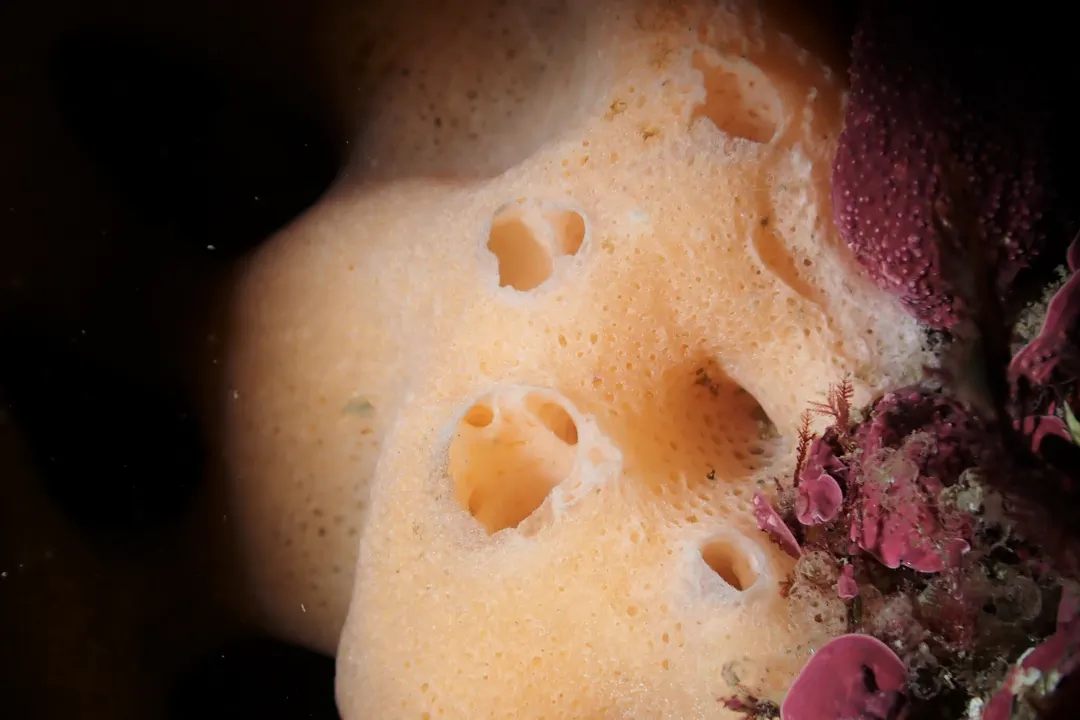
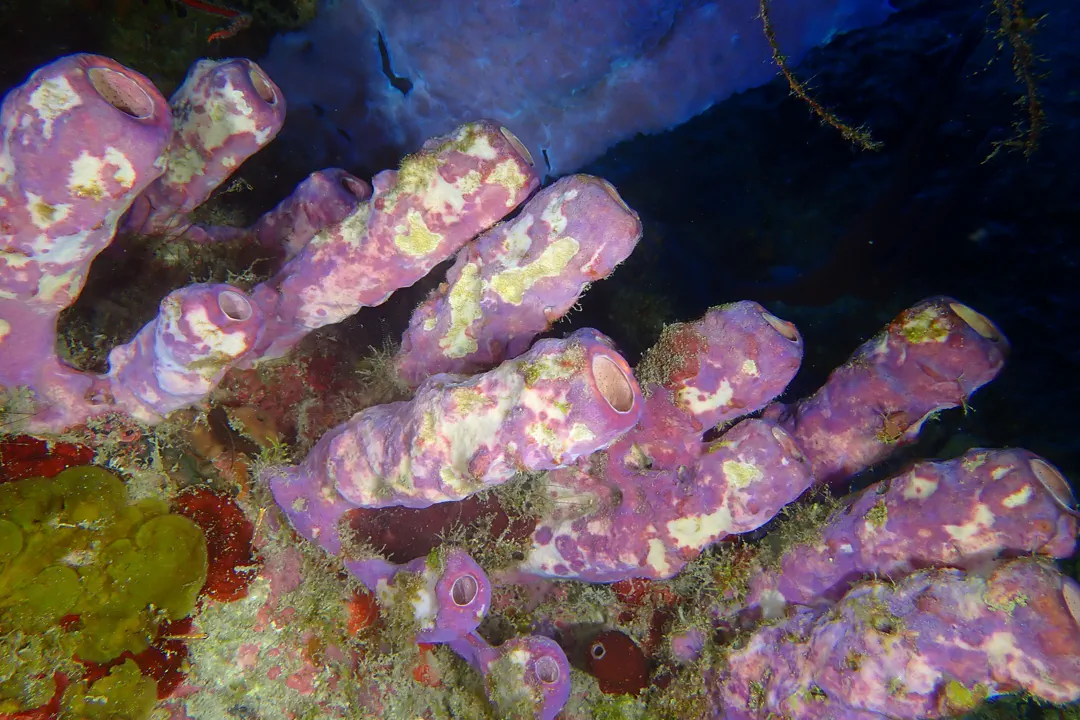
 © Robin WhiteCC BY 4.0 · iNaturalist
Stovepipe Sponge
Aplysina archeri
Leucosolenia rosea, known descriptively as a calcareous marine sponge, belongs to the family Leucosoleniidae and is found in the Southwest Pacific, with its type locality in Central New Zealand.
The species was first described by Herbert B. Kirk in 1896. The original description appeared in Kirk’s "New Zealand sponges. Third paper," published in Transactions of the New Zealand Institute 28, pages 209–210. The name Leucosolenia combines Greek leukos ("white") with solēn ("tube" or "pipe"), referring to the genus’s tubular body form, while rosea is Latin for "rose-colored" or "pink," presumably describing the sponge’s coloration. WoRMS currently lists no species-level synonym or reclassification for L. rosea; it remains under Leucosolenia. The genus Leucosolenia has had historical alternative names, including Ascortis, Asculmis, Ascuris, and Clistolynthus, but these are not established synonyms specifically of L. rosea. The current classification of Leucosolenia rosea is Animalia → Porifera → Calcarea → Calcaronea → Leucosolenida → Leucosoleniidae → Leucosolenia → L. rosea.
The species forms a small, delicate, arborescent colony composed of many thin-walled tubes that branch repeatedly, with the tubes not anastomosing, meaning they do not form a fused network. Each erect tube ends in a terminal osculum, which serves as the exhalant opening. The tube walls are thin and externally hairy or minutely hispid due to spicules projecting through the surface, resulting in a soft and fragile sponge. The sponge is recorded as white in life and after preservation, and pink or rose color should not be treated as diagnostic for Leucosolenia rosea due to potential variations in field color. The referenced specimen measured approximately 21.3 mm in height and 3.4 mm in width, although this measurement is not a dependable field-size limit. Leucosolenia rosea can be distinguished from similar species such as L. macquariensis and L. tenera using spicule characters rather than color. Microscopy is required to confidently separate L. rosea from L. eleanor, which differs in its combination of sagittal and regular triactines.
The species is a benthic sponge found in shallow coastal rocky habitats and has also been recorded on mesophotic rocky reefs. Leucosolenia rosea is attached to hard substrates, including rocky reef surfaces, and studies have examined its presence on boulder tops and relatively flat reef platforms. The depth range of Leucosolenia rosea has been reported to extend from about 30 m to approximately 70 m. Geographically, the species has been recorded from New Zealand, specifically the South Island, and is placed in the Southwest Pacific.
Leucosolenia rosea is a suspension-feeding calcareous sponge that likely consumes microscopic suspended particles, including bacteria, small plankton, and organic detritus. The feeding process involves water entering through small pores called ostia, where flagellated choanocytes generate a water current and trap food particles with their collars. Captured food particles are digested intracellularly by choanocytes, while amoebocytes receive and further digest food, distributing nutrients throughout the sponge. Filtered water and waste exit through larger openings called oscula, indicating that the species does not actively hunt or ingest large prey, but feeds by filtering microscopic particles from flowing seawater.
No documented commercial fishery or fishery value was found for Leucosolenia rosea, as commercially harvested sponges generally refer to other, larger sponge taxa. No reliable evidence was found that Leucosolenia rosea is regularly collected or marketed for the aquarium trade. No authoritative source documents Leucosolenia rosea as food, and it should not be considered edible based on the absence of toxicity information. No species-specific reports of bites, stings, poisoning, or other harm to people were found for Leucosolenia rosea; however, direct contact with any wild sponge can cause mechanical irritation or an individual skin reaction. A species-level IUCN Red List assessment was not located for Leucosolenia rosea, and therefore, its global conservation status is not known.
© Robin WhiteCC BY 4.0 · iNaturalist Leucosolenia rosea has no known danger to humans. However, always observe marine life responsibly.
Download Seabook free for iOS and Android.