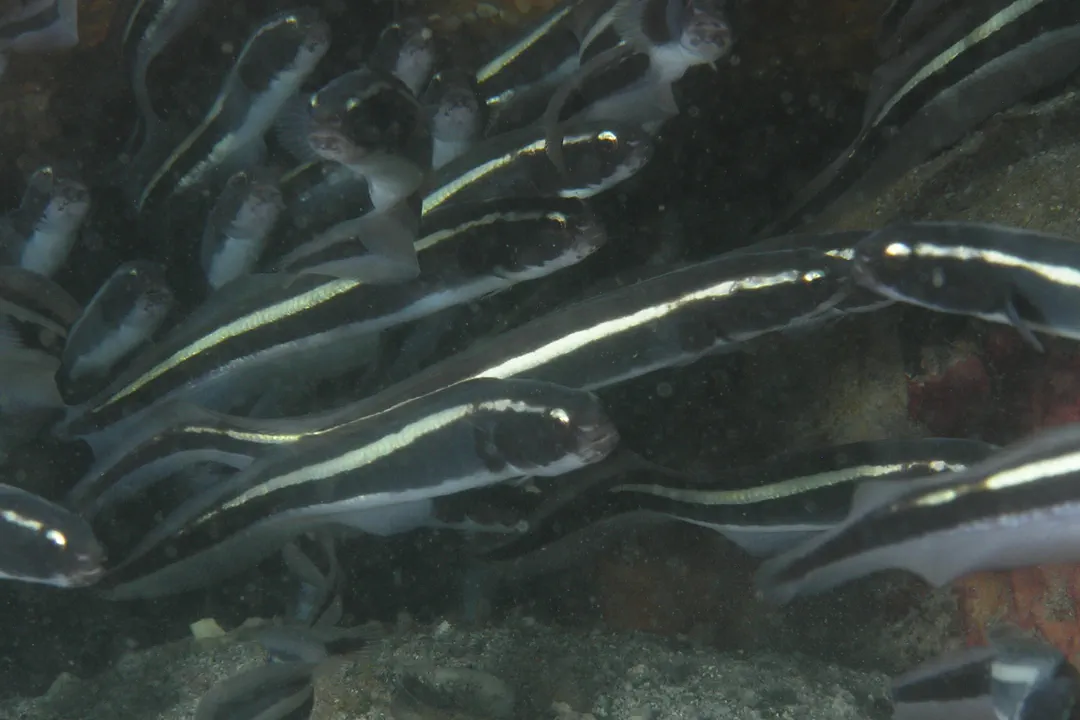
Convict Blenny
Pholidichthys leucotaenia
- Max size
- View in app
- Max depth
- 30 m
- Found in
- 11 regions
How to recognise it
- Colours
- whiteblack
- Body shape
- Elongated
- Pattern
- Camouflage pattern, Horizontal markings
Pholidichthys leucotaenia is a marine fish from the west-central Pacific Ocean. It is neither a blenny nor a goby, but is in fact one of two species in the family Pholidichthyidae.
Description
A small eel-shaped fish, it can grow up to 60 cm (24 in) in length. Juveniles resemble the striped catfish Plotosus lineatus, which is venomous, having a black body with a white dorsal stripe. As they develop, the stripe changes to white convict-style barring or spotting in the adult.
Ecology
It lives in shallow lagoons and on coastal reefs from the Philippines to the Solomon Islands. It is often found in schools under ledges or around coral heads. These schools swim in such tight formations, they resemble a single organism. Occasionally, the species is found in the aquarium trade, where it is known for disrupting all but the most stable structures.
DNA analyses show this species to be neither a blenny nor a goby, but part of a separate fish family, the Pholidichthyidae.
In the Solomon Islands, researchers under Eugenie Clark found juveniles emerging from holes in the seafloor and adjoining coral reefs. By day, these juveniles swim up to 50 m (55 yd) from their home burrows to feed on plankton. At the end of the day, all returned to the burrows, remarkable and unique behaviour for larval fish.
While their young are out feeding, the parents eject mouthfuls of debris from the burrows. Research has revealed a maze of tunnels and chambers totaling a length of some six meters. At night, young fish dangle by their mouths from the roof of the tunnels by thin mucous threads.
Questions
Is Convict Blenny dangerous?
Convict Blenny has no known danger to humans. However, always observe marine life responsibly.
Where can you find Convict Blenny?
How deep does Convict Blenny live?
Convict Blenny can be found at depths of up to 30 meters.