 © Lesley ClementsAll rights reserved
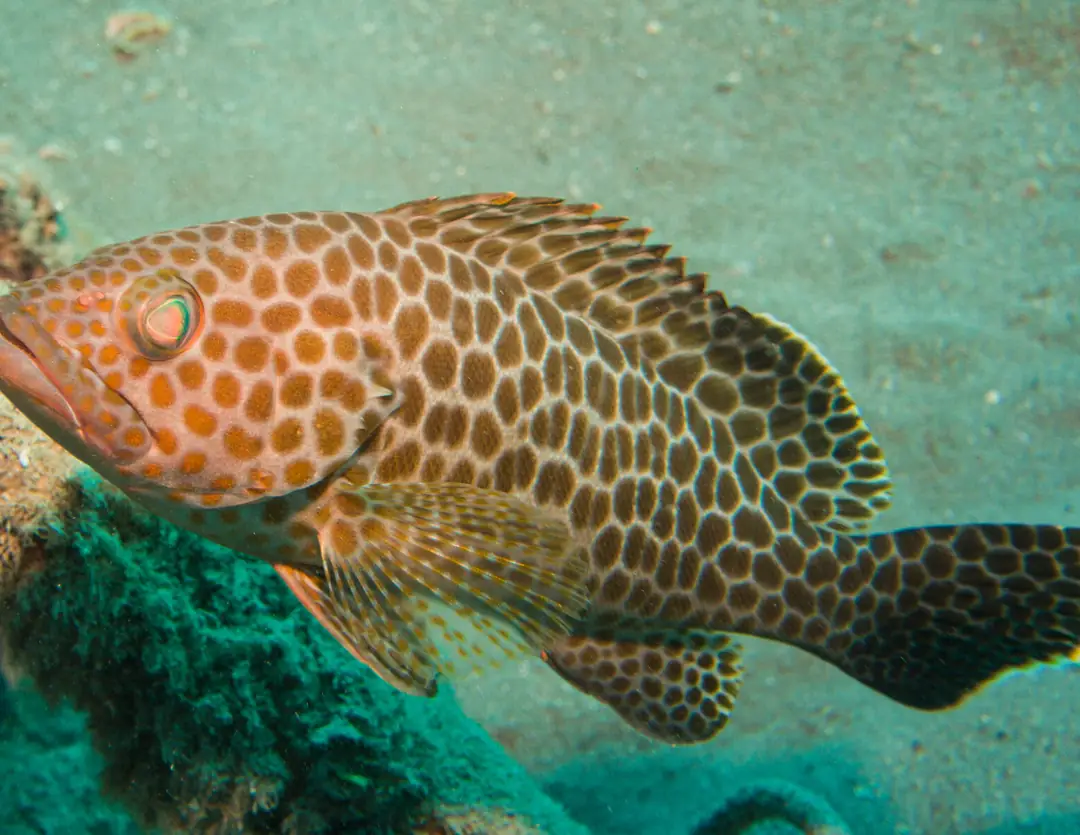
Areolate Rock Cod
Epinephelus areolatus
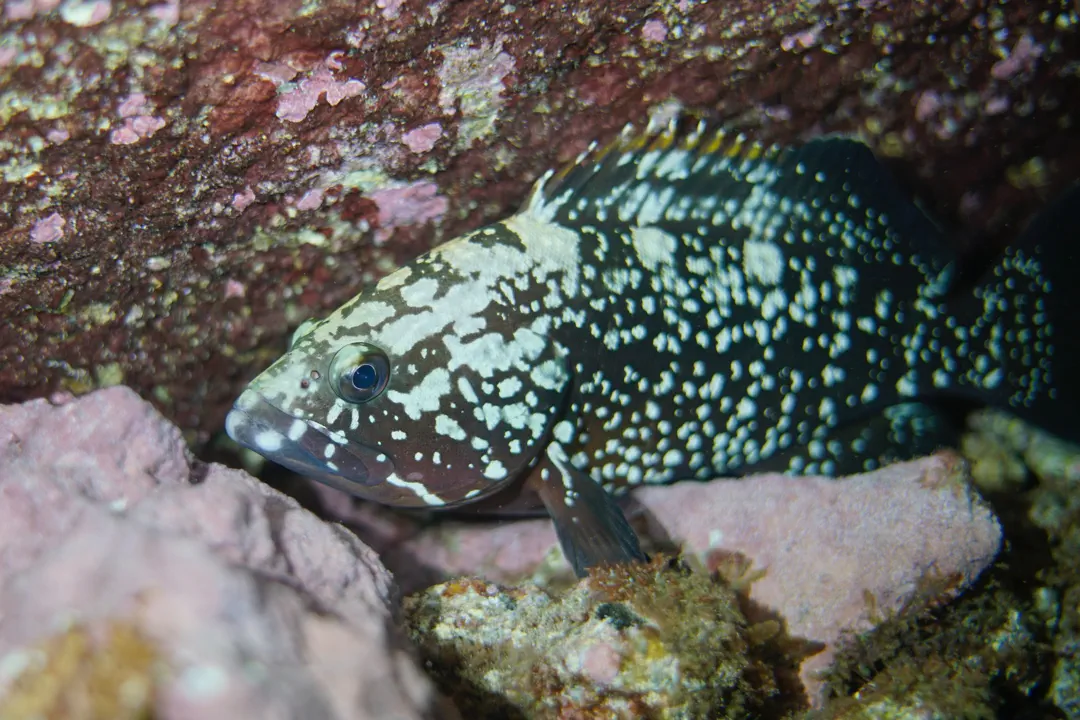
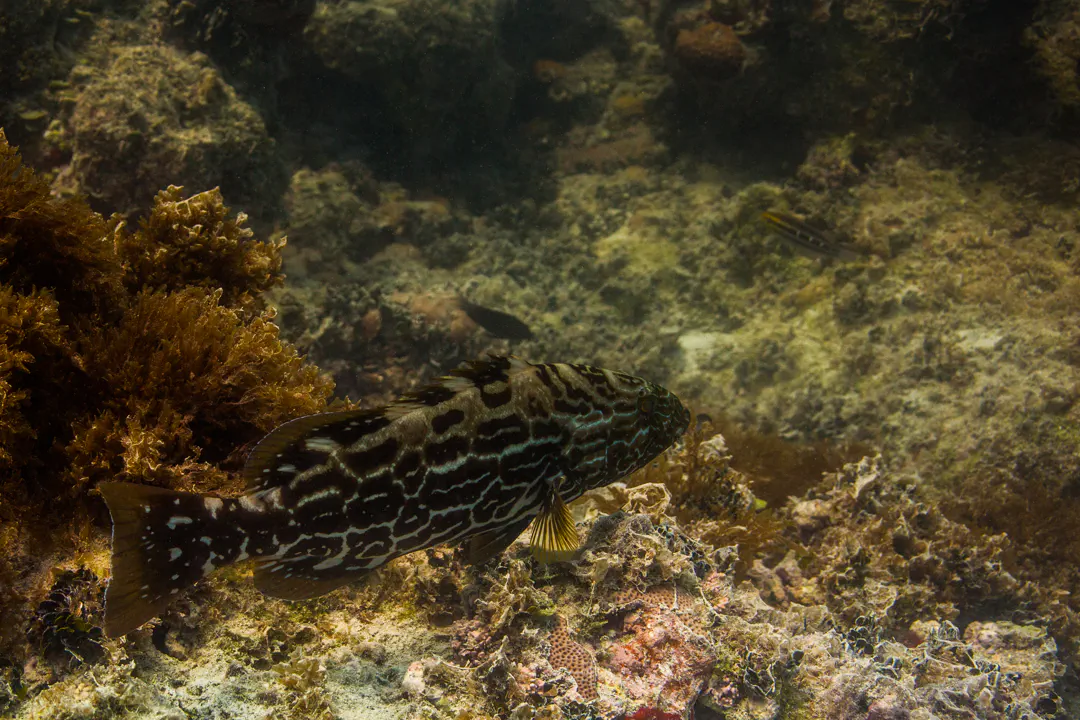
Epinephelus marginatus
*Epinephelus marginatus (*formerly Epinephelus gigas) is the best known grouper of the Mediterranean Sea and North Africa coast. It is said to have the best taste of all Mediterranean fishes.
Epinephelus marginatus is a very large, oval-bodied and large-headed fish with a wide mouth which has a protruding lower jaw. The head and upper body are coloured dark reddish brown or greyish, usually with yellowish gold countershading on the ventral surfaces; the base colour is marked by a vertical series of irregular pale greenish yellow or silvery grey or whitish blotching which is normally rather conspicuous on the body and head; the black maxillary streak varies in its markedness; dark brown median fins; distal edges of the anal and caudal fins and also often pectoral fins have narrow white terminal bands; the pelvic fins are black towards their tips while the pectoral fins are dark reddish-brown or grey; the margin of spiny dorsal fin and basal part of the pectoral fins are often golden yellow in colour. There are eleven spines and 13-16 soft rays in the dorsal fin. This species can grow up to 150 cm in standard length but is more often 90 cm.
The Dusky Grouper has a big body with a big mouth. One long dorsal fin and a rounded tail. Its color varies from brown to green depending on the season and the age. It is green during its juvenile phase. The adult is upper brown with yellow spots and lower yellow. On the operculum there are three spines.
Epinephelus marginatus has two disjunct distribution centres, the main one is in the eastern Atlantic from the west coast of Iberia south along the western coast of Africa to the Cape of Good Hope, extending east into the south-western Indian Ocean, as far as southern Mozambique, with doubtful records from Madagascar and possibly Oman. It is found throughout the Mediterranean too. The second population occurs in the south western Atlantic off the coast of South America in southern Brazil, Uruguay and northern Argentina. In the eastern Atlantic it is not normally found further north than Portugal but there have been rare records from the Bay of Biscay and in the English Channel as far north as northern France, Great Britain and Ireland.
The dusky grouper is a solitary fish. It likes to live alone in rocks, at depths from the coast to 300 meters, but it's rare to find it below 60 meters. It has a barometric distribution, where the younger specimens are found near the coast and the older ones at the depths.
It normally has one cave considered as home and several other caves as temporary refuges. Its home has a minimum of two exits, and a size slightly bigger than the grouper, so no bigger animal can enter in. In case of biting attack or other force to extract it, the grouper opens its mouth, and the operculum spines wedge it inside the cave.
It is a protogynous hermaphrodite, i.e. the young are predominantly female but transform into males as they grow larger. Reproduction normally takes place between the summer months.
It feeds mainly on other fish, crabs and octopus. It is very greedy and one of the major predators in the Mediterranean sea.
In some countries the dusky grouper is considered a delicacy. Referring to its preference among restaurant guests, the Spanish say 'De la mar el mero y de la tierra el carnero' (From the sea the dusky grouper, from the land the lamb).
Due to overfishing, it is now considered an endangered species.
It normally grows to lengths of between 50 and 100 cm, and between 3 to 10 kg. It can grow up to 150 centimeters in length and 60 kilograms in weight.
© Lesley ClementsAll rights reserved 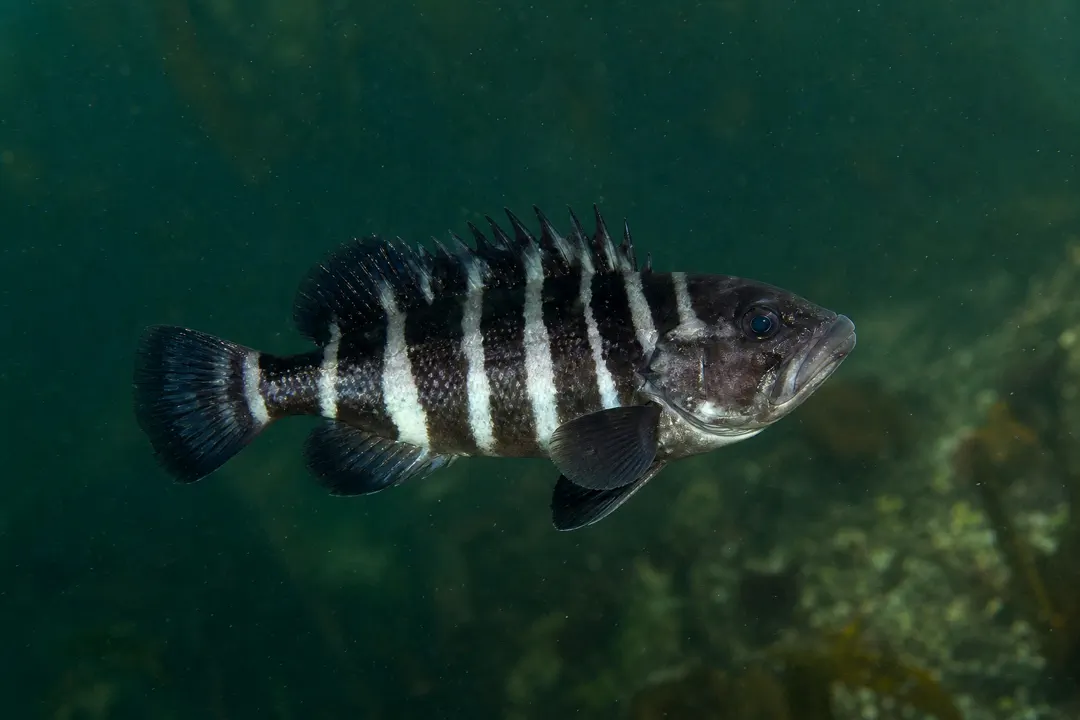 © seabook.appAll rights reserved
  © Lesley ClementsAll rights reserved
  © João D'AndrettaCC BY 4.0 · iNaturalist
  © Ewout KnoesterCC BY-SA 4.0 · iNaturalist
  © Logan JonesCC BY 4.0 · iNaturalist
 Dusky Grouper has no known danger to humans. However, always observe marine life responsibly.
Dusky Grouper can be found at depths of up to 300 meters.
Download Seabook free for iOS and Android.