 © seabook.appAll rights reserved
Spotted Eagle Ray
Aetobatus narinari
Aetomylaeus vespertilio
Aetomylaeus vespertilio is a species of fish in the Myliobatidae family. It is found in Australia, China, India, Indonesia, Malaysia, Maldives, Mozambique, Taiwan, and Thailand. Its natural habitats are open seas, shallow seas, subtidal aquatic beds, and estuarine waters. It is usually found at depths of 5-50 m.
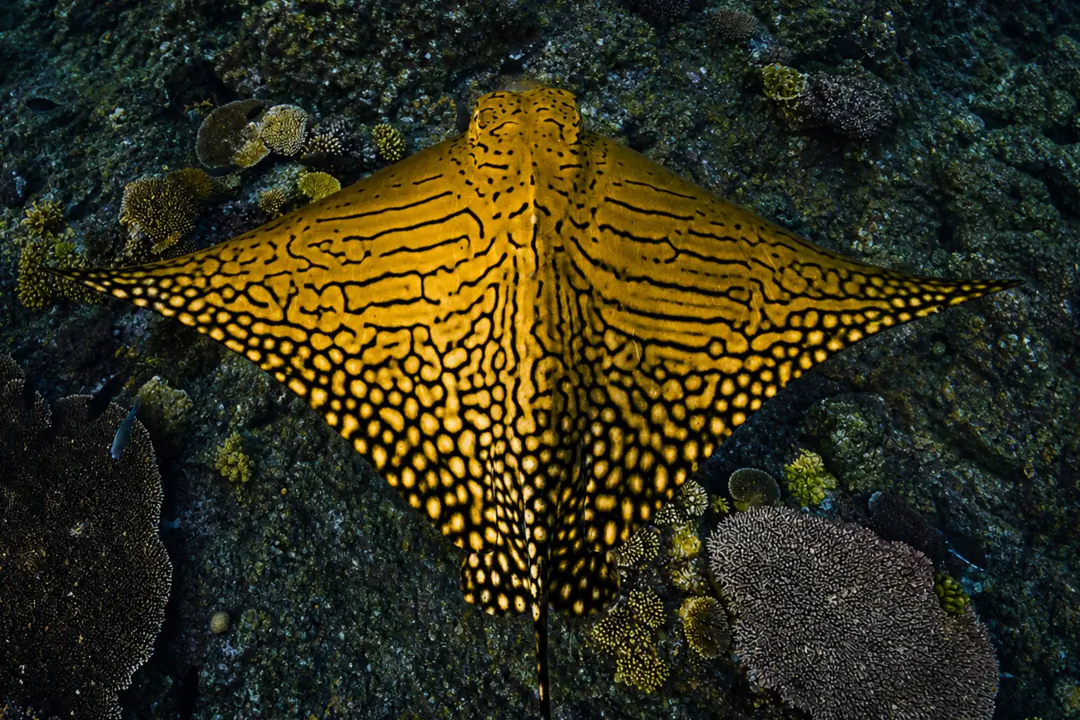
Aetomylaeus vespertilio has a maximum size of around 240 cm in disc width and a clearly distinct pattern of reticulate dark lines and rings on its back. If the extremely long tail is unbroken, it can considerably add to the maximum body length of 4 m. Lacking a spine on the tail, it is deemed harmless to humans. Lacking spine on the tail, it is deemed harmless to humans.
Aetomylaeus vespertilio can be spotted up to 110 meters deep along the coasts of Australia, China, India, Indonesia, Malaysia, Maldives, Mozambique, Philippines, Taiwan, and Thailand. Despite the wide range it can be spotted at, it is rarely observed, and has been suspected to have had a large population decline within the past three generations. Currently, this species is considered endangered by the International Union for Conservation of Nature(IUCN).
Aetomylaeus vespertilio are estimated to have a low fecundity similar to other myliobatids. They have a generation length of 15 years, and can grow as old as 24 years.
Although Aetomylaeus vespertilio was once common, they are now considered rare in areas such as the Gulf of Thailand. The largest threats they encounter are demersal fisheries, which are used frequently in the areas they live in. When caught, they are mostly retained and sold in fish markets. No species-specific conservation measures have taken place.
© seabook.appAll rights reserved Ornate Eagle Ray has no known danger to humans. However, always observe marine life responsibly.
Ornate Eagle Ray can be found at depths of up to 110 meters.
Download Seabook free for iOS and Android.