 © prilfishCC BY 4.0 · iNaturalist
Fragile File Shell
Limaria fragilis
Ctenoides ales
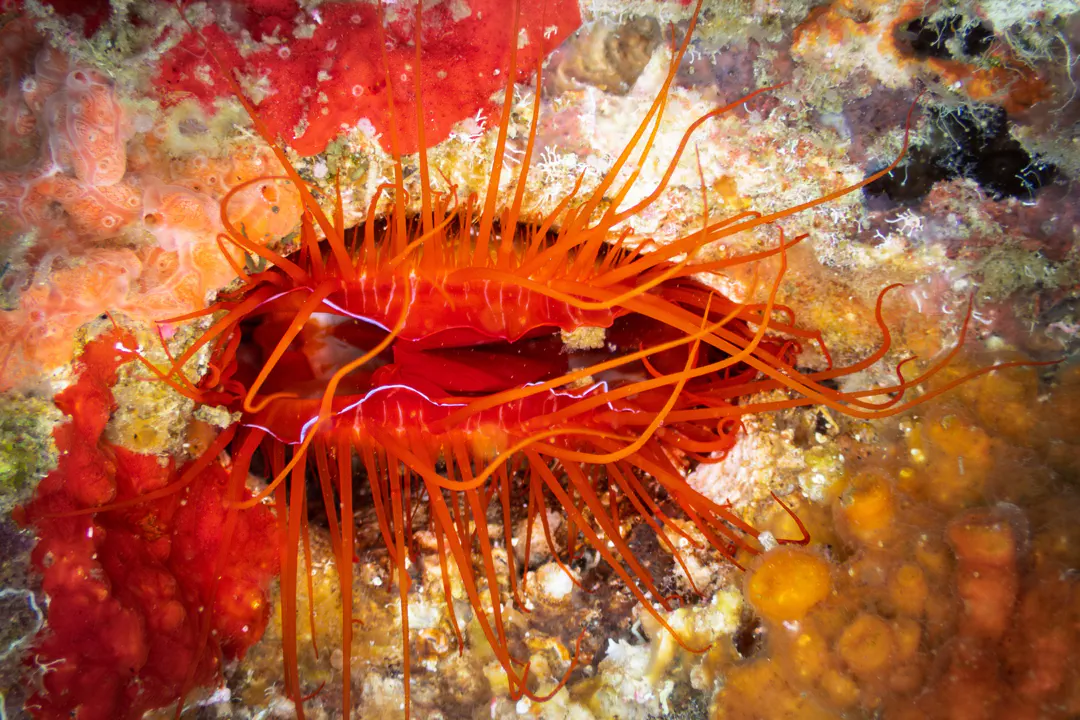
Ctenoides ales is a species of saltwater clam, a marine bivalve mollusk in the family Limidae, the file clams. The clam has been given these nicknames because its soft tissues flash light like a disco ball. Along with Ctenoides scaber, they are among the only bivalves known to have light displays.
A small bivalve that resembles a scallop that shows a bright orange–red fringe of soft filaments/tentacles extending out between the two valves.
The exposed soft tissue (mantle) is described as bright red–orange, with many long tentacles/filaments radiating outward; these can look disproportionately long compared to the shell.
Along the mantle lip runs a striking flashing line (often perceived as white/blue).
The electric clam is widespread throughout the tropical waters of the central Indo-Pacific region from Indonesia to Palau Islands and New-Caledonia. It is typically a benthic species, commonly found around 5–20 m depth. It often hides in reef crevices, showing its mantle (and flashes) when disturbed.
The flashing effect is not bioluminescence: the mantle edge has two sides — one highly reflective “mirror-like” side and one much less reflective side. By rapidly furling/unfurling that edge, it creates a strobe-like flash from ambient light. The reflective area is packed with silica nanospheres (~340 nm wide), which contribute to the strong reflection.
© prilfishCC BY 4.0 · iNaturalist  © Stas KuryanAll rights reserved
  © Stas KuryanAll rights reserved
 Electric Fileclam has no known danger to humans. However, always observe marine life responsibly.
Electric Fileclam can be found at depths of up to 20 meters.
Download Seabook free for iOS and Android.