 © tunicatedreamzCC BY 4.0 · iNaturalist
Ballan Wrasse
Labrus bergylta
Labrus mixtus
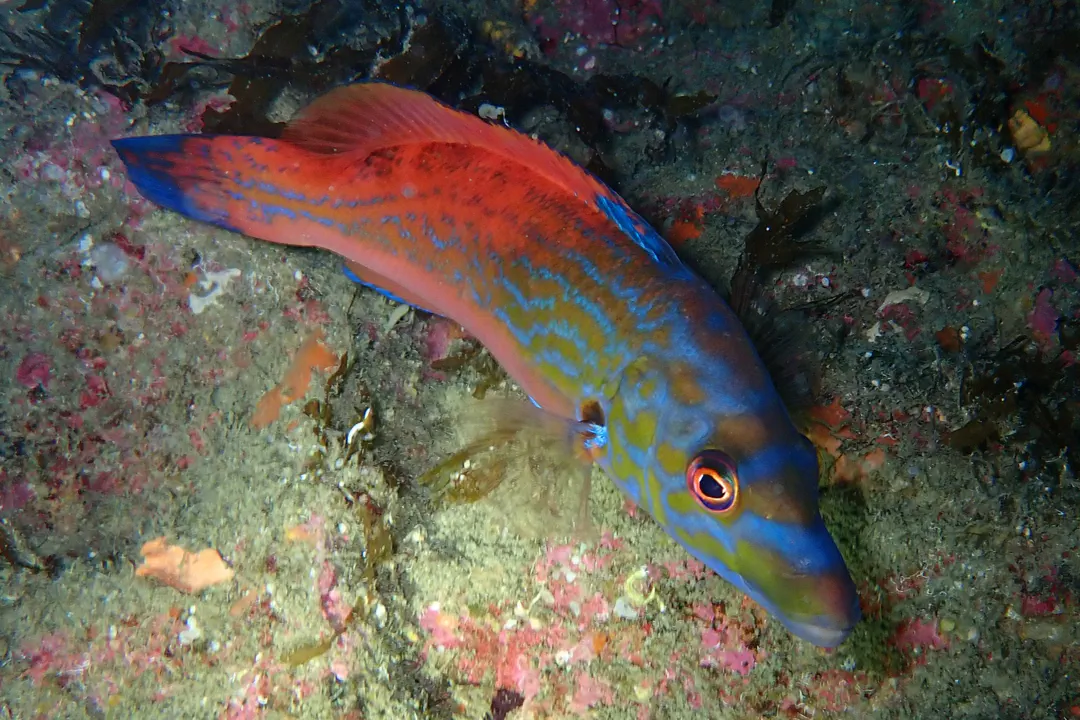
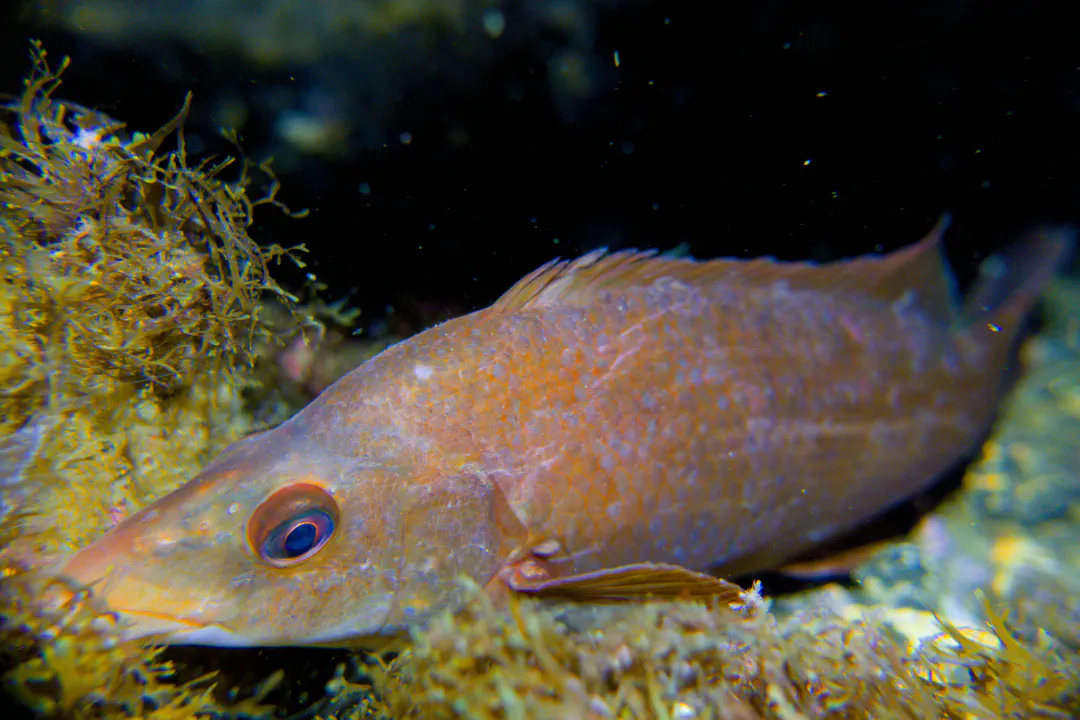
Labrus mixtus is a species of wrasse native to the eastern Atlantic Ocean from Norway to Senegal, including the Azores and Madeira. It is also found in the Mediterranean Sea. They can be found amongst the algae on rocky shores at depths from 2 to 200 m (6.6 to 656.2 ft), though mostly between 40 and 80 m (130 and 260 ft). This species is an important food fish for local populations and is also popular as a game fish. It is also a popular fish for display in public aquaria.
This species is sexually dimorphic. The male normally has a blue head with a blue body and orange pattern and blue tail. During the breeding season. the body colouration gradually changes to an orange head and body with a blue pattern that may be more pronounced at the head. The male can reach 40 cm (16 in) in standard length. The female, however, has an orange head, body, and tail with a black stripe on the dorsal fin broken up by a number of white spots. Females can grow to 30 cm (12 in) in total length.
The female has the ability to change sex when no males are present in the area.
The name cuckoo wrasse comes from Cornish fishermen who associated the blue markings with bluebell flowers. In the Cornish language, a bluebell is bleujenn an gog, literally "the cuckoo flower".
© tunicatedreamzCC BY 4.0 · iNaturalist Cuckoo Wrasse has no known danger to humans. However, always observe marine life responsibly.
Cuckoo Wrasse can be found at depths of up to 200 meters.
Download Seabook free for iOS and Android.