 © Roger RittmasterCC BY 4.0 · iNaturalist
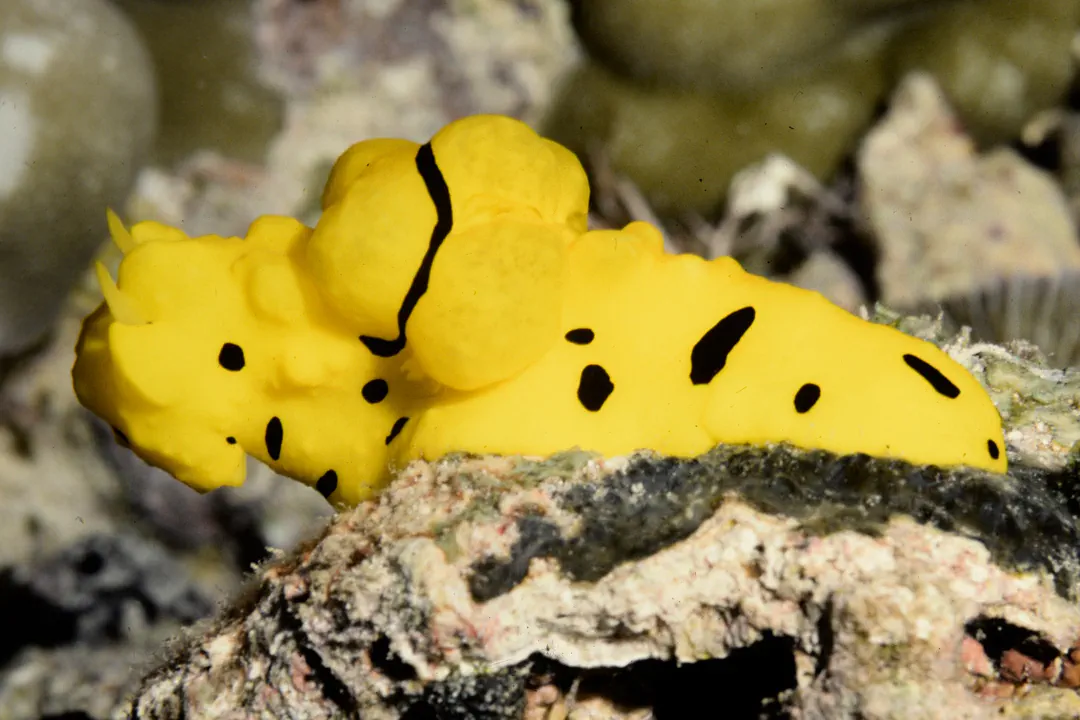
Banana Nudibranch
Notodoris minor
Thecacera pikachu
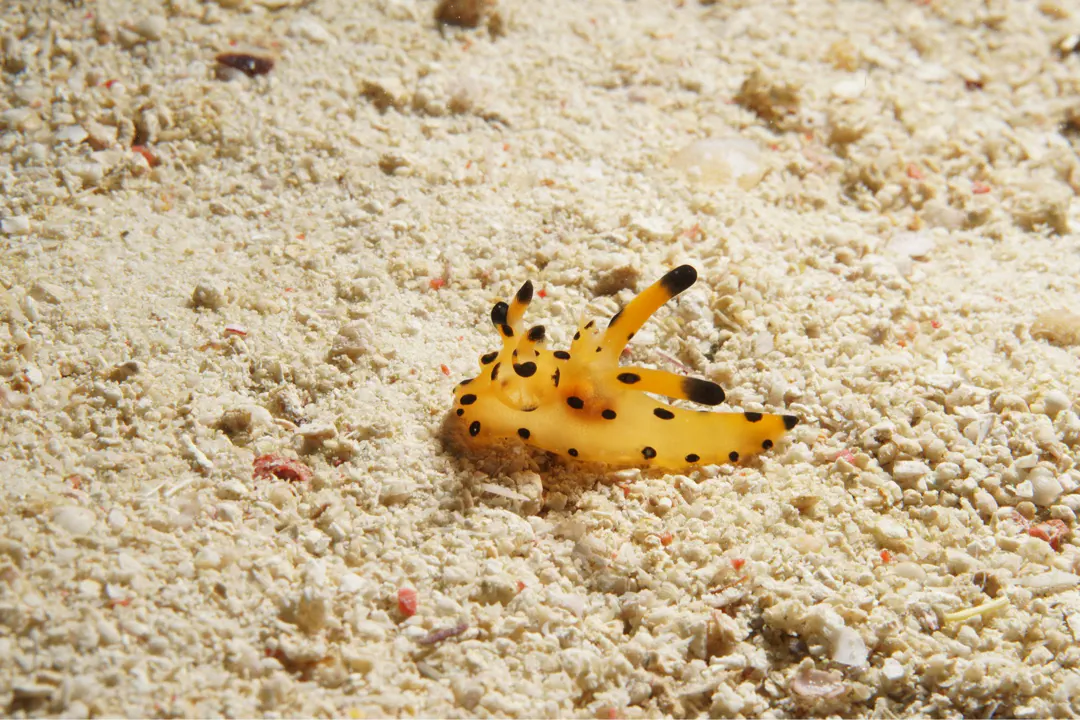
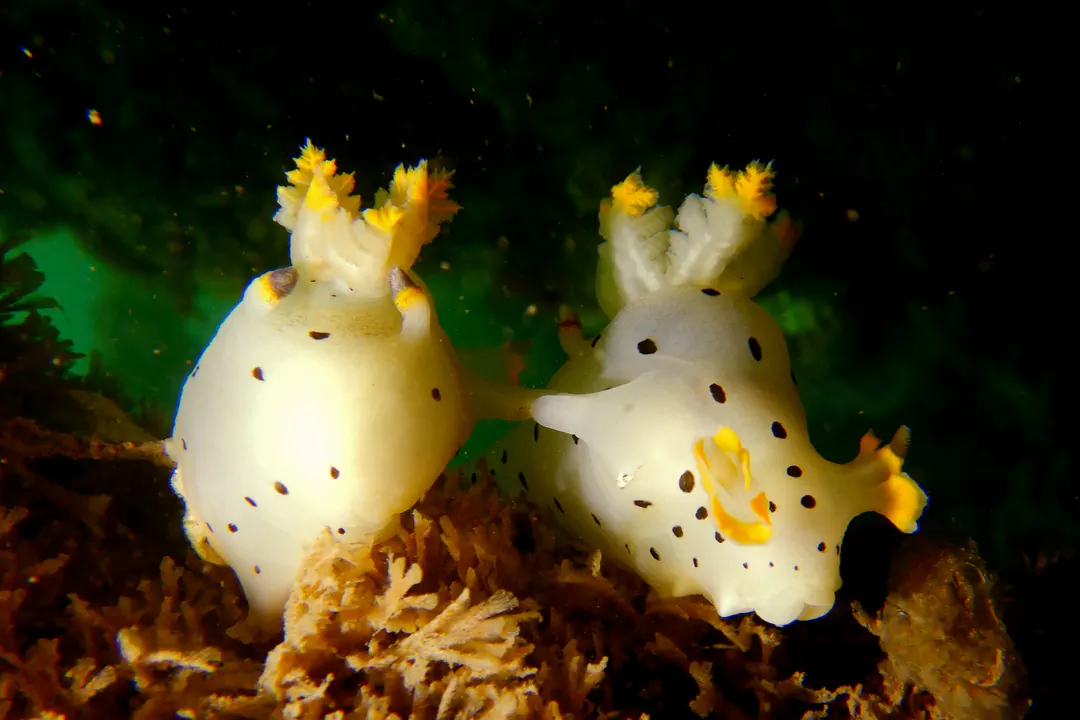
Thecacera pikachu, commonly known as the Pikachu nudibranch or Pikachu sea slug, belongs to the family Polyceridae and is reported from the western Pacific.
The species was first described in 2026 by Pola, Paz-Sedano, Martín, L. Warren, Noble & Martín-Hervás. Its original name was Thecacera pikachu sp. nov., and its type locality is Tasi Tolu Bay, Dili, East Timor. The species name 'pikachu' was chosen because the animal resembles the Pokémon character Pikachu in its yellow-orange body color and black spots. There are no listed synonyms or subsequent reclassifications for Thecacera pikachu, as it is presented as a newly described species in 2026.
The species has a small, bright yellow-orange to pale orange body with a conspicuous black-spotted pattern on the notum. It can grow to about 40 mm long and features a smooth mantle and short rounded oral tentacles. The rhinophores are long with multiple lamellae and are accompanied by large lateral extrabranchial processes that flank the gill, which is located near the first third of the body. Two parallel lines of dots run along the edge of the notum and converge toward the tail, with two larger aligned spots typically found between the rhinophores and the gill. The overall silhouette of the animal appears compact and spotted, with ear-like rhinophores and side appendages that enhance its resemblance to Pikachu. To distinguish it from similar species, the rhinophoral sheath colour pattern is the most useful field character. Thecacera pikachu can be identified by its black spots arranged in rows across a yellow-orange body, while Thecacera pacifica features blue-tinted tail and papillae with black-to-blue sheath gradients.
The True Pikachu Nudibranch is recorded from the western Pacific, with a type locality in Tasi Tolu Bay, Dili, East Timor. It has been found on sandy substrate and coral rubble during night dives. The species is reported to feed on bryozoans and hydrozoans. It is widely distributed in the western Pacific, with reports from East Timor, the Philippines, Indonesia, China, Malaysia, and Japan.
The True Pikachu Nudibranch is reported to be active during night dives, moving over sandy substrate and coral rubble while feeding.
The True Pikachu Nudibranch primarily eats bryozoans, with some reports also indicating hydrozoans in its diet. It feeds by crawling over the substrate and using its radula to scrape prey off surfaces such as sand-adjacent rubble, rock, or other hard substrates. While a few sources mention it eating algae, the more consistent reports identify it as a specialist on bryozoans rather than an algal feeder.
No evidence of commercial or artisanal fishery use was found for the True Pikachu Nudibranch. No source indicates that the species is commonly collected or sold for aquaria. No source describes the True Pikachu Nudibranch as edible or used as food. Nudibranchs are not presented as dangerous, and no toxin-related human hazard is reported for Thecacera pikachu. No formal IUCN-style conservation category for Thecacera pikachu appears in the provided results.
© Roger RittmasterCC BY 4.0 · iNaturalist  © Stas KuryanAll rights reserved
  © Stas KuryanAll rights reserved
  © seabook.appAll rights reserved
  © Erasmo Macaya HortaCC BY 4.0 · iNaturalist
  © Dan SchofieldCC BY 4.0
 True Pikachu Nudibranch has no known danger to humans. However, always observe marine life responsibly.
Download Seabook free for iOS and Android.