 © Donovan WoodAll rights reserved
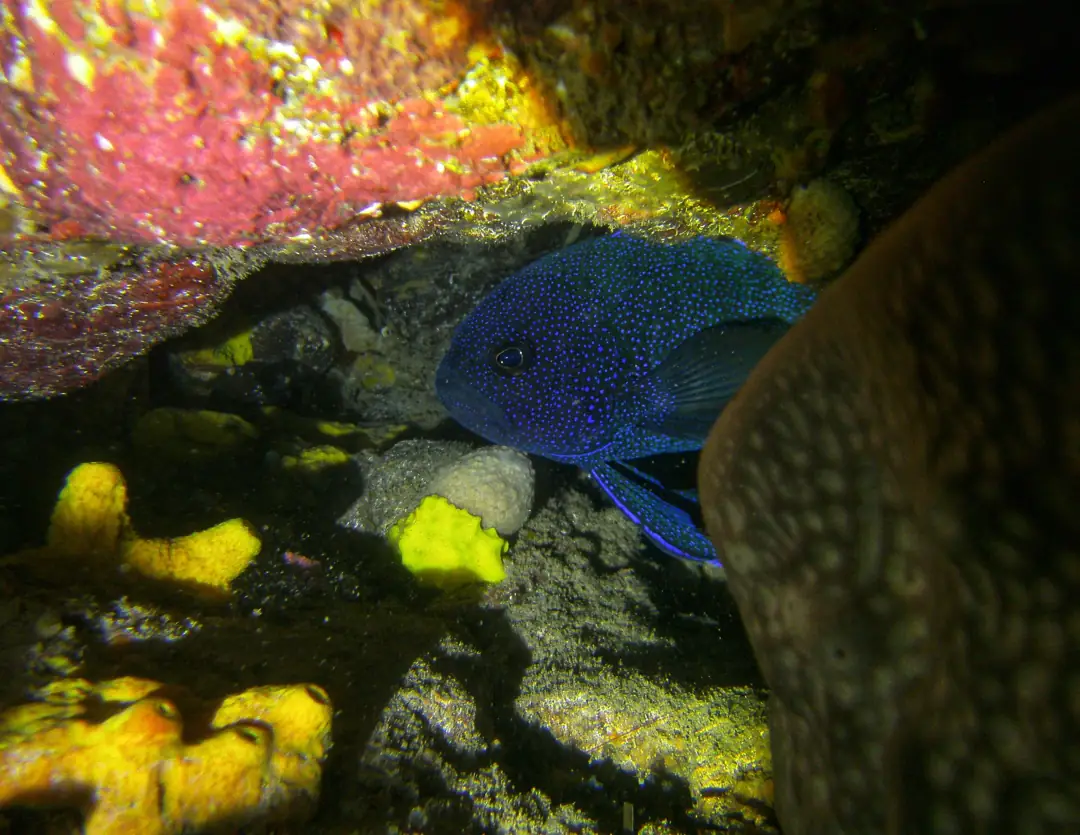
Southern Bluedevil
Paraplesiops meleagris
Calloplesiops altivelis
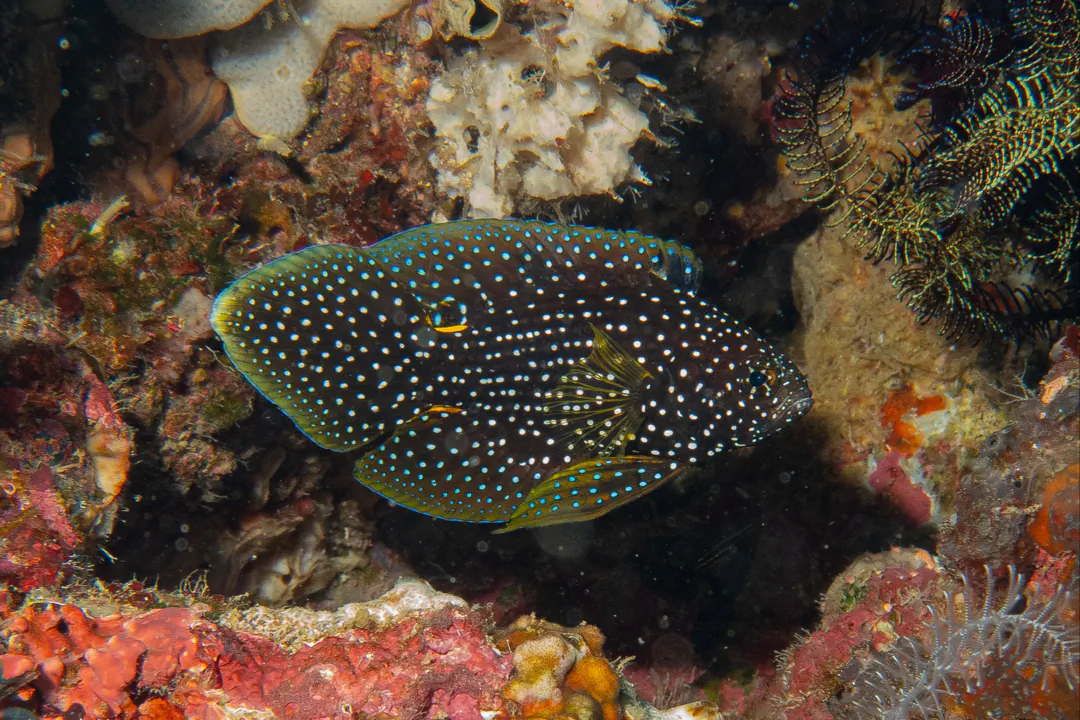
Calloplesiops altivelis is a species of reef-associated tropical marine fish in the longfin family Plesiopidae, most commonly found between 3 to 50 m deep. It is native to the Indo-Pacific Ocean. It can reach a maximum length of 20 cm.
Head and body are brownish black with small white to pale blue spots; vertical and pelvic fins dark orange-brown, with many small blue spots; blue ringed black ocellus above base of last 3 dorsal rays; yellow spots at base of upper caudal rays; pectoral rays bright yellow, fin membrane transparent. Dorsal spines (total): 11; Dorsal soft rays (total): 8-10; Anal spines: 3; Anal soft rays: 9. Characterized by having tubed lateral-line scales 19-20+9-10; depth of body 2.5-2.7 in SL; dorsal and anal fins elevated posteriorly; rounded caudal fin. The false eye which is actually the dorsal fin ocellus confuses predators because it poses an inverted image of a fish. When alarmed, this fish will poke its head into a hole and expose its tail end which mimics the head of the moray eel.
Indo-Pacific: Red Sea and East Africa to Tonga and the Line Islands.
Adults are usually found near reefs, and in caves and crevices along drop-offs. The comet is nocturnal by nature, and will hide under ledges and in holes by day. During night time, it leaves its hiding place and swims along the reef searching for food. They possess an eye-like shape which is actually the dorsal fin. When in danger, this fish will poke its head into a hole and expose its tail end, which mimics the head of the moray eel.
Comets are predators, feeding on crustaceans and small fish. They catch their prey by approaching it swimming sideways and then waiting for the prey to try to escape. As the prey tries to escape on the side of the fish, it will escape towards the fish's mouth half the time.
Comets are known to be difficult to feed in captivity, as they will generally only accept live foods. Moreover, they require time to stalk their prey. Therefore, if they are in an aquarium with other predatory fish (e.g. lions and groupers), they might starve, as they are not fast enough to get a good share of the food. Comets have been successfully bred in captivity.
© Donovan WoodAll rights reserved Comet has no known danger to humans. However, always observe marine life responsibly.
Comet can be found at depths of up to 110 meters.
Download Seabook free for iOS and Android.