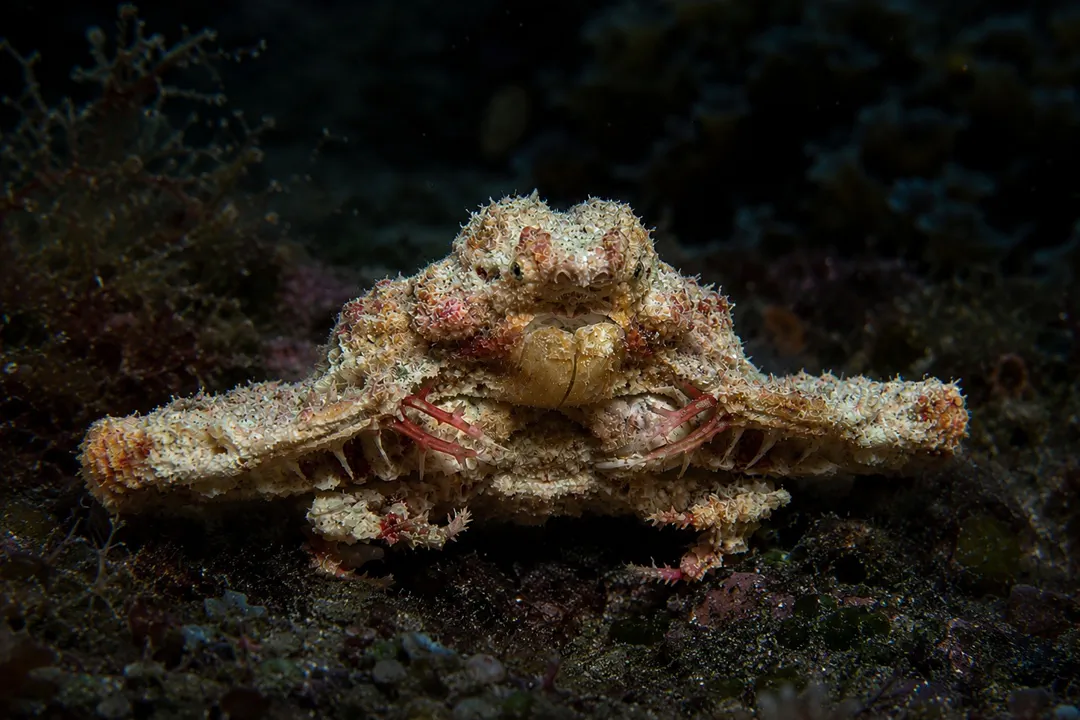
Thyrolambrus efflorescens
- Max depth
- 66 m
- Found in
- 17 regions
How to recognise it
- Colours
- brownorangered
Diagnosis
Carapace dorsal surface tuberculate, tubercles paxilliform, tips intensely stellate, forming reticulate pattern. Lateral margins of sternum segments 4–6 with a long sharp spine on each side. Chelipeds manus slender, inner and lower margins each with a row of sharp, curved spines, spines very slender; fingers very thin, forceps-like. Male sternal pit bottom tuberculate, tubercles paxilliform. Ambulatory legs with wellspaced irregular paxilliform tubercles.
Distribution
The type specimens was described from the Andaman Sea (Alcock 1895) and subsequently reported from Mauritius (Michel 1964). The specimens from the Philippines, Guam and Tuamotu Archipelago represent new records.
Discussion
Thyrolambrus efflorescens is the only represensative of the genus in the Indo-West Pacific. It can easily be distinguished from the other two species by the unique shape of its cheliped manus. The manus of T. efflorescens is thinner than in the other two species, and has longer and thinner spines on the inner and lower margins. The form of the cheliped fingers is diagonostic of T. efflorescens, both of which are extremely thin, slender and forceps-like in contrast to the comparatively thicker, more robust fingers of T. astroides and T. verrucibrachium. Thyrolambrus efflorescens most closely resembles T. astroides and was once considered a synonym of the latter species (Michel, 1964). The texture of the dorsal surface of the carapace of T. efflorescens, however, is more densely tuberculate than in T. astroides. The tubercles of T. efflorescens are also paxilliform with far more numerous tips than that of T. astroides. The teeth on chliped of T. efflorescens are long, slender and sharp, as opposed to those of T. astroides, which are short, blunt and broadly triangular (compare Figs. 30b and 30c). Interestingly, Serène (1980) reported that L. Zehntner had correctly recognised this species as new about one year (ca. 1894) before the publication of T. efflorescens by Alcock (1895a). Apparently, Zehntner never published his new species (Serène 1980). Zimmerman & Martin (1999) reported a specimen from Mauritius, which they tentatively identified as T. astroides. That specimen could well be T. efflorescens except for the fact that they did not mention the structure of the cheliped fingers. If the cheliped fingers were indeed very slender and forceps-like, it is very likely that that specimen is T. efflorescens rather than T. astroides.
World Distribution (Tan & Ng, 2007: 160) - Andaman Sea, Mauritius, Philippines, Guam, French Polynesia (Tuamotu). Also Mayotte.
Environment: Marine - Substrat/Association: Hard bottom (rock and rubbles)
Vertical range: Shallow-waters (0-100 m) - Min-Max observed: 1-66 m
Mayotte data Thyrolambrus efflorescens (Alcock, 1895) Material examined — Mayotte KUW 2009, coll. J. -M. Bouchard, 2008-2011, 1 M 8 x 12 mm, MNHN-IU-2013-7226, det. & photos J. Poupin 16/01/2013, specimen in École Navale/IRENav collection, September 2017. Remarks — A key to Thyrolambrus species, with photographs, is in Tan & Ng (2007). Thyrolambrus efflorescens is very similar and can be considered as a geminate species of western Atlantic T. astroides Rathbun, 1894. Geographic and depth ranges — Mayotte (this work), Mauritius to Guam, French Polynesia; subtidal to 66 m.
Central Pacific data (Wallis & Futuna, Polynesia, Clipperton, Easter Island) Thyrolambrus efflorescens - Tan & Ng, 2007: 160, fig. 30b (coll. G. Paulay, Rangiroa, 12-17m). - Moorea Biocode project
Comment(s) on data In the Carribean the sister species, sometimes considered as a synonymy, is Thyrolambrus asteroides Rathbun, 1894.
Questions
Is Thyrolambrus efflorescens dangerous?
Thyrolambrus efflorescens has no known danger to humans. However, always observe marine life responsibly.
Where can you find Thyrolambrus efflorescens?
How deep does Thyrolambrus efflorescens live?
Thyrolambrus efflorescens can be found at depths of up to 66 meters.