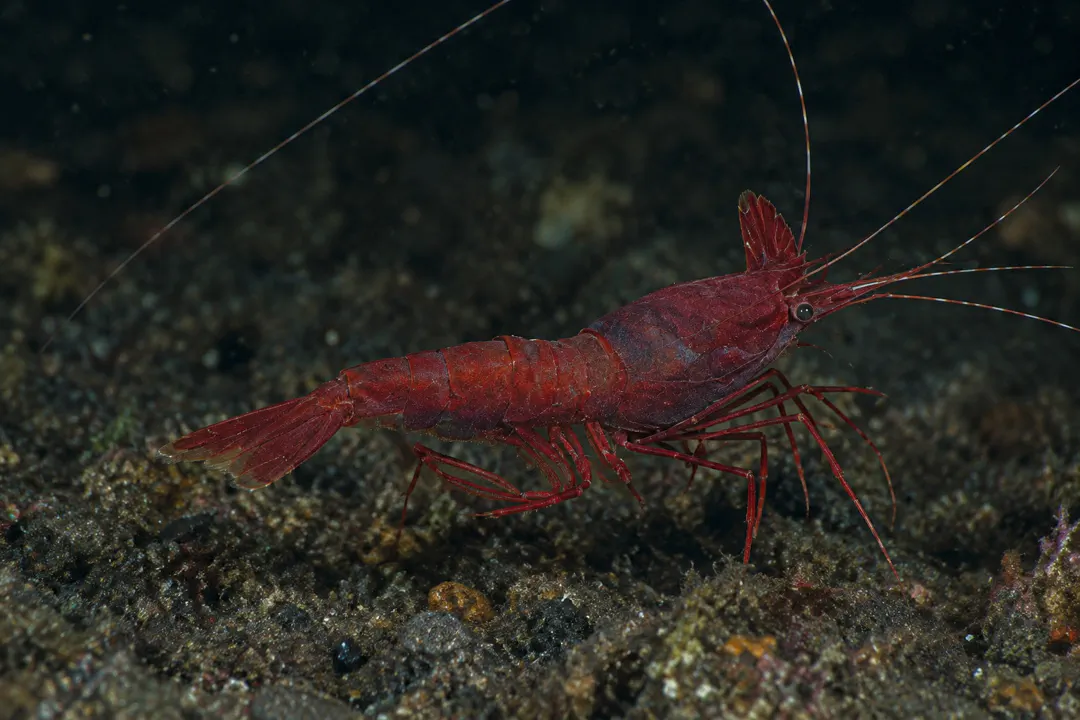
 © Stas KuryanAll rights reserved
Longarm Prawn
Heteropenaeus longimanus
Cerataspis monstrosus
Cerataspis monstrosus, known commonly as the monstrous gamba prawn, belongs to the family Aristeidae and is broadly distributed across the Atlantic, Indian, and Pacific oceans.
Cerataspis monstrosa was first described by John Edward Gray in 1828 in Spicilegia zoologica as a new, primitive crustacean in the group Leptostraca. The name Cerataspis is derived from Greek elements meaning 'horned shield' or 'horned armor,' while the epithet monstrosa is Latin for 'monstrous,' reflecting its anomalous appearance. Initially treated as a distinct primitive crustacean, molecular phylogenetic work published in 2012 demonstrated that C. monstrosa is an early developmental stage of the deep-water aristeid shrimp Plesiopenaeus armatus. WoRMS lists several junior subjective synonyms for Cerataspis monstrosa, including Plesiopenaeus armatus, Aristeus armatus, Cerataspis petitii, Cryptopus defrancii, and Lepsia tuberculosa. The principle of priority supports retaining C. monstrosa as the valid name, as it was published before the adult-associated name Plesiopenaeus armatus in 1881.
The larva has a thick, compact, heavily armored body with an unusually robust, 'monster-like' outline rather than the slender form of most ordinary shrimp larvae. It is usually described as having red to reddish-purple armored body regions, with conspicuous bright or neon-blue horns. The most distinctive visible feature of the larva is its prominent, backward-curving horn-like projections on the head. The combination of a compact armored body, large blue horn-like projections, and red or reddish-purple coloration is more diagnostic than colour alone.
The species is primarily oceanic and deep-sea, with larvae occurring in surface or midwater plankton and adults found near the seafloor. Adults are associated with soft muddy or silty bottoms, including abyssal plains, and some records also come from cold-seep habitats. Reported records for the species range from surface waters for early larvae to approximately 6,474 m for deep-sea individuals, with adult records including roughly 752–5,413 m. The reef-zone designation is not applicable or currently unsupported for this species, which is better characterized as a pelagic-to-abyssal, soft-substrate species.
Most available observations of Cerataspis monstrosus come from remotely operated or baited lander deployments, not direct diver encounters. There is no reliable evidence establishing a diurnal, nocturnal, or diel activity pattern for the species. Cerataspis monstrosus is usually solitary, with brief aggregations of two or three individuals recorded, and a maximum of nine seen at one deployment. At bait, the species acts mainly as a scavenger and occasionally as a predator, approaching bait by circling or apparent homing. The cited field studies provide no verified information on mating, spawning, egg carrying, larval development, parental care, or reproductive seasonality for Cerataspis monstrosus. No authoritative observations documenting the response of Cerataspis monstrosus to scuba divers or human divers have been found, making its reaction to divers unknown.
Adults identified as C. cf. monstrosus primarily engage in scavenging, with occasional predation. They locate bait, inspect it with their walking legs, and use their mandibles to tear off pieces of flesh. Adults have also been observed seizing and carrying away amphipods, indicating predatory behavior. The feeding habits of larvae remain unknown, as the available literature does not establish what they eat or describe their feeding mechanism.
No evidence was found that Cerataspis monstrosus supports a targeted commercial or recreational fishery. No authoritative record was found of an established aquarium trade or routine public-aquarium husbandry for Cerataspis monstrosus. No reliable source documents human consumption, culinary use, or food-safety evaluation for Cerataspis monstrosus, indicating it should not be regarded as an established edible seafood species. No documented venom, toxin, aggressive behavior, or human injury has been found associated with Cerataspis monstrosus. The species is described as rare and poorly known, and its conservation status should be reported as not assessed or not located.
© Stas KuryanAll rights reserved Monstrous Gamba Prawn has no known danger to humans. However, always observe marine life responsibly.
Download Seabook free for iOS and Android.