Greater Weever
Trachinus draco
Max Size
See in AppMax Weight
See in AppMax Depth
150 m
Trachinus draco is a weever fish of the family Trachinidae. This venomous fish is found in the northeast Atlantic, the Mediterranean and Black Sea.
Description
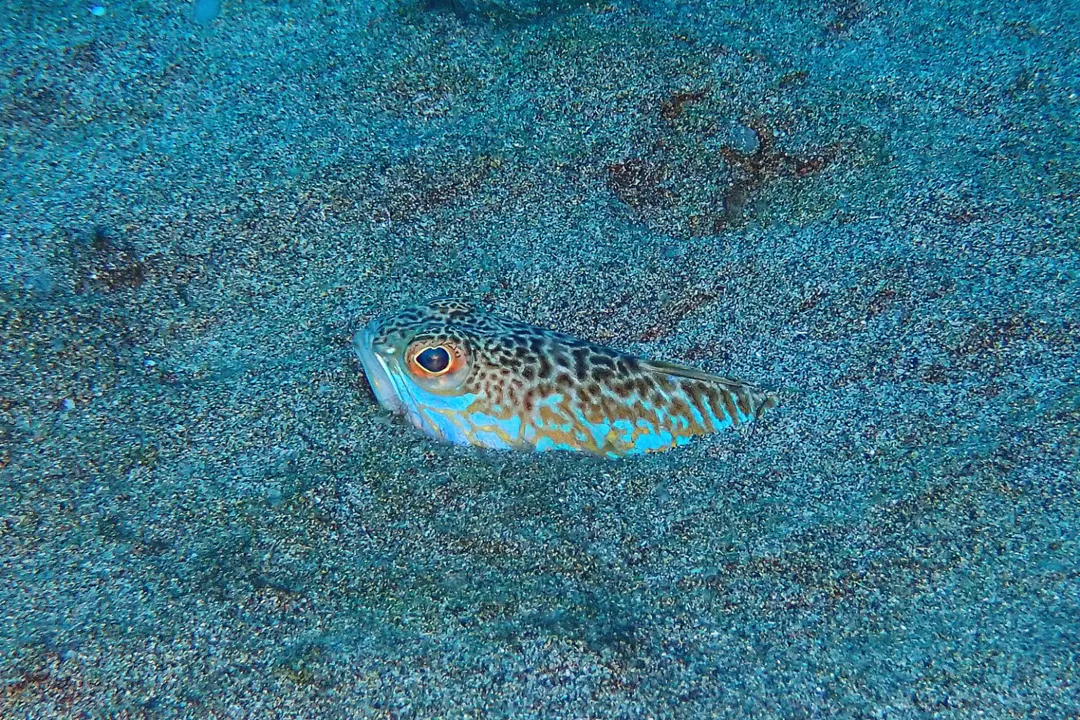
Its body is a greenish yellow or lime, to dark green and brown, on the head and back, with pale sides, and with yellowish to bluish-brown oblique lines.
The greater weever's body is elongate, tapered and laterally compressed, with a large head. Its length is up to six times its height. The upper rim of the eye has two to three small open spines, in front of each eye.
The mouth is huge and is set obliquely. The eyes are placed toward the top of the head. The dorsal fin is blackish. The second dorsal fin and anal fins have a yellow stripe running their length.
Its pectoral fin is rounded with a notch. On the first dorsal fin, both of the spines, and those of the gill covers, have venom glands attached to them. The spines are grooved, and when pressed, toxin is driven up the grooves.
It reaches up to 53 centimeters (21 in) in length and 1.86 kilograms (4.1 lb) in weight.
Sting mechanism
The interaction of two muscles (flexor and extensor) attached to the plate opercularis increases the exposed portion of the spine to facilitate the injection of venom. These two muscles are antagonistic, the contraction of one erects the spine, and thus increases its exposed portion such that the membrane surrounding the spine is not elastic, while the contraction of the other reduces the size of the exposed portion. The length of the exposed part of the spine depends on the angle of the opening of the cover.
The outer membrane of the spine presses on the venom gland during the contraction of the flexor muscle, ejecting the venom along the spine.
First aid for stings follows the general pattern for treatment of all weever stings.
Reproduction
Spawning begins in June and August. Pelagic eggs are 1 millimeter (0.039 in). Breeding season is from June to August.
Range and habitat
It inhabits the Eastern Atlantic, in the area 66° N - 27° N, 19° W - 42° E. It ranges from Norway to Morocco, Madeira and the Canary Islands, including the Mediterranean and the Black Seas. It also lives in all waters of the United Kingdom. It prefers a temperate Climate.
The greater weever, like the lesser weever, lives on muddy, sandy or gravelly bottoms, at depths up to about 150 meters (490 ft). It usually rests on the bottom, often with eyes closed, exposing the tip of the first dorsal fin. They feed at night, pelagically, feeding on crustaceans, shrimps and crabs, as well as smaller fish.
Toxicity
Venomous apparatus
The venomous apparatus of T. draco consists of one spine on each operculum and five to eight dorsal spines. The spines on the operculum point towards the cauda, or tail, and are slightly bent downwards. The opercular spines arise from the upper edge of the operculum and are connected to the operculum with one third of their complete length. The other two thirds of their length lies free along the operculum. The total length of the opercular spines is approximately 27 mm. The spine itself is “covered by an integumentary sheath”. If this sheath ruptures because there is force applied to the spine, it allows the venom to leak from the venom gland cells and to run through a deep groove along the spine and into the wound caused by the sting. Each of the dorsal spines is covered in an individual integumentary sheet. The spines are connected through a fine interspinous membrane. The spines have different length and are by that arranged in a curve like manner. The spines observed by Russel & Emery (1960) had minimum lengths of 5 mm and maximum lengths of 29 mm and were quite heterogeneous in their appearance on a microscopic level. The dorsal spines are all bent very slightly towards the tail of the fish. The mechanism of envenomation is quite similar to that of the opercular spines.
Venom glands
The glands producing T. draco’s venom are located in the derma of the fish. The venom glands are cased in connective tissue coated with a basal lamina which has a length of 0.1 μm. The venom glands are built up of polygonal cells with a long axis length of 40-50 μm. These cells show a relatively heterogeneous cytoplasm with noticeable large vacuoles and heterogeneous granular (Verdiglione, Mammola, Gargano, & Montesi, 2003). As in the tissue of the lesser weever (Echiichthys vipera / Trachinus vipera) supporting cells can be found in T. draco which develop from epidermal cells. These supporting cells form pockets inside the venom glands which are filled with differentiated glandular cells. The supporting cells most probably play a role in the cohesiveness of the venom gland and in the regeneration of the glandular cells.
Toxin
The potentially lethal protein component in the crude venom of T. draco is a 105 kDa polypeptide which is called Dracotoxin. The crude venom of T. draco has been shown to have membrane depolarizing and haemolytic characteristics. Those characteristics could be retraced to said single protein component.The depolarisation effect however could not be explained by well-established approaches. Neither does the depolarisation effect take place through Na+ or K+-channels nor through Na+-K+-ATPase activity. The weever sting is often followed by first ischemic and subsequently hyperemic effects in the tissue surrounding the sting. These effects might be related to the high concentrations of histamines and catecholamines found in the venom. While Church & Hodgson (2002) suggest a cholinesterase activity of the toxin itself, Haavaldsen & Fonnum (1963) interpreted their finding of a high concentration of cholinesterase in the venom as a sign for a cholinergic mechanism in the production of the venom because cholinesterase activity hasn't yet been described in the venoms of the animal kingdom. As Russel & Emery (1960) stated, the toxin extract of T. draco has a greyish colour but is clear in its appearance. It is said to have a “fishy taste” and “ammoniacal odor”. The pH value of the extract seems to be 6.78 and is with that slightly sour. The toxin of the closely related lesser weever T. vipera has been shown to contain 5-Hydroxy-Triptamine also called Serotonin but in the toxin of T. draco this finding could not be confirmed. The toxicity of the venom was dependent on the way of extraction. The highest toxicity was measured in live fish which were shock frozen and laired in −70 °C-freezers. Under such conditions the minimal lethal dose for mice was 1.8 μg/g while at least 110 mg could be extracted from an average sized fish.
Relationship with humans
The most common incident regarding humans is strongly connected with T. draco’ s typical behaviour: being burrowed in the sand of shallow waters. Especially in the summer it is quite possible for a careless bather to step, jump or fall on the venomous spines of the greater weever. The other occasion where humans are at risk to get stung by T. draco is when fishermen are handling the fish if caught in a net.The venom of the greater weever is best-known for the excruciating pain it provokes a short period of time after the initial sting which can last from a few hours to days. There are in fact cases reported, in which victims of a weever sting were still affected by it after a period of 4 months, even if this seems to be a rare scenario.The pain can in some cases reach up to a 10/10 on the numeric rating scale. In a reported case from 1782, a fisherman who had been stung, amputated his own finger to relieve the pain.Even if there are reported cases of fatal accidents with T. draco, it is widely believed that those are due to secondary infections and sepsis rather than to the toxin itself.
Treatment
There are as many recommended treatments for a sting of the greater weever as there are fishermen who were stung by them. These recommendations reach from the application of hot water or vinegar to more arcane methods like fish liver, tobacco juice or the suggestion of “burning the devilish weever, swear and pray”. The modern medicine does in fact recommend the application of any kind of heat preferably to souse the affected limb into hot water (40-42 °C). Beside this first aid attempt to ease the pain it is recommended to clean the wound and to see a physician because antibiotics, further analgesics or even a tetanus prophylaxis might be appropriate.
Importance to humans
The greater weever has minor commercial importance, and is a gamefish. It can be found in aquariums, mainly those that are public. This weever has medium resilience. The minimum population (that is doubling) time 1.4 to 4.4 years (assuming tm=2-4).
It is eaten fresh or frozen, can be fried, broiled, boiled and baked.
As sport
The UK Record Weights from rod/line from shore as of 2010 is 1 lb-07oz-15dr, and on boat 2 lb-00oz-13dr.
Colors
Habitat and Environment
Benthic
Mud and Sand
Conservation status
(LC) Least concern
Edible
See in SeabookVenomous
See in SeabookDanger to human
See in SeabookFrequently Asked Questions
Is Greater Weever dangerous?
Greater Weever is classified as: Yes, Yes. Always exercise caution and keep a safe distance.
Where can you find Greater Weever?
How deep does Greater Weever live?
Greater Weever can be found at depths of up to 150 meters.