
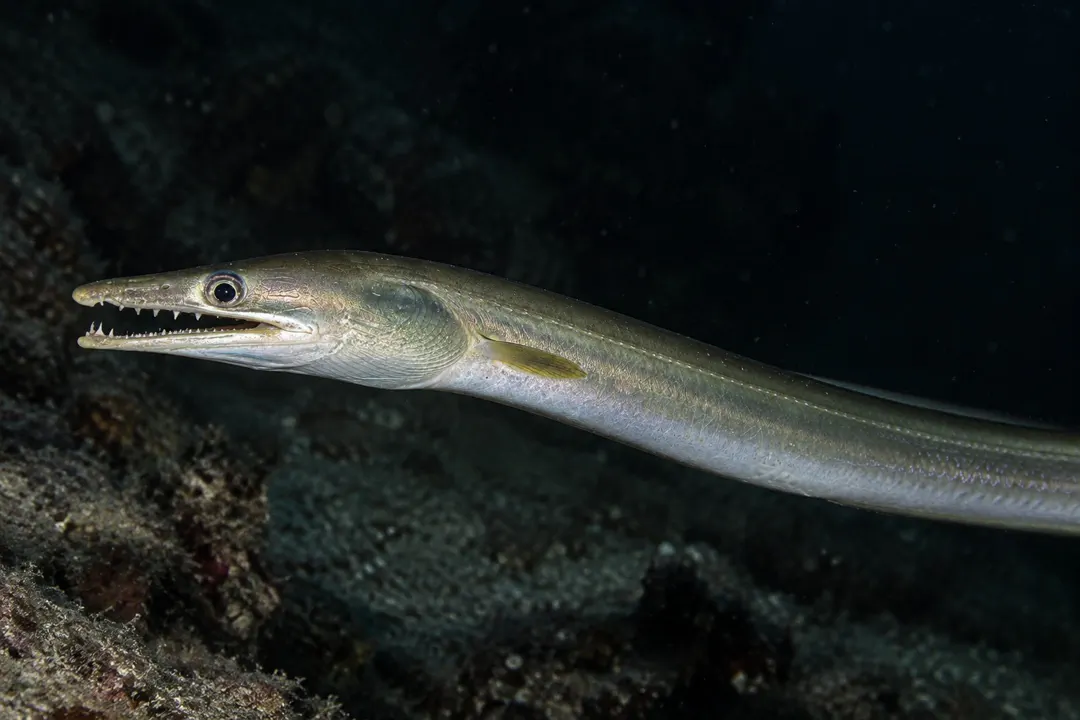
Common Pike Eel
Muraenesox bagio
Congresox talabonoides
Congresox talabonoides, the Indian pike conger, common eel, conger-pike eel, daggertooth pike-conger or Indian putyekanipa, is an eel in the family Muraenesocidae (pike congers). It was described by Pieter Bleeker in 1853. It is a marine, tropical eel which is known from the Indo-Western Pacific, including Somalia, India, Sri Lanka, Indonesia, the Philippines, Hong Kong and Taiwan. It dwells at a depth range of 800 to 875 metres (2,625 to 2,871 ft), and inhabits soft sediments in coastal waters and estuaries. Males can reach a maximum total length of 250 centimetres (98 in), but more commonly reach a TL of 180 centimetres (71 in).
Congresox talabonoides is amphidromous; spawning is reported in India to occur in April–May and September–October. Its diet consists of bony fish, shrimp, and other benthic crustaceans. It is a commercial fish in markets, and is mostly sold fresh.
Indian Pike-conger has no known danger to humans. However, always observe marine life responsibly.
Indian Pike-conger can be found at depths of up to 875 meters.
Download Seabook free for iOS and Android.