 © Lesley ClementsAll rights reserved
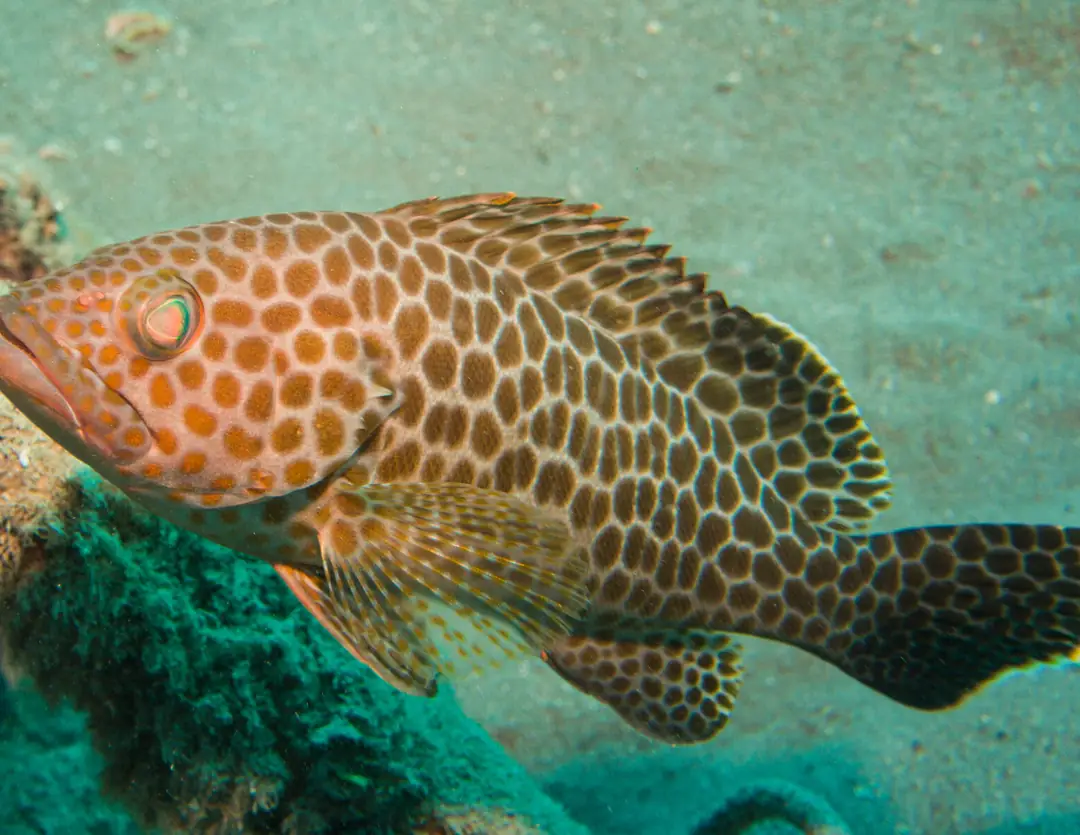
Areolate Rock Cod
Epinephelus areolatus
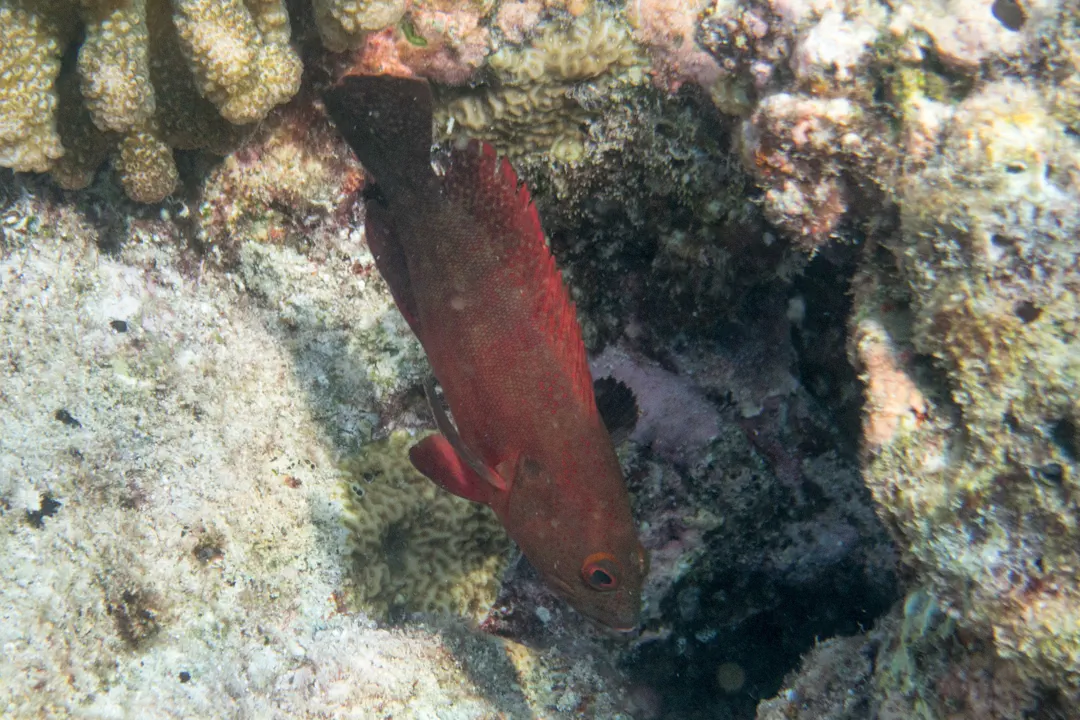
Cephalopholis nigripinnis
Cephalopholis nigripinnis is a species of marine fish in the family Serranidae.
Cephalopholis nigripinnis has a body which is less deep than the head is long with the body being around a third as deep as the standard length. The profile between the eyes is convex and the rounded preopercle has a serrated edge and a fleshy lower edge. The maxilla extends beyond the eye. The dorsal fin has 9 spines and 14-16 sodt rays while the anal fin has 3 spines and 8-9 soft rays. The caudal fin is rounded and the pelvic fins do not extend to the anus. This species is an overall red colour becoming darker towards its tail with some spotting and barring, but this is normally rather faint. The tail fin is dark and can be almost black and is covered in small pale spots while the pectoral fins are redat their base and darken towards the margin. In the Comoros Islands there are fish that are coloured almost black to match their dark coloured habitat. There is a prominent brown spot on the opercle. At a maximum total length of 28 centimetres (11 in) this is a small grouper species.
Cephalopholis nigripinnis is distributed in the western Indian Ocean along the eastern coast of Africa from Kenya south as far as Europa Island and South Africa, as well as the Seychelles, Mascarenes. Madagascar and the British Indian Ocean territory. Farther east they are found in the Maldives and off Sri Lamka and in the Andaman Sea south to Sumatra. The only place they are found in Australia is Christmas Island.
Cephalopholis nigripinnis is common wherever it occurs and lives in areas with plentiful coral where they feed on small fishes and crustaceans. It occurs at depths down to 60 m.
Cephalopholis nigripinnis was first formally described as Serranus nigripinnis in 1828 by the French zoologist Achille Valenciennes (1794-1865). This species has been regarded as a synonymous with Cephalolophis urodeta but is now largely accepted as a valid species. The two taxa are most allopatric but do occur together around Christmas Island where they hybridise.
© Lesley ClementsAll rights reserved 
 © Lesley ClementsAll rights reserved
 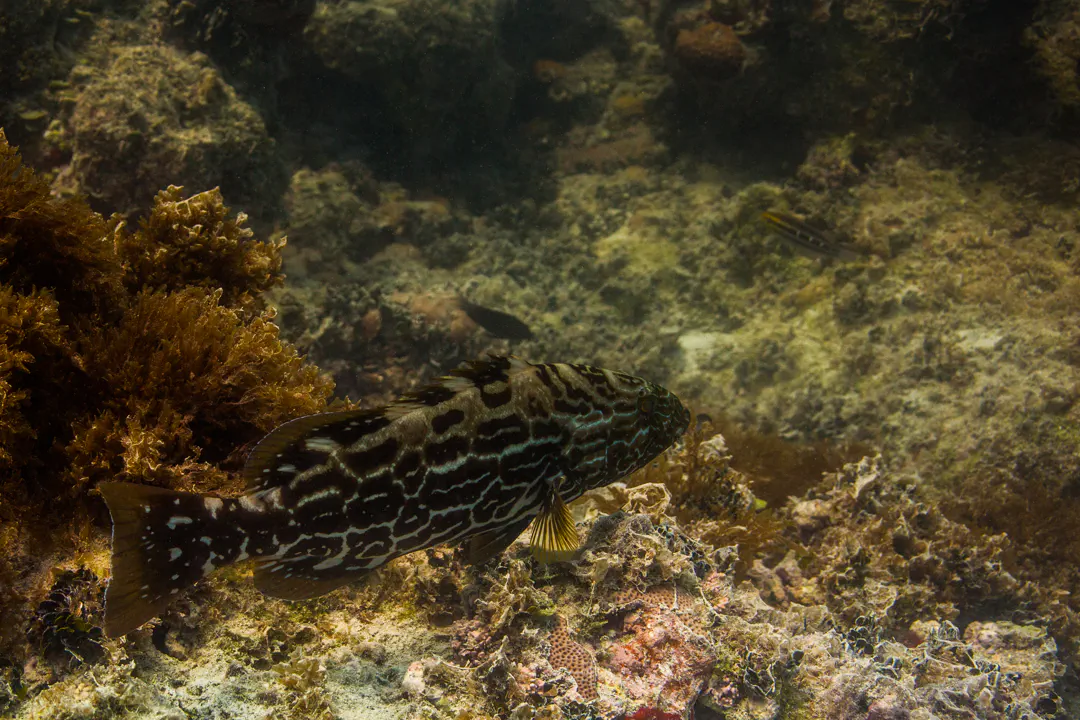 © João D'AndrettaCC BY 4.0 · iNaturalist
 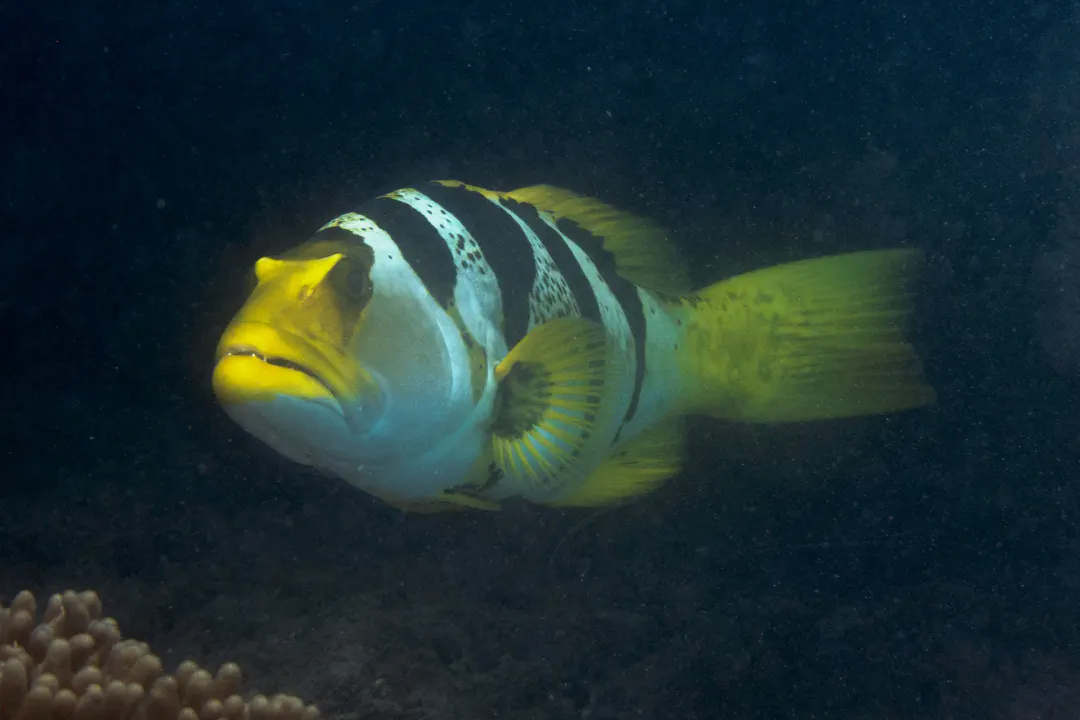 © Ewout KnoesterCC BY-SA 4.0 · iNaturalist
 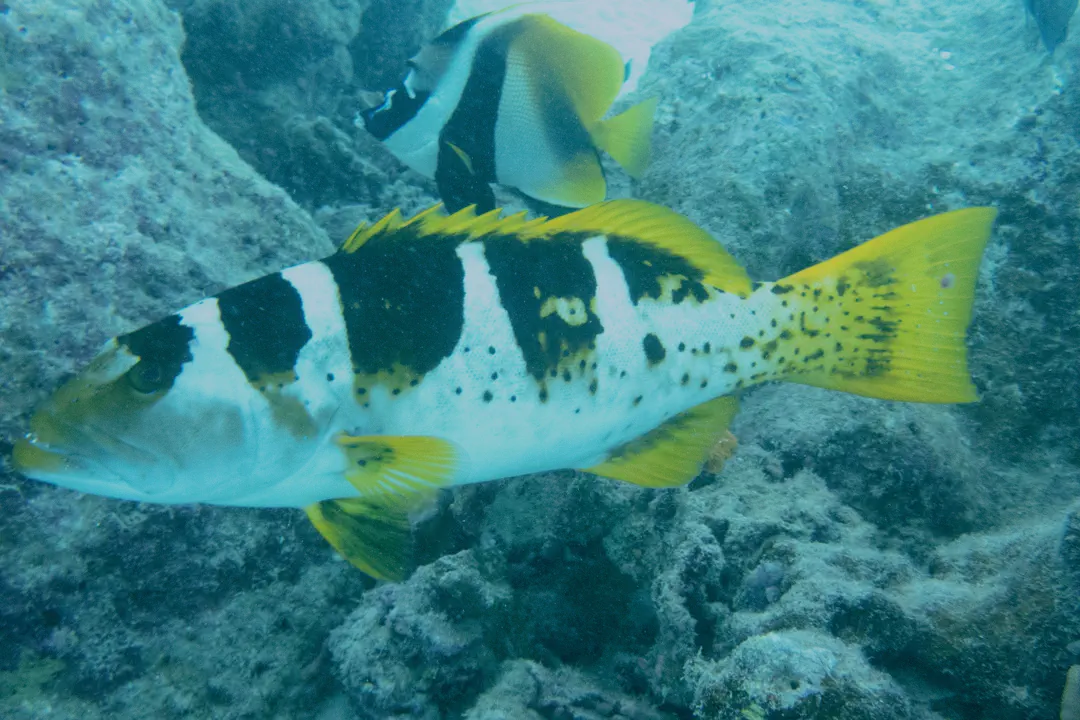 © Logan JonesCC BY 4.0 · iNaturalist
 Darkfin Hind (juvenile) has no known danger to humans. However, always observe marine life responsibly.
Darkfin Hind (juvenile) can be found at depths of up to 60 meters.
Download Seabook free for iOS and Android.