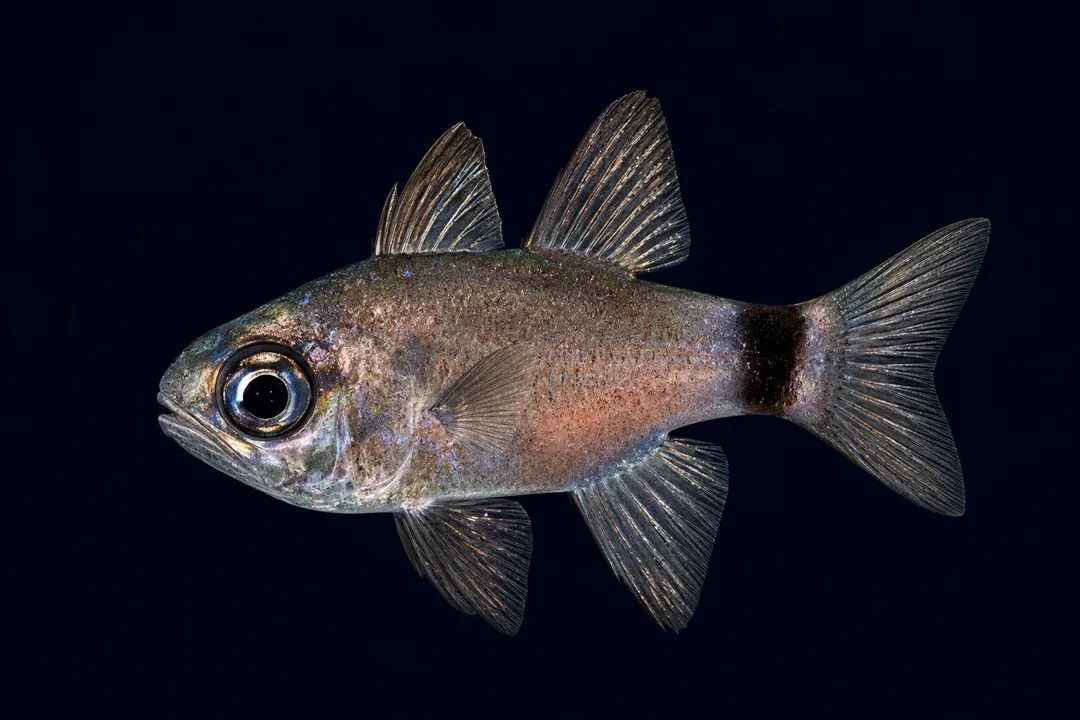
Banda Cardinalfish
Nectamia bandanensis
Cheilodipterus artus
Cheilodipterus artus, known commonly as the Wolf Cardinalfish, belongs to the family Apogonidae and is found in the Indo-Pacific region, ranging from East Africa to the Tuamotu Islands, north to the Ryukyu Islands, and south to the Great Barrier Reef.
Cheilodipterus artus was first described by James Leonard Brierley Smith in 1961. The original name was Cheilodipterus artus Smith, 1961, and the type locality is Mahé, Seychelles. The genus name Cheilodipterus derives from Greek cheilos (“lip”), di (“two”), and pteryx (“fin” or “wing”). The species epithet artus is Latin for “narrow,” “tight,” or “restricted.” Current major databases treat C. artus Smith, 1961 as the accepted name and do not list a formal species synonym. It has remained in Cheilodipterus; Gon’s 1993 revision retained it as C. artus. Cheilodipterus lachneri australis Smith, 1961 appears in some non-authoritative aquarium material, but it is not listed as an accepted synonym by WoRMS or FishBase.
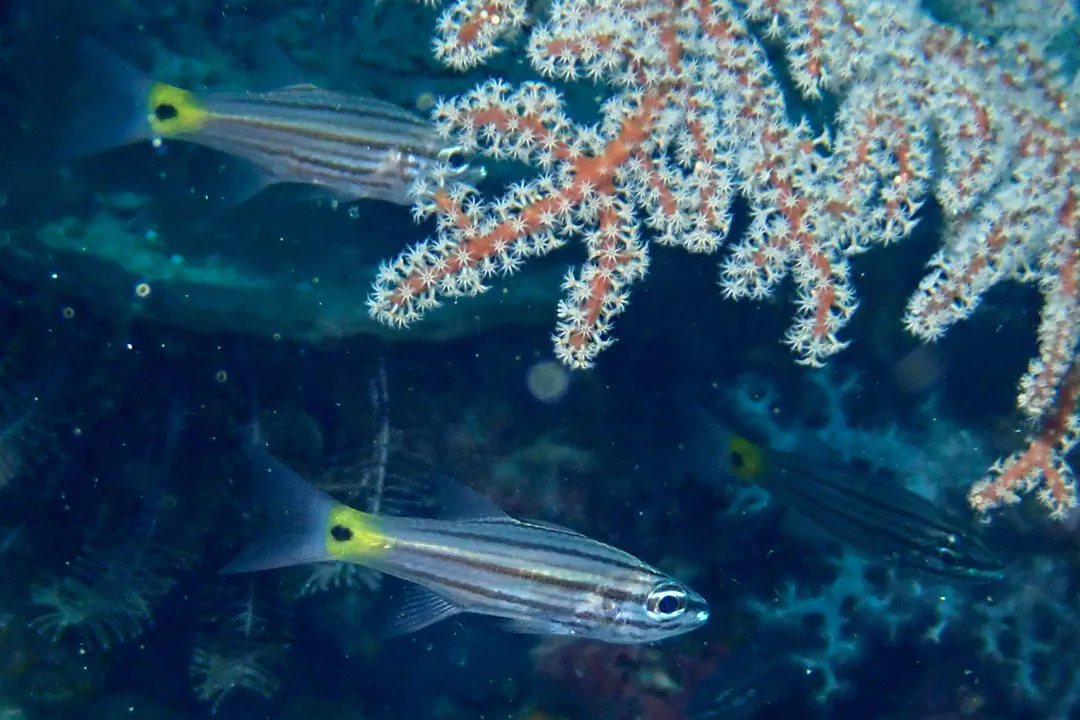
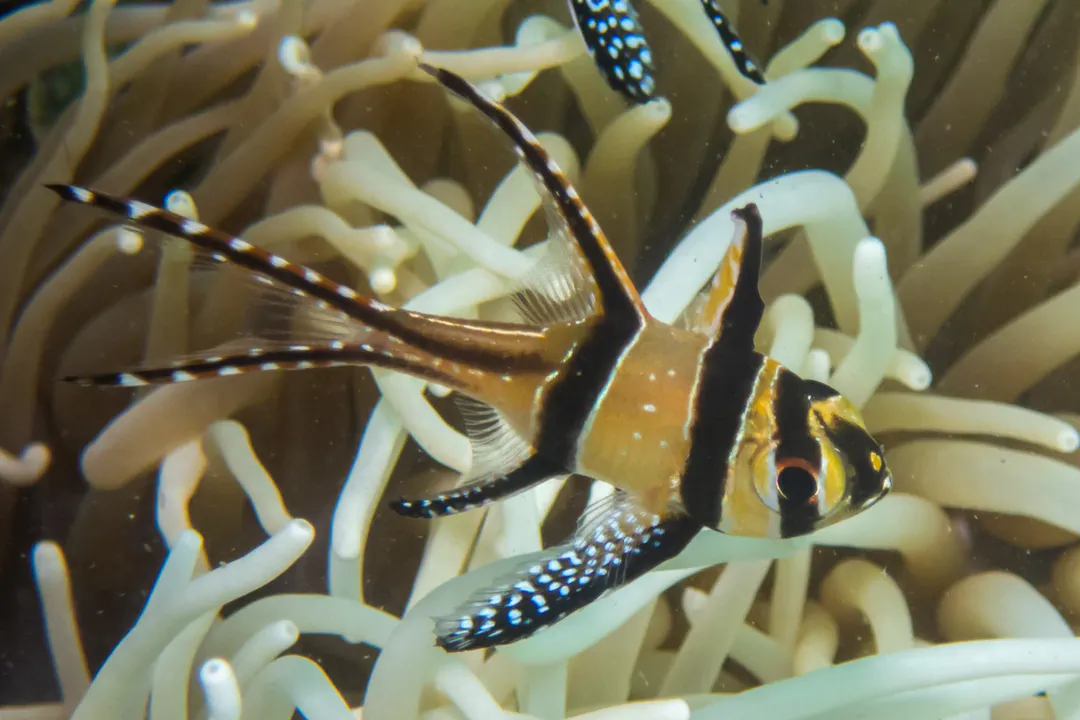
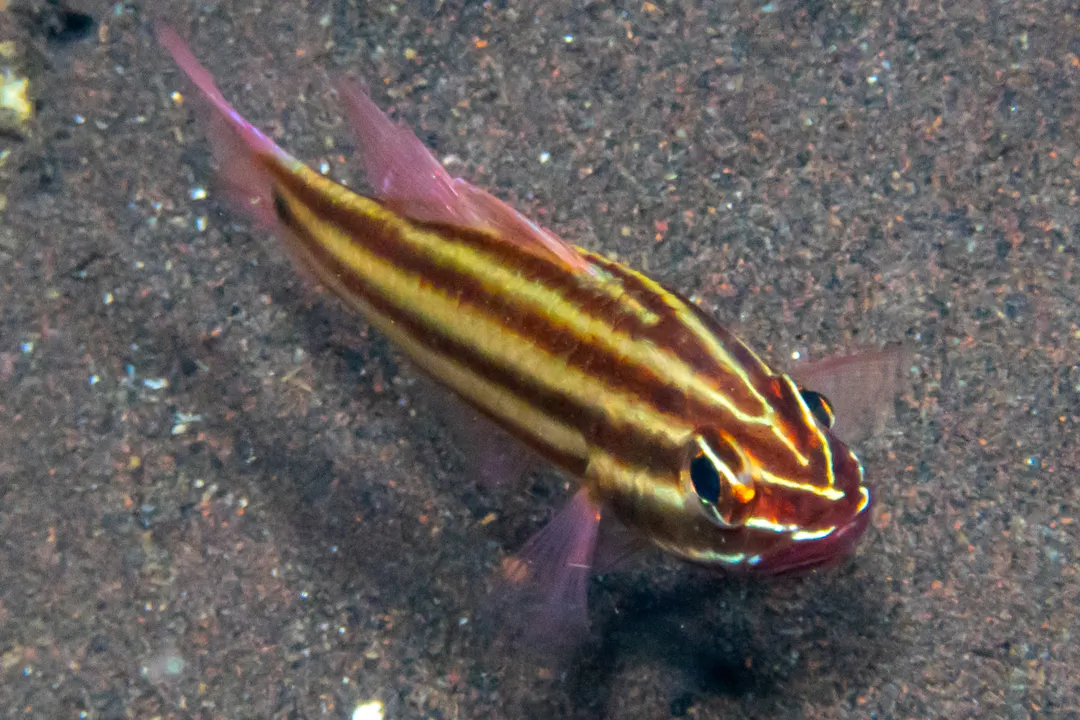
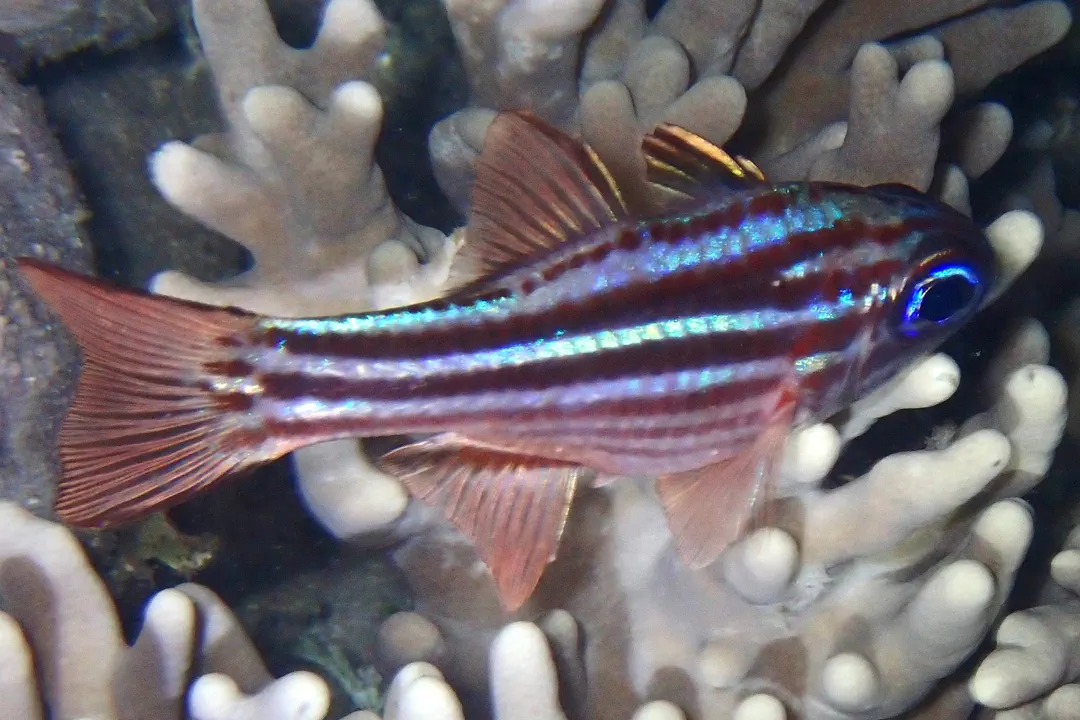
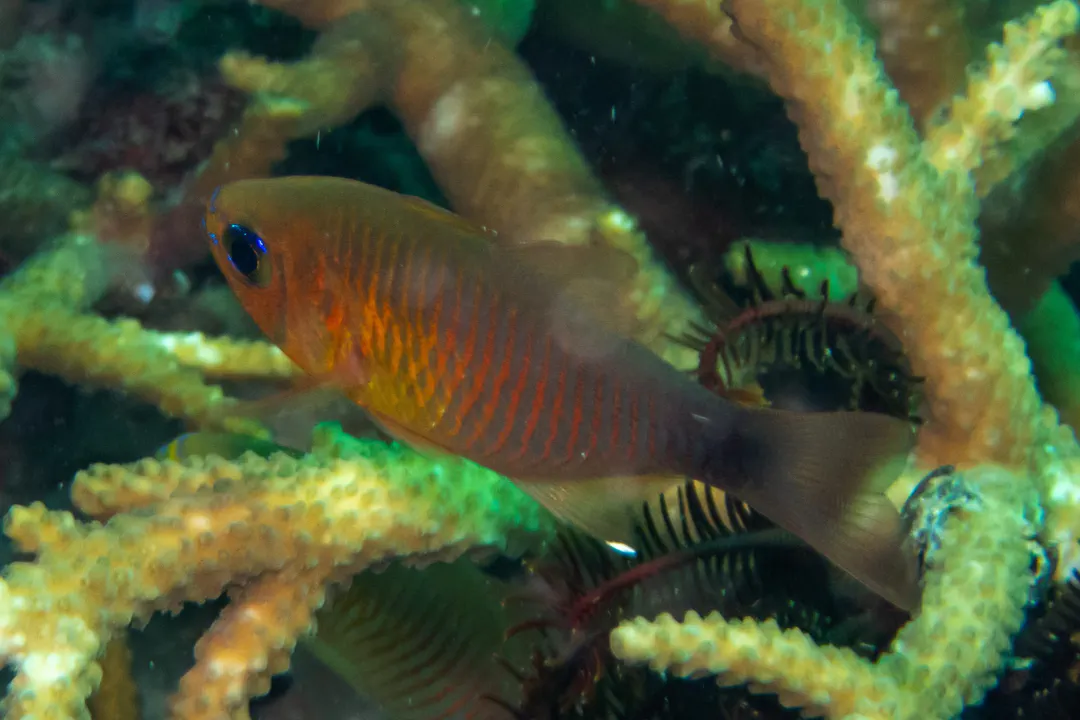
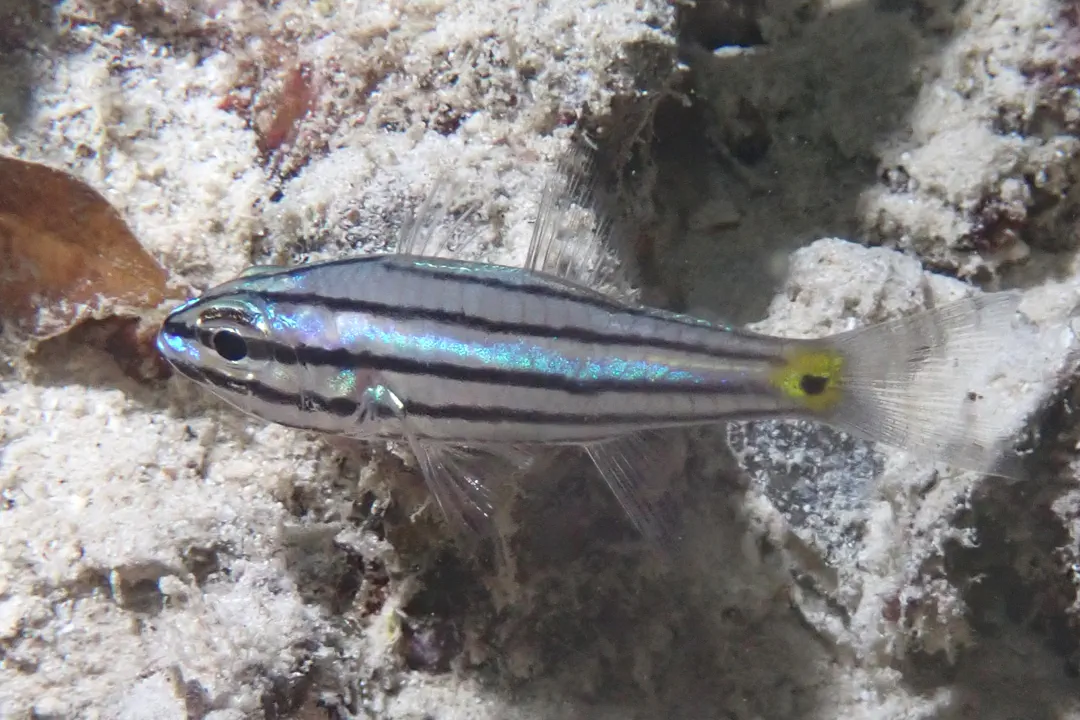
The Wolf Cardinalfish has a mauve to pale-grey ground colour with eight reddish-brown longitudinal stripes along its body. Adults exhibit a blackish to brown base on the caudal fin, which is a distinguishing feature from similar species. The species has a relatively short and deep body that is compressed from side to side, with a maximum body depth about one-quarter to one-third of its standard length. It possesses seven dorsal spines, nine dorsal soft rays, two anal spines, and eight anal soft rays. Juveniles of the species can be identified by a small black spot surrounded by a larger golden blotch on the caudal peduncle. The Wolf Cardinalfish can be distinguished from Cheilodipterus intermedius by its distinctly dark tail base in larger individuals. Compared to Cheilodipterus nigrotaeniatus, the Wolf Cardinalfish has narrower reddish-brown stripes rather than broader black stripes with yellow in between. Identification of the Wolf Cardinalfish should not rely solely on the presence of eight stripes; it is important to confirm the combination of a relatively deep body, reddish-brown stripes, and a dark caudal-fin base in larger specimens.
The Wolf Cardinalfish is a tropical, reef-associated marine fish that inhabits sheltered coastal bays, lagoon patch reefs, and reef slopes. It forms small, loose groups in caves or immediately above branching corals. The species is primarily observed at depths ranging from 5 to 20 m in sheltered bays and lagoon reefs, although it has a broader depth range of 3 to 158 m. The Wolf Cardinalfish occurs above both reef and sand habitats while foraging at night. It is associated with complex hard-reef structures, including caves, rocky overhangs, and branching corals. The geographic distribution of the Wolf Cardinalfish extends from East Africa and Madagascar eastward to the Tuamotu Islands, north to the Ryukyu Islands, and south to the Great Barrier Reef.
The Wolf Cardinalfish is primarily nocturnal, resting in caves or among branching corals during the day and foraging after dusk. It commonly forms small, loose aggregations in caves or just above coral branches, but it is also sometimes seen alone. The species is a mouthbrooder, with courtship and spawning involving a distinct male–female pair, and the male incubates the eggs in his mouth. Species-specific data on the Wolf Cardinalfish's reaction to divers are limited, but observations suggest it shows little response to diver presence when moving between resting sites under moonlight. Direct published studies testing the Wolf Cardinalfish's responses to divers, including flight distance or tolerance thresholds, were not identified.
The Wolf Cardinalfish is a carnivorous predator that feeds mainly on small fishes, particularly the clupeid Spratelloides delicatulus. It captures prey directly with rapid strikes rather than filtering or grazing. The species is primarily nocturnal, foraging after dark and moving into the water column to pursue prey. There is limited evidence for substantial crustacean consumption in the Wolf Cardinalfish's diet, although aquarium sources commonly recommend mysid shrimp and other small meaty foods.
The Wolf Cardinalfish is landed in small numbers in at least some regional fisheries, but there is no evidence indicating it is a major food fishery. In India, reported capture methods for the Wolf Cardinalfish include hand nets and surround nets. The species is collected and sold for the marine aquarium trade, valued for its small size and reef-associated habits, although the scale and sustainability of this trade are not well quantified. No authoritative source documents the Wolf Cardinalfish as an important edible or regularly marketed food fish, and its edibility should be regarded as not established. The species is listed as harmless and has no documented venomous, poisonous, or otherwise significant human hazard. The global IUCN Red List assessment for the Wolf Cardinalfish is Least Concern (LC), assessed in 2021, indicating it is not currently at risk of extinction. The species is not evaluated under CITES, but Singapore’s national Red Data Book lists it as Data Deficient, which is a local assessment and does not replace the global IUCN category.
 © portioidCC BY 4.0 · iNaturalist
  © portioidCC BY 4.0 · iNaturalist
  Jean-Paul BoerekampsCC0 · iNaturalist
  © portioidCC BY 4.0 · iNaturalist
  © Roger RittmasterCC BY 4.0 · iNaturalist
 Wolf Cardinalfish has no known danger to humans. However, always observe marine life responsibly.
Wolf Cardinalfish can be found at depths of up to 158 meters.
Download Seabook free for iOS and Android.