 © Heather Dawnstar SabinCC BY 4.0 · iNaturalist
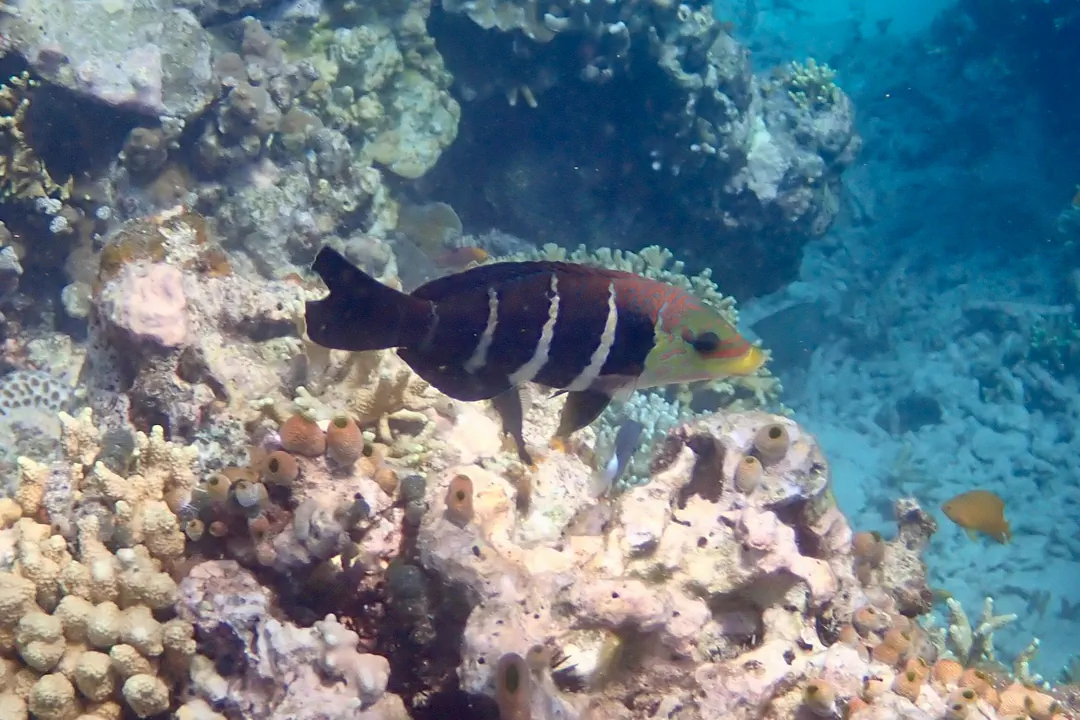
Barred Thicklip (female)
Hemigymnus fasciatus
Halichoeres hortulanus
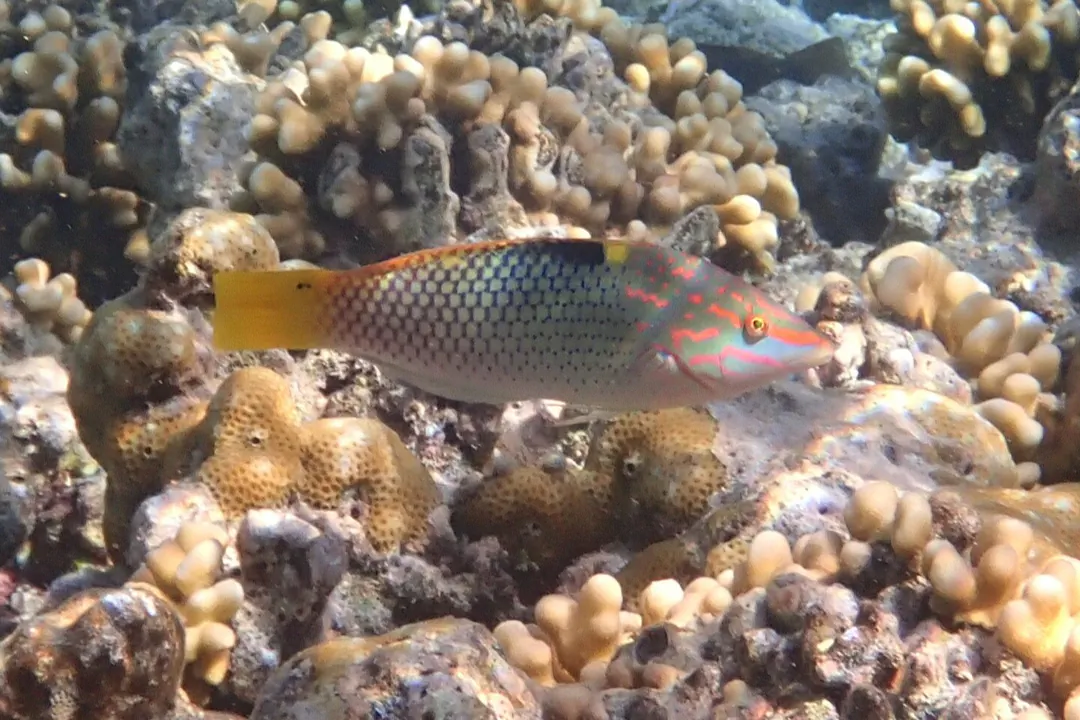
The checkerboard wrasse, Halichoeres hortulanus, is a fish species belonging to wrasse family native to the area including the Indian Ocean to central Pacific Ocean.
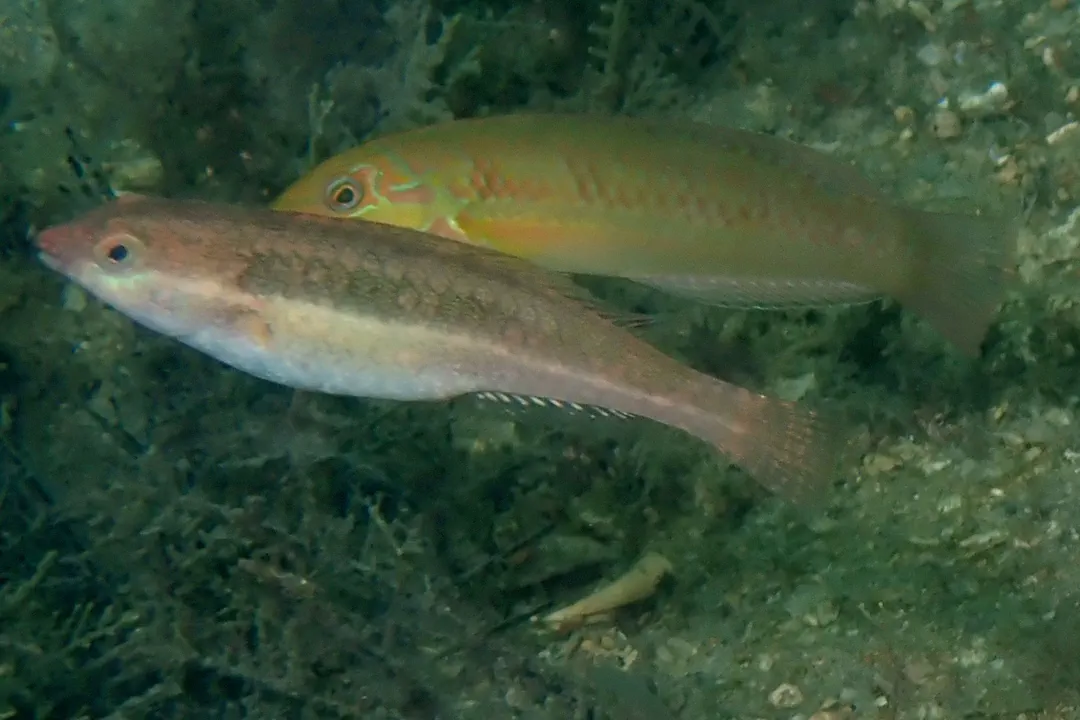
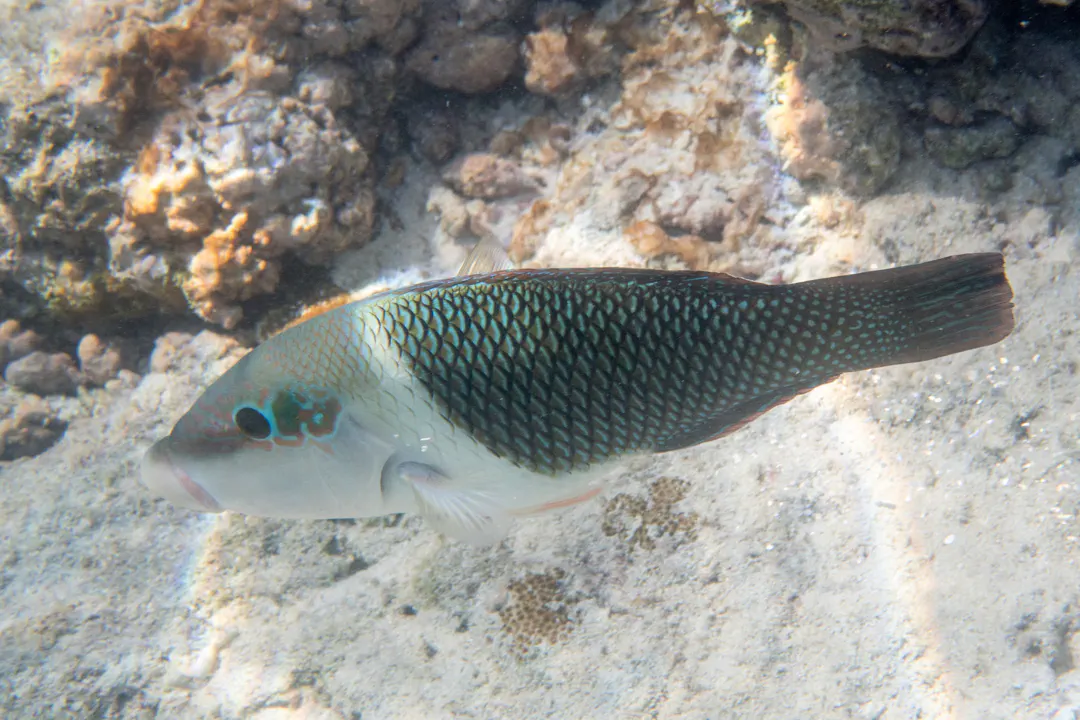
The checkboard wrasse is a small sized fish that can reach a maximum length of 27 cm. Both, its sex and appearance change during its life and the colouring at each stage is rather variable even according to the distribution area. The body is thin, relatively lengthened and its mouth is terminal.
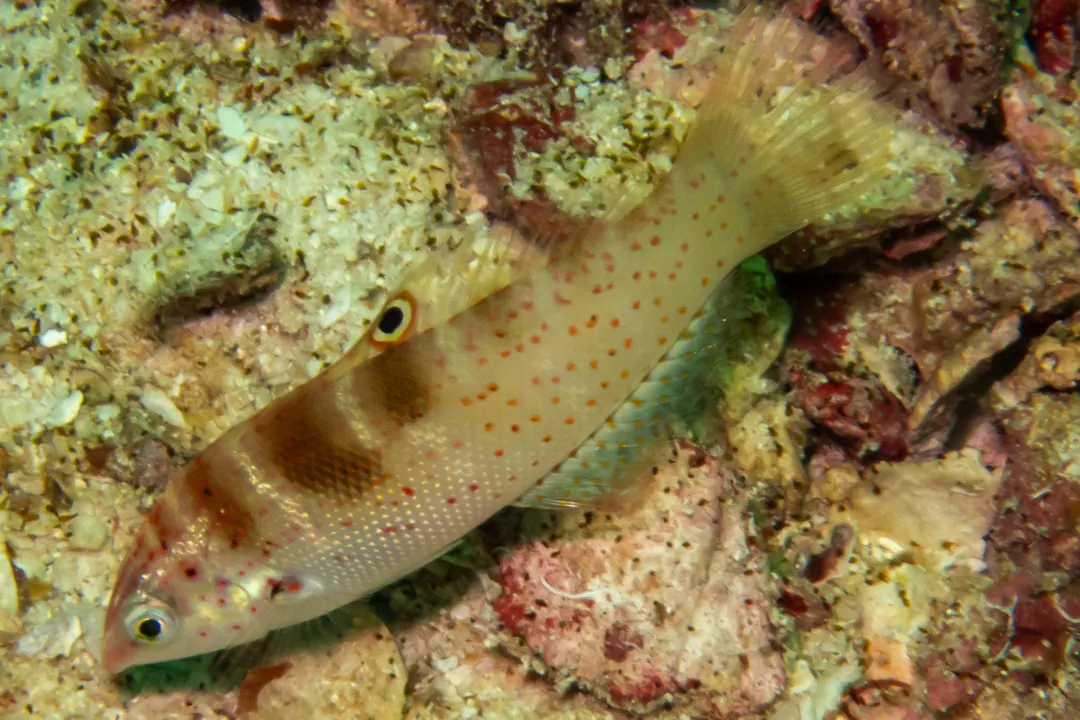
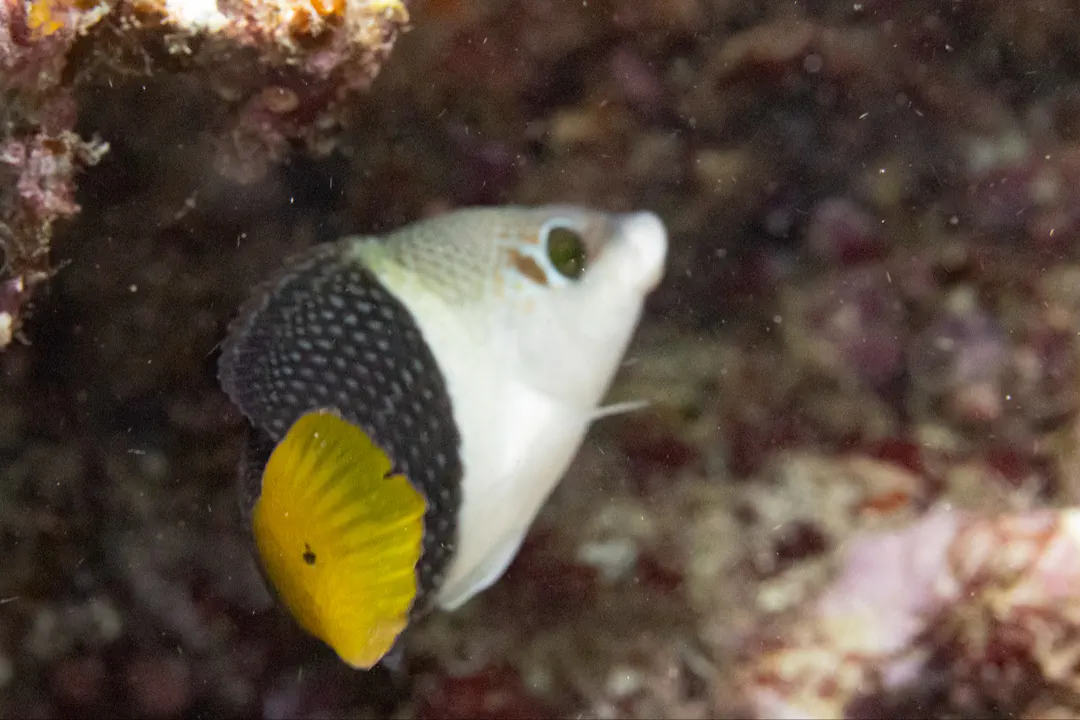
At juvenile stage, this wrasse has a white silvery background color with three black and dark red vertical patchs from back head, middle of the body and on the caudal peduncle. A black ocellus with yellow ring adorns the rear of the dorsal fin, two distinctive white spots are also visible on top and bottom of the caudal peduncle. Also a reddish line passes through the eyes starting from tip of the snout.
From the initial to terminal phase, there is a large variation of coloration, which makes the description quite difficult. But we can describe the species at its terminal phase. The checkerboard wrasse has a white to greenish background coloration with blue to black on the edge of its scales, thus reminding a checkerboard pattern. The head is greenish with pink lines stretching to dots behind the eyes until the base of dorsal fin. Whatever the distribution area where the wrasse is observed, all have a bright yellow spot in front of the body just at the border of the side and the dorsal fin. Some color variation occur with a possible black spot just behind the characteristic first yellow spot, and a second bright yellow spot can be seen along the edge of the dorsal fin but at the end of this later. In Red Sea, some checkerboard wrasse have half back body colored in blue. The caudal fin is truncated and it's usually yellow with pinkish pattern, which can be faded or completely blue.
The checkerboard wrasse is widespread throughout the tropical and subtropical waters of the Indian Ocean, from Red Sea to South Africa, to the oceanic islands (French Polynesia) from central Pacific Ocean. The northern limit is the south of Japan and the southern limit is the Great Barrier Reef.
It is usually found in clear lagoons and on seaward reefs at depths from 1 to 30 m (3.3 to 98.4 ft).Juveniles are found at the bottom of surge channels or under ledges.
The checkerboard wrasse is a predator that feeds mainly on small invertebrates such as crustaceans, molluscs, worms , echinoderms captured on the substrate or in the sand.
Like many other wrasses, the checkerboard wrasse is a protogynous hermaphrodite, starting life as a female and later becoming a male, changing sex when it is about 12,8 cm (5,0 in) long.
This species is of minor importance to local commercial fisheries and it is targeted for the aquarium trade, but it is not thought to be a major threat. This species is listed as least Concern (LC) on the UICN Red List.
© Heather Dawnstar SabinCC BY 4.0 · iNaturalist 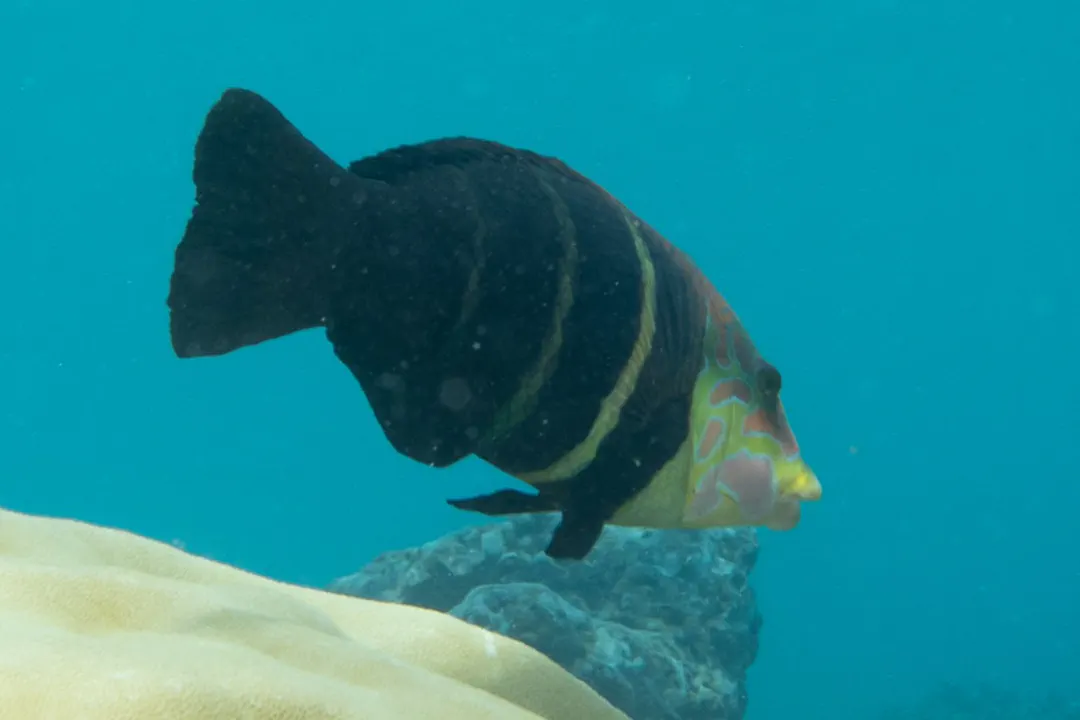 © Storm MartinCC BY 4.0 · iNaturalist
  © portioidCC BY 4.0 · iNaturalist
  © jeyreCC BY 4.0 · iNaturalist
  © Emanuele SantarelliCC BY-SA 4.0 · iNaturalist
  © cello caruso-turielloCC BY 4.0 · iNaturalist
 Checkerboard Wrasse has no known danger to humans. However, always observe marine life responsibly.
Checkerboard Wrasse can be found at depths of up to 40 meters.
Download Seabook free for iOS and Android.