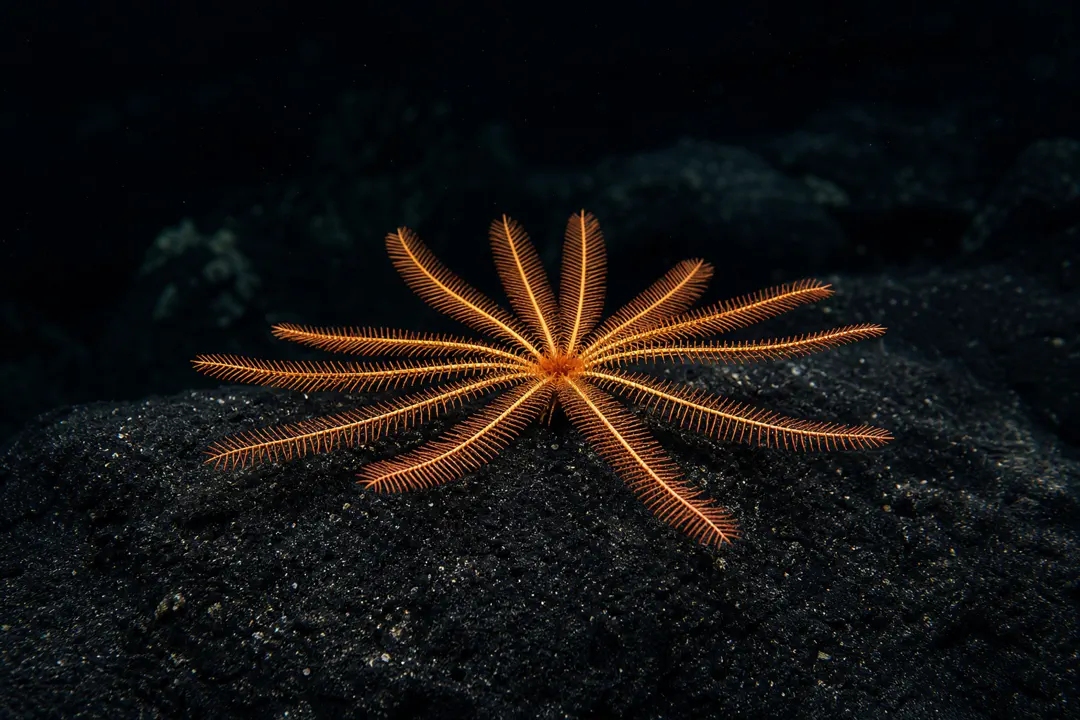
 © Debra BakerCC BY 4.0 · iNaturalist
Bennett's Feather Star
Anneissia bennetti
Thaumatocrinus rugosus
Thaumatocrinus rugosus, commonly known as the Wrinkled feather star, is a member of the family Pentametrocrinidae and is found in the central Pacific near the Hawaiian Islands.
Austin Hobart Clark described the species in 1908 under the original combination Decametrocrinus rugosus. The holotype was collected about 11 miles east of Moku Manu, Hawaiʻi, at depths of 762–1,000 fathoms during the night of 6–7 August 1902. The genus name Thaumatocrinus combines Greek thauma (“wonder” or “marvel”) with krinon (“lily”), referencing the lily-like form of crinoids, while the species epithet rugosus is Latin for “wrinkled” or “rough.” The species was originally named Decametrocrinus rugosus and is now cited as Thaumatocrinus rugosus, indicating transfer to Thaumatocrinus. It belongs to the phylum Echinodermata, class Crinoidea, order Comatulida, family Pentametrocrinidae, genus Thaumatocrinus.
The Wrinkled feather star has a relatively large, stalked body with nine unbranched arms, each approximately 20–25 cm long. The calyx, or body, of the species is flattened and about 9 mm wide. No authoritative source provides a dependable live colour description, so colour should not be used as a primary diagnostic feature. There is no verified underwater marking pattern for this species, and claims about spots or bands should not be treated as diagnostic without validation. The combination of nine unbranched arms and a flattened, narrow calyx is the most useful provisional distinction from similar species. Confirming the species against related Thaumatocrinus species generally requires detailed morphological characters, such as arm segmentation and calyx plates, rather than just colour or silhouette.
The Wrinkled feather star is a deep-water comatulid crinoid, not a shallow coral-reef inhabitant. It is known from approximately 1,394–1,828 m (762–1,000 fathoms). The species is known from the Hawaiian region, specifically about 11 miles east of Moku Manu, Hawaiʻi. No reliable evidence places it in a defined reef zone, indicating an open deep-sea setting rather than a photic reef environment. The substrate is not reported for the type specimen, therefore its preferred bottom material is unknown.
No documented commercial, artisanal, or recreational fishery targeting the Wrinkled feather star was found. It may occur incidentally in deep-sea sampling or bottom-trawl catches, but the scale and consequences are unknown. No reliable evidence indicates that the Wrinkled feather star is collected or sold for public or home aquaria. Deep-sea crinoids generally have specialized feeding and pressure requirements that make routine aquarium maintenance difficult. No authoritative source documents the Wrinkled feather star as a food species, and its edibility and toxicity are therefore unknown. No documented venom, bite, sting, or other human hazard specific to the Wrinkled feather star was identified. Direct danger appears undocumented, but handling wild echinoderms should still be avoided. A species-specific IUCN Red List assessment or population-based conservation category was not located, and its conservation status should therefore be reported as not evaluated or unknown. The main plausible concern is incidental damage from deep-sea fishing and seabed disturbance, but species-level effects for the Wrinkled feather star have not been quantified.
© Debra BakerCC BY 4.0 · iNaturalist 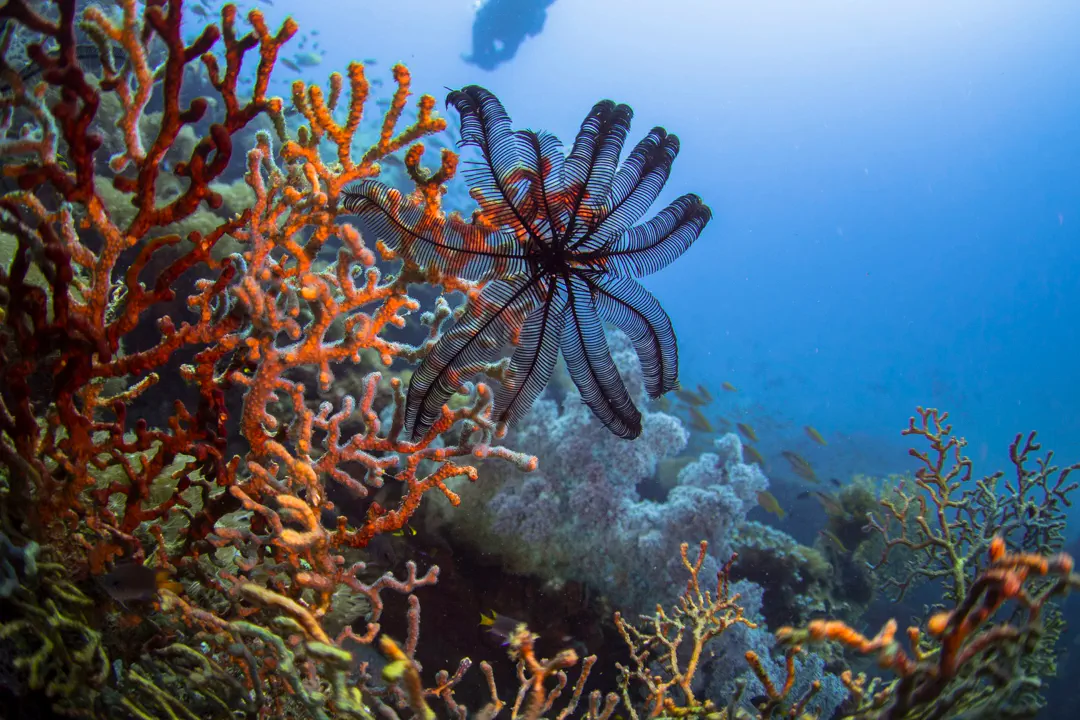 © Christopher MarkCC BY 4.0 · iNaturalist
Wrinkled feather star has no known danger to humans. However, always observe marine life responsibly.
Wrinkled feather star can be found at depths of up to 1828 meters.
Download Seabook free for iOS and Android.