 © KongCC BY-SA 4.0 · iNaturalist
Coral Catshark
Atelomycterus marmoratus
Cephaloscyllium sarawakense
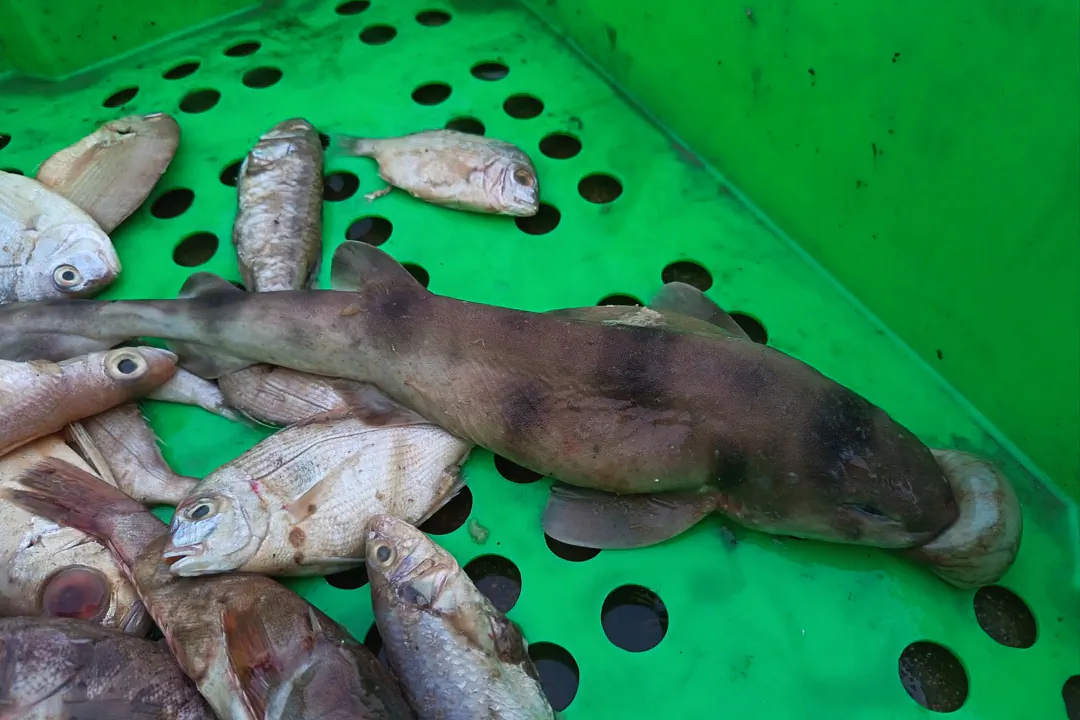
Cephaloscyllium sarawakense, commonly known as the Sarawak pygmy swellshark, belongs to the family Scyliorhinidae and is found in the western Pacific, particularly in the South China Sea around Sarawak and other Malaysian waters.
The species was first described in 2005 by K. Yano, A. Ahmad, and A. C. Gambang, with additional authors listed in some databases as Idris, Solahuddin, and Aznan. Its original name was Cephaloscyllium sarawakense Yano, Ahmad & Gambang, 2005. The type locality is Sarawak, Malaysia, where specimens were collected for the description. The genus name Cephaloscyllium combines Greek kephalē (“head”) with skylion (“dogfish” or “small shark”), referring to the genus’s broad head. The species epithet sarawakense is a Latin geographical adjective meaning “from Sarawak.” The current placement of the species is in the order Carcharhiniformes, family Scyliorhinidae, genus Cephaloscyllium. Cephaloscyllium circulopullum and Cephaloscyllium parvum are treated as junior synonyms of the species. A 2008 revision concluded that C. parvum was a junior synonym of C. sarawakense, while C. circulopullum was retained as a separate taxon. WoRMS currently lists C. sarawakense as accepted, although database treatments are not entirely uniform in displaying the species epithet.
The Sarawak pygmy swellshark has a small, comparatively slender and elongated body with a short, broad, flattened head and a short, broadly rounded snout. Adults display a few broad, dark brown saddles on their back, while juveniles may have three dorsal saddles that fade as they grow. A distinct dark, vertically elongated blotch is usually present on the side between the pectoral and pelvic fins of adults. Dark circular-to-oblong blotches occur above the gill openings and along the sides of the trunk in adults, which generally lack white spots. Juveniles are characterized by numerous small polka-dot-like spots on their body and fins. The anterior nasal flap of the species is triangular and does not form a long, posteriorly extended flap, and there are no labial furrows at the mouth corners. The Sarawak pygmy swellshark can be distinguished from C. umbratile by its smaller size, more slender body, fewer broad saddles, and the presence of a dark lateral blotch between the pectoral and pelvic fins. Identification of the Sarawak pygmy swellshark from other western North Pacific Cephaloscyllium species relies on a combination of saddle pattern, lateral blotches, triangular nasal flap, and proportions of the head, mouth, fins, and internarial region.
The Sarawak pygmy swellshark is a bottom-associated marine shark found at the continental-shelf edge rather than in shallow reef habitats. It inhabits a depth range of 100 to 200 meters, with more narrowly documented records between approximately 118 and 165 meters. The species is recorded in the South China Sea and western Pacific, including waters off Sarawak, Brunei, Hainan, and extending from western Taiwan and Hong Kong toward Vietnam and Malaysia. The species is classified as benthopelagic, indicating it lives near the seafloor, although specific substrate types such as sand, mud, or coral have not been identified.
The Sarawak pygmy swellshark has been documented as bycatch, captured in trawl nets near the continental-shelf edge, but it is not targeted in commercial fisheries. No authoritative source identifies an established aquarium trade or routine captive husbandry for the Sarawak pygmy swellshark, making its use in the aquarium trade unknown and apparently undocumented. No authoritative source confirms that the Sarawak pygmy swellshark is eaten or has a recognized food market, indicating its culinary use is unknown and it is generally described as having little or no commercial value. The species is classified as harmless to humans, with no reported attacks or documented human-safety concerns. The IUCN Red List assesses the Sarawak pygmy swellshark as Critically Endangered (CR) under criterion A2d, and it is listed as not evaluated under CITES. Information on the Sarawak pygmy swellshark's population size, trends, biology, utilization, and threats remains limited due to the species being known from few records and specimens.
© KongCC BY-SA 4.0 · iNaturalist 
 © Daniel BenákCC BY 4.0 · iNaturalist
 Sarawak Pygmy Swell Shark has no known danger to humans. However, always observe marine life responsibly.
Sarawak Pygmy Swell Shark can be found at depths of up to 200 meters.
Download Seabook free for iOS and Android.