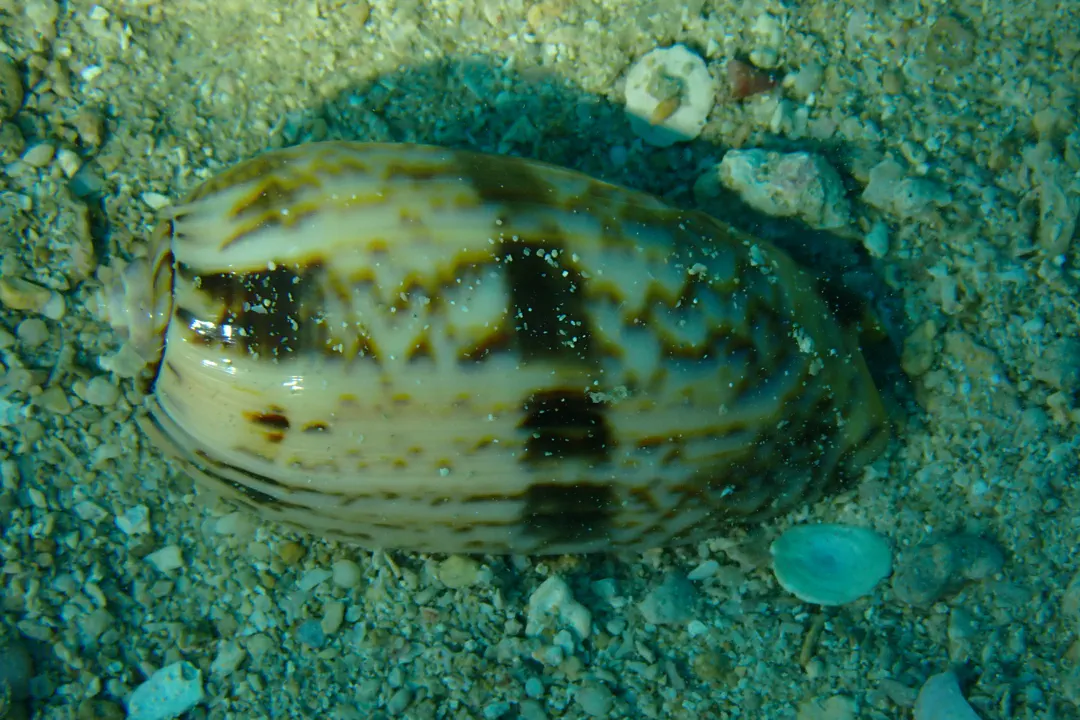
Red-mouthed Olive
Oliva miniacea
- Found in
- 35 regions
How to recognise it
- Colours
- whiteblackbrownyelloworange
Miniaceoliva miniacea, common name the Pacific common olive, is a species of sea snail, a marine gastropod mollusk in the family Olividae, the olives.
There are two subspecies:
- Oliva miniacea berti Terzer, 1986: synonym of Miniaceoliva efasciata berti (Terzer, 1986)
- Oliva miniacea tremulina Lamarck, 1811: synonym of Miniaceoliva tremulina (Lamarck, 1811)
Description
The length of the shell varies between 45 mm and 100 mm.
As is typical of olivids, the shell of this species is smooth, glossy, and elongated, with a very long aperture. The spire of this species is quite low even for an olivid. The filament channel, a groove present on the spire of olivids, is especially distinct in this species.
Shells of this species tend to have a yellowish or pale orange ground color with a pattern of two or three wide, rough bands of a much darker color (usually dark brown or black). Finer patterning is often present between the bands. Exceedingly pale specimens may be off-white with light brown patterns. At the opposite extreme, sometimes the pattern can cover so much of the shell that the shell is nearly black. The inside of the aperture is orange or yellowish-orange.
This species has caused food poisoning with a paralytic toxin in Taiwan in 2002.
Distribution
This species occurs in the Indian Ocean off Chagos, the Mascarene Basin and Mauritius; in the Western Pacific Ocean and in the Andaman Sea.
Questions
Is Red-mouthed Olive dangerous?
Red-mouthed Olive has no known danger to humans. However, always observe marine life responsibly.