 © Dan SchofieldCC BY 4.0 · iNaturalist
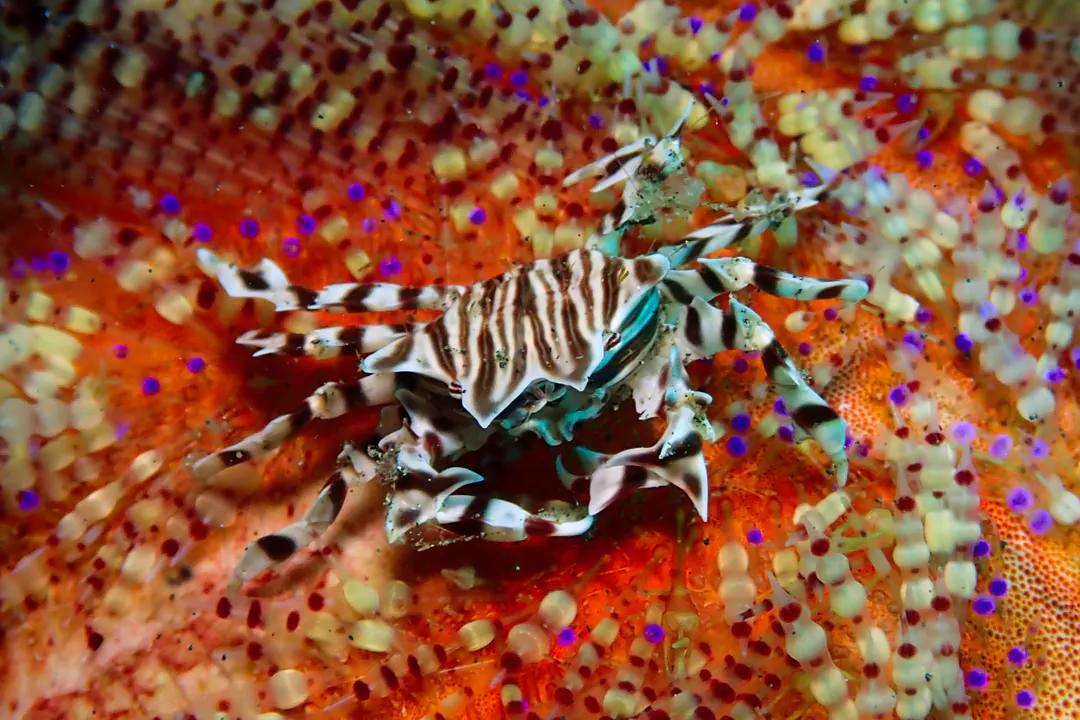
Zebra Urchin Crab
Zebrida adamsii
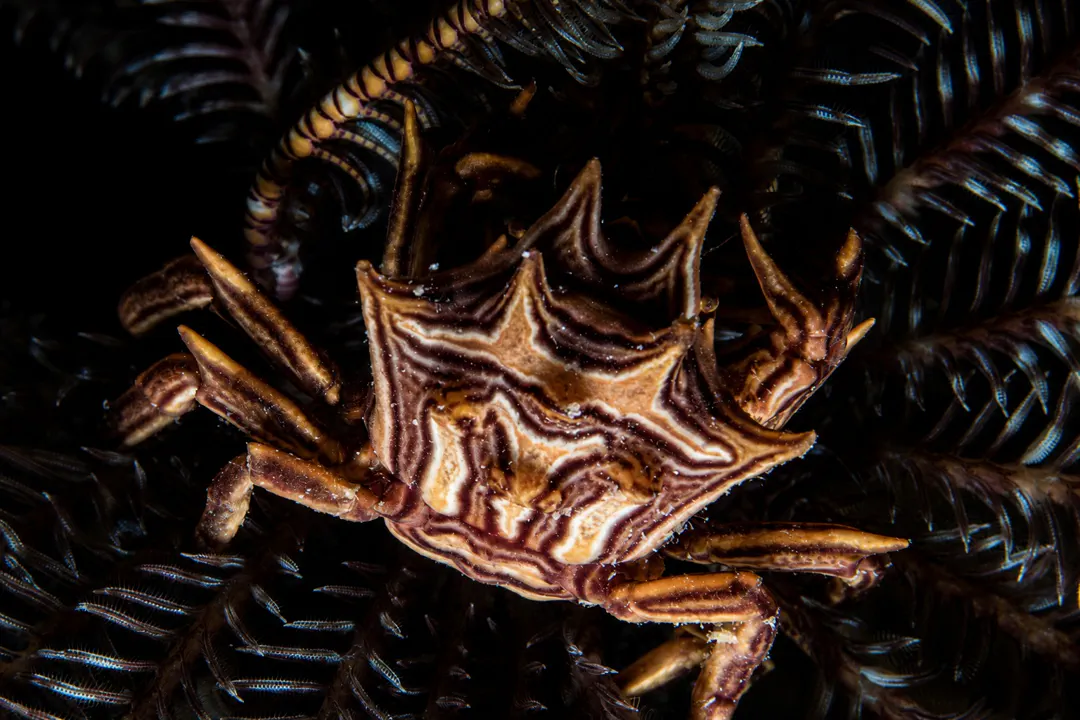
Tiaramedon spinosum
Tiaramedon spinosum is a crab species from the Pilumnidae family.
Six spines are prominent on the carapace - two rostral, two epigastric and two lateral branchial. No teeth or lobes on the antero-lateral borders. Carpus and propodus of chelipeds with distal spines.
Carapace squarish, slightly broader than long; regions well defined, protogastric, metagastric, branchial and cardiac regions strongly produced into dorsally directed spines, length of spines varies, protogastric spines always longest; surfaces of carapace smooth, densely covered with short, stiff setae in a systematic fashion. Frontal lobes, triangular, very short, narrow, strongly deflexed downwards, appears beak-like from dorsal view. Inner supraorbital teeth well developed, long, almost 1.5 times longer than broad, produced well beyond and obscuring most of frontal margin. Antero-lateral and postero-lateral margins clearly demarcated; antero-lateral margin sublamelliform, entire, without trace of teeth or lobes; lateral carapace teeth strong, sharp. Antennules folding obliquely, ca. 45° from horizontal, covered with setae; antennular fossae oblique. Surfaces of antenna covered with short stiff setae; antennal free, does not fill orbital hiatus, reaching into orbit; antennal basal segment rectangular; length to width ratio of second antennal segment 1.3-1.8. Eyes well developed, filling orbit; cornea distinct, pigmented; infraorbital tooth distinct, subhepatic tooth distinct. Anterior surface of epistome depressed; posterior margin appears entire because of 2 fused truncate median lobes. Pterygostomial, subhepatic, suborbital regions smooth with occasional scattered, minute granules beneath a dense layer of stiff short setae. Third maxilliped quadrate, surfaces covered with short, stiff setae; ischium rectangular, inner margin mildly granulated, median oblique sulcus shallow; merus squarish; exopod just reaches antero-external edge of merus. Thoracic sternum covered with setae; sutures between sternite segments 1 and 2, 2 and 3 distinct, shallow; between 3 and 4 interrupted medially; lateral clefts indistinct. Abdomen 7 segmented, sutures for all segments visible, all surfaces covered with setae. Chelipeds smooth, densely covered with short, stiff setae; merus and basi-ischium unarmed; carpus with sharp spine on inner distal angle and distinct tooth on outer distal angle; chela stout, length 3 times length of fingers, height ca. 2-3 times height of fingers, distal dorsal margin with distinct elongate tooth; fingers not carinate, pollex not bent downwards. Ambulatory legs unarmed, densely covered with short, stiff setae; meri of all ambulatory legs with strong tooth on subdistal dorsal margin; merus of first ambulatory leg more slender than that of others, unarmed, not cristate; first ambulatory dactylus more elongate and more slender, ca. 1.3 times that on other legs. G1 long, sinuous, tip bends at approximately 90°. G2 relatively short, distal segment short.
Western Central Pacific.
Lives symbiotic with fetherstars and sea urchins.
© Dan SchofieldCC BY 4.0 · iNaturalist Thorny Crinoid Crab has no known danger to humans. However, always observe marine life responsibly.
Thorny Crinoid Crab can be found at depths of up to 59 meters.
Download Seabook free for iOS and Android.