 © seabook.appAll rights reserved
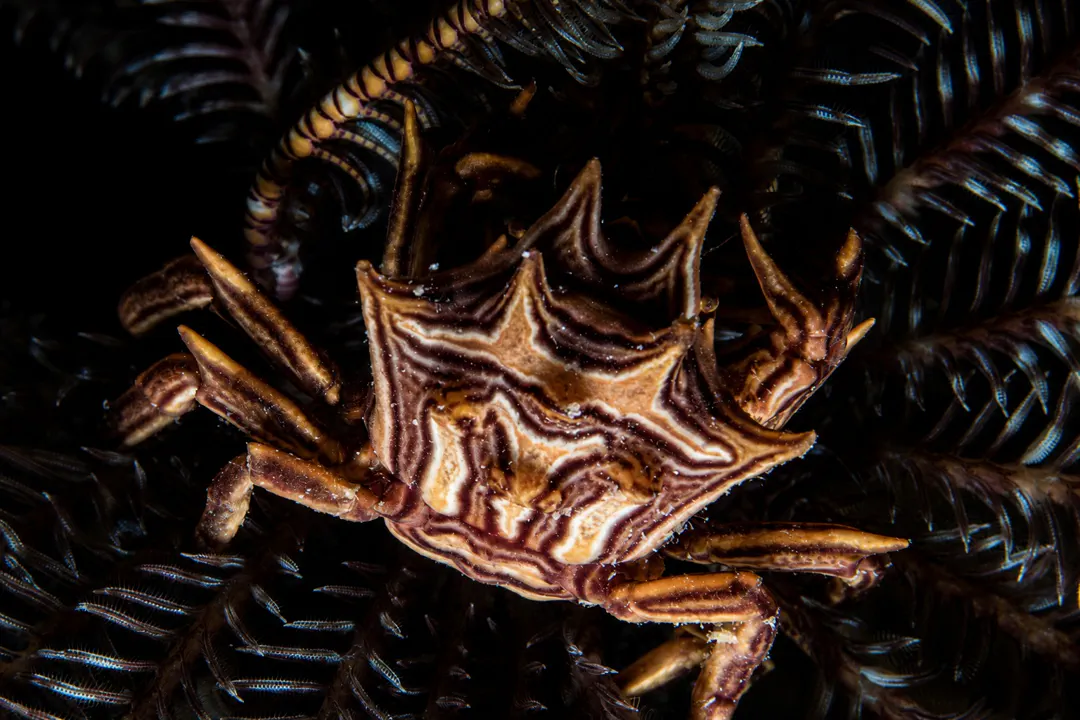
Thorny Crinoid Crab
Tiaramedon spinosum
Zebrida adamsii
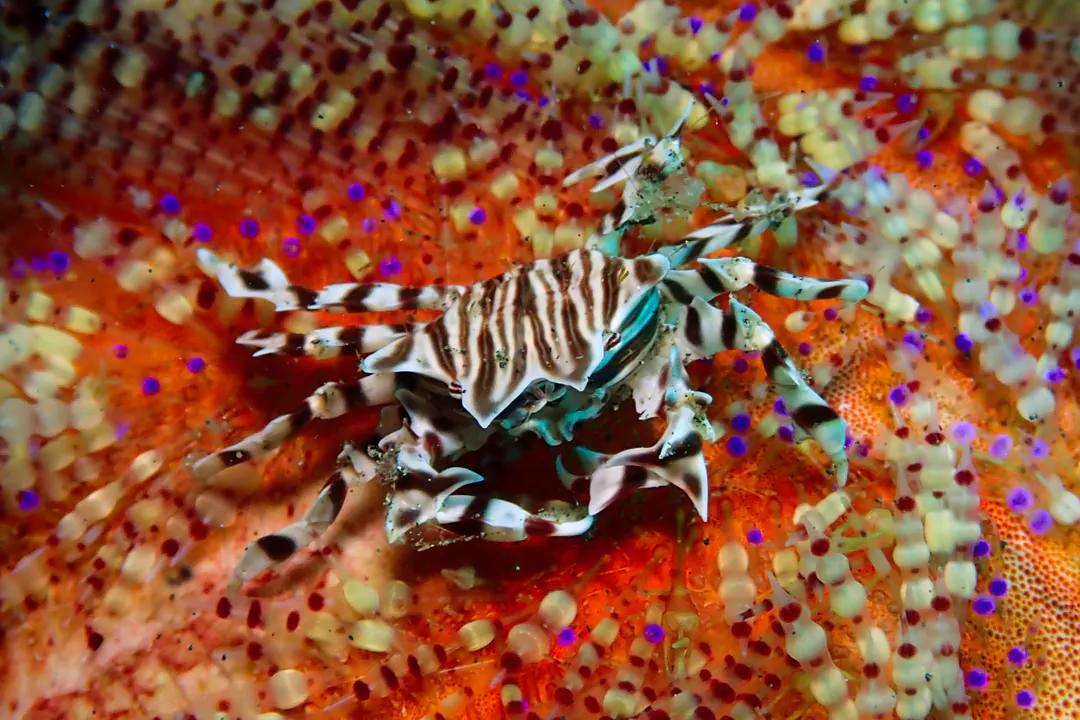
Zebrida adamsii is a distinctively striped species of crab that lives in association with a sea urchin in the Indo-Pacific region. It is cryptically coloured with vertical stripes and has special adaptations to its legs to enable it to cling to its host's spines.
Z. adamsii is a small crab, described as "a torpid, though elegant little crustacean" by the English naturalist Arthur Adams when it was first discovered by him and the Scottish zoologist Adam White during the surveying voyage of HMS Samarang in the Far East between 1843 and 1846. The carapace and limbs are smooth and hairless and are adorned with long spines. The colour is pink with dark, reddish-brown vertical stripes.
Z. adamsii has a wide distribution in shallow water in the tropical Indian Ocean and western Pacific Ocean. The type locality is the estuary of the Pantai River in Borneo at a depth of about 35 ft (11 m).
Z. adamsii lives in symbiosis with a sea urchin, living among its spines. Sea urchins on which it has been found include Asthenosoma ijimai, Diadema setosum, Heliocidaris crassispina, Pseudocentrotus depressus, Salmacis bicolor, Salmacis virgulata, Toxopneustes elegans, Toxopneustes pileolus, Tripneustes gratilla and a species of Acanthocidaris. Adaptations for this lifestyle include a specialist joint between the propodus and dactylus on the walking legs enabling the crab to cling to its host, and cryptic colouring in the form of vertical stripes. Females are slightly larger than males and usually live singly on a sea urchin while males move from one urchin to another searching for females.
Z. adamsii feeds on its host's tube feet and on the epidermal tissue covering the test and the base of the spines. This does little harm to the host which readily regenerates both the tissue and the tube feet.
Z. adamsii larvae are planktonic and pass through four zoeal stages, and one megalopa stage before settling on the seabed and undergoing metamorphosis into juvenile crabs.
Zebrida is a small genus of distinctive striped crabs, known as zebra crabs, that live in association with sea urchins in the Indo-Pacific.
Zebrida was described by Arthur Adams as "a torpid, though elegant little crustacean". It is "the most unusual" of the genera in the subfamily Eumedoninae, with long spines projecting from the body, and a distinctive pattern of stripes across the exoskeleton.
The genus was thought to be monotypic for a long time, but in 1999, Peter Ng & Diana Chia recognised two additional species, bringing the total number to three.
Crabs of the genus Zebrida live, often in pairs, in association with sea urchins, including Toxopneustes pileolus, Toxopneustes elegans, Tripneustes gratilla, Diadema setosum, Asthenosoma ijimai, Salmacis bicolor, Salmacis virgulata, Heliocidaris crassispina, Pseudocentrotus depressus and a species of Acanthocidaris.
Z. adamsii passes through four zoeal phases, and one megalopa phase before reaching the mature condition.
© seabook.appAll rights reserved Zebra Urchin Crab has no known danger to humans. However, always observe marine life responsibly.
Zebra Urchin Crab can be found at depths of up to 11 meters.
Download Seabook free for iOS and Android.