 © portioidCC BY 4.0 · iNaturalist
Bigeye Snapper
Lutjanus lutjanus
Lutjanus viridis
Lutjanus viridis is a species of marine ray-finned fish, a snapper belonging to the family Lutjanidae. It is native to the eastern Pacific Ocean where it is important to local subsistence fisheries.
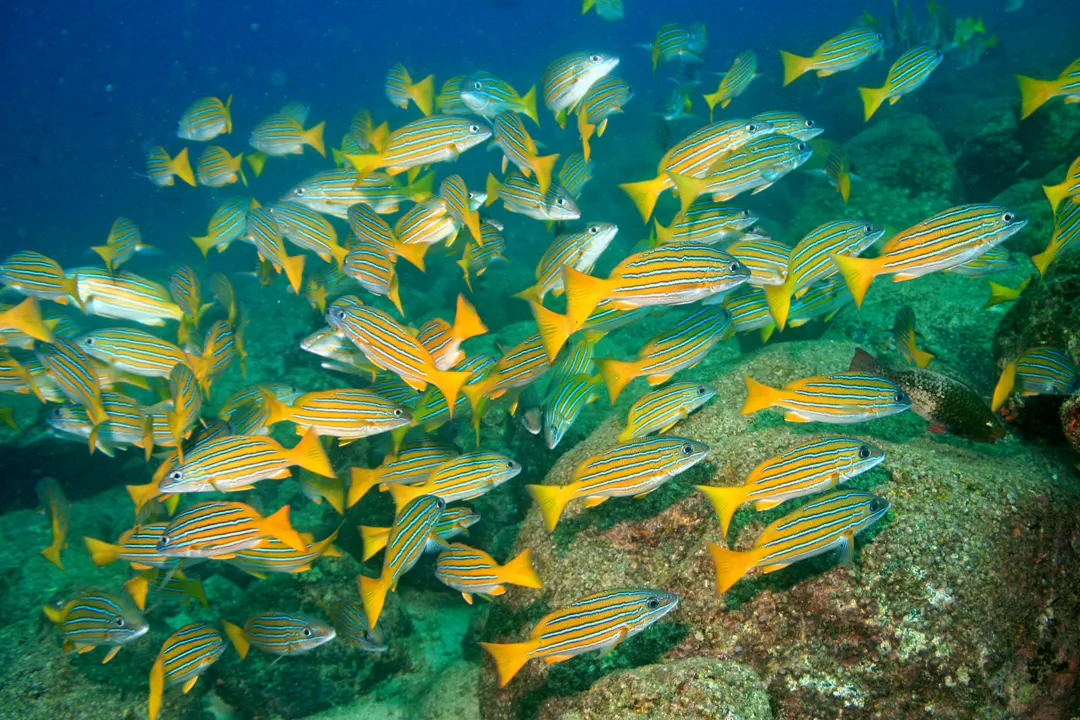
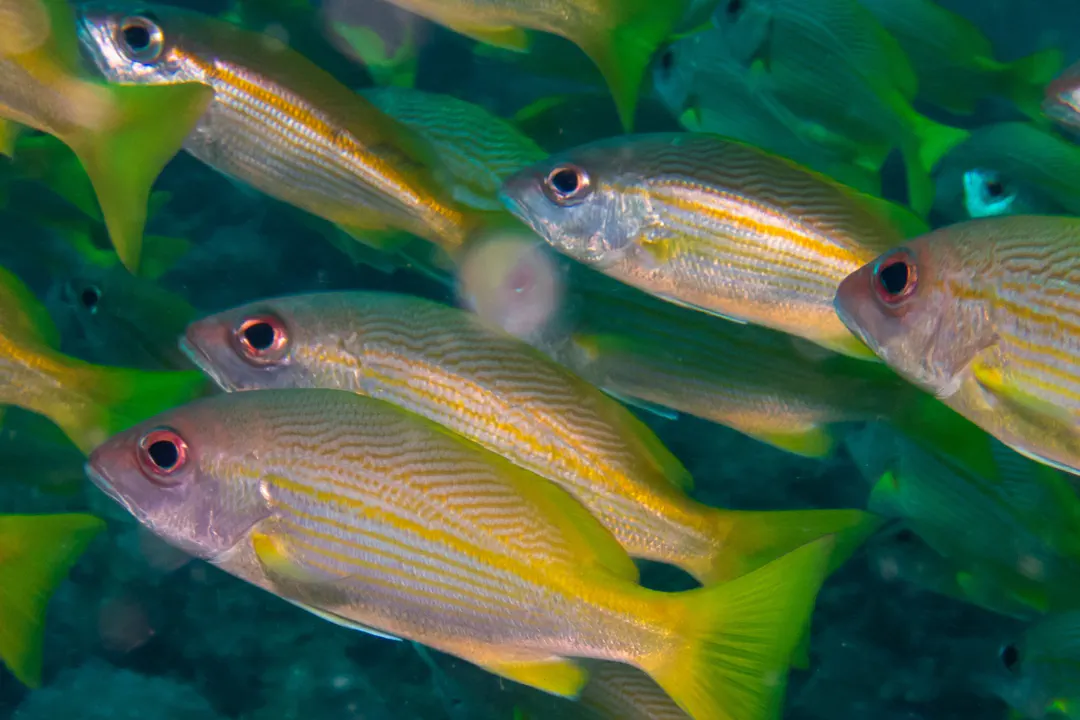
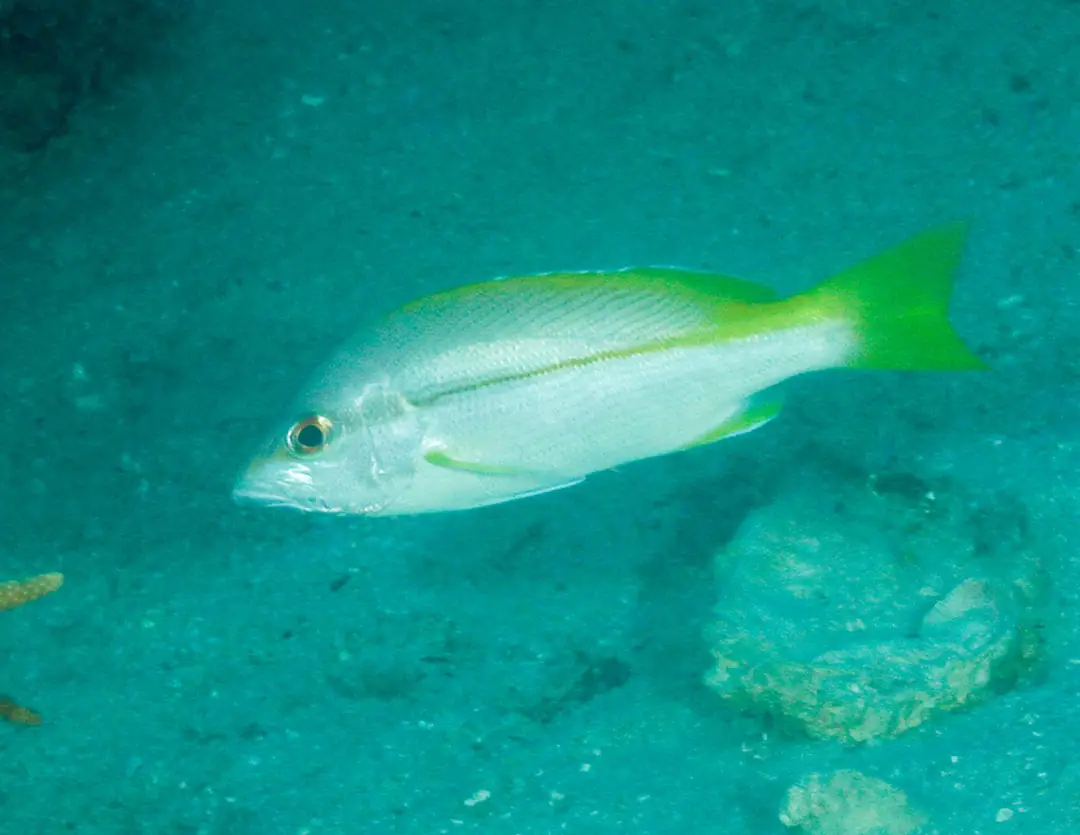
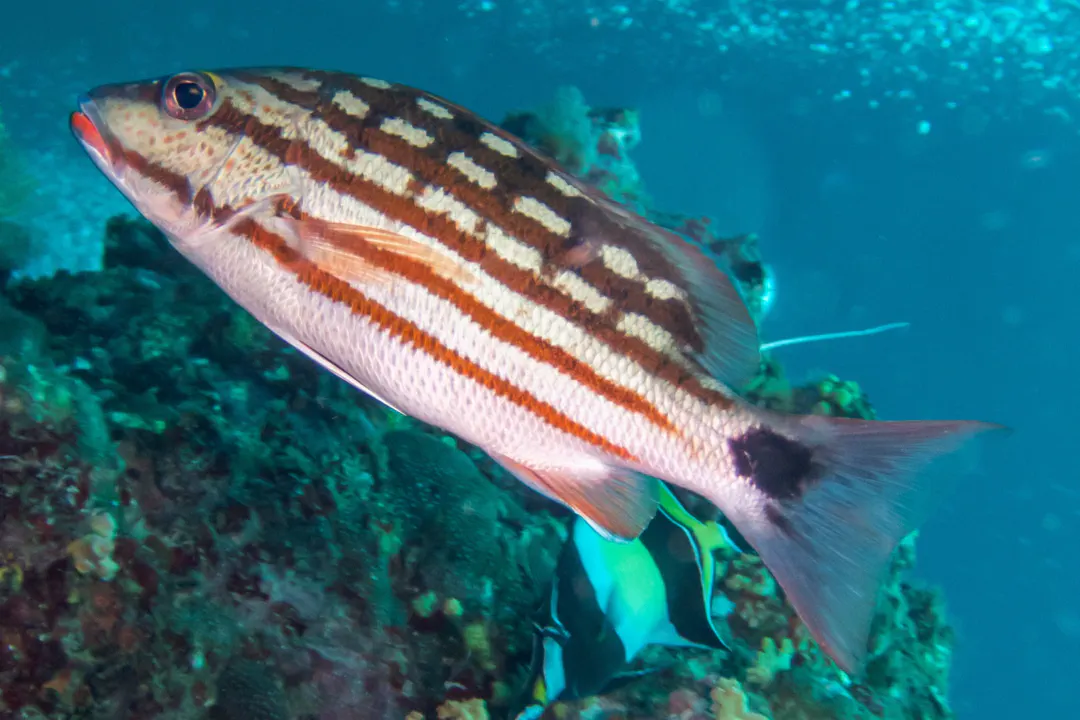
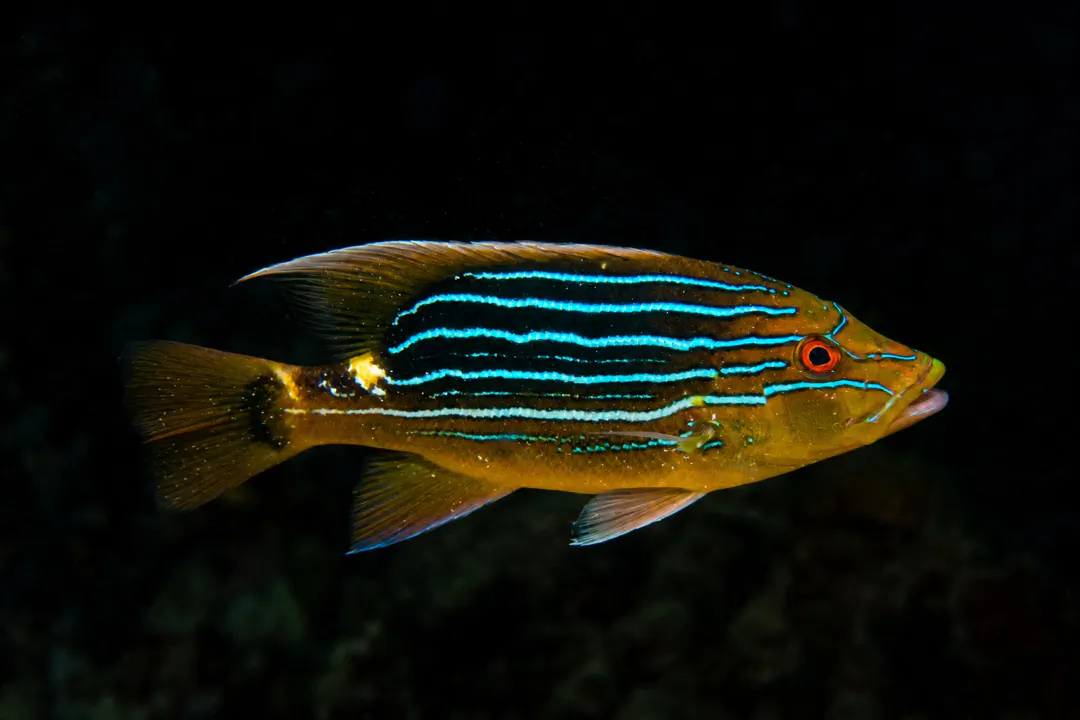
Blue-and-gold snapper has an oblong body. The pointed snout has front and rear nostrils which are simple holes. It has a relatively large mouth which has protractile jaws. The teeth are conical to canine like in shape, with the front teeth typically enlarged so that they resemble fangs. The vomerine teeth are arranged in a V-shape with no rearwards extension and there is a patch of teeth at each side of the palate, but there are no teeth on the tongue. The preoperculum has a weakly developed incision and knob. The dorsal fin is continuous, containing 10 spines and 14-15 soft rays while the anal fin has 3 spines and 8 soft rays, the rear of the dorsal and anal fins may be rounded or pointed. The pectoral fins contain 16-17 rays and the caudal fin is truncate or weakly emarginate. This species attains a maximum total length of 30 cm (12 in). The overall colour of this fish is bright yellow on the body, although this can be dark, with five black-margined blue stripes along the flanks. The abdiomen is paler and is marked with many thin orange to yellow lines. They frequently show a reddish face.
The blue and gold snapper is found in the eastern Pacific Ocean where it has a rather discontinuous distribution. It occurs at the mouth of the Gulf of California and southern Baja California, and along the western coast of Mexico, from southern Guatemala to Panama and Colombia. It also occurs at the Revillagigedo Islands of Mexico, Clipperton Island, Cocos Island of Costa Rica, Malpelo Island of Columbia and the Galápagos Islands in Ecuador.
They usually can be found in large schools around both rocky and coral reefs at depths from 3 to 30 m (9.8 to 98.4 ft), though usually between 9 and 15 m (30 and 49 ft).
They are important to local subsistence fisheries.
© portioidCC BY 4.0 · iNaturalist  © Rickard ZerpeCC BY 4.0 · iNaturalist
  © Deb AstonAll rights reserved
  © Ian ShawAll rights reserved
  © portioidCC BY 4.0 · iNaturalist
  © seabook.appAll rights reserved
 Blue-and-gold Snapper has no known danger to humans. However, always observe marine life responsibly.
Blue-and-gold Snapper can be found at depths of up to 60 meters.
Download Seabook free for iOS and Android.