 © Dan SchofieldCC BY 4.0
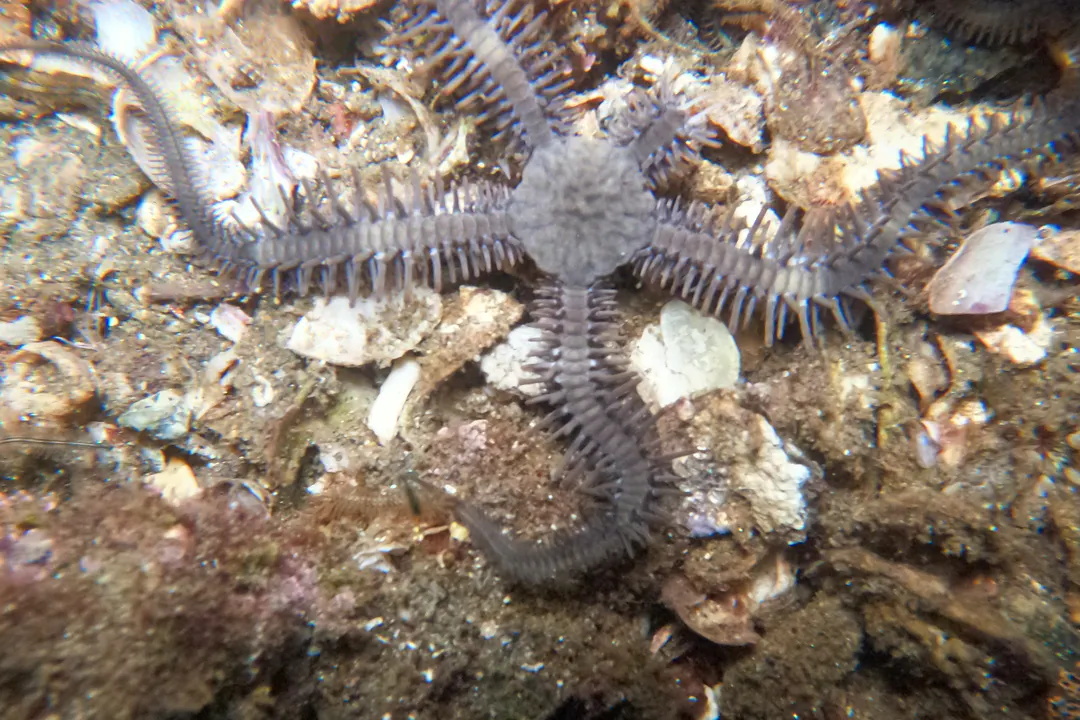
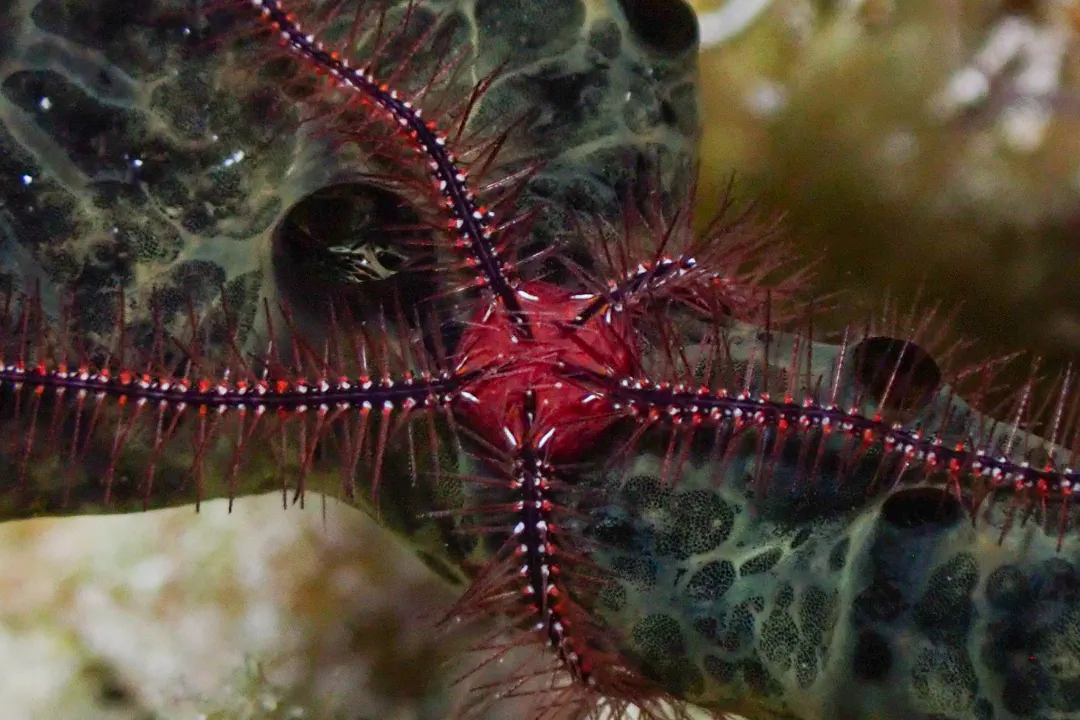
Sponge Brittle Star
Ophiothrix suensonii
Ophiocoma aethiops
Ophiocoma aethiops, commonly known as the Black Spiny Brittle Star, is a marine echinoderm in the family Ophiocomidae found in the tropical and subtropical eastern Pacific.
Christian Frederik Lütken described the species in 1859. It was published under the original name Ophiocoma aethiops Lütken, 1859. Lütken’s description appeared in Additamenta ad historiam Ophiuridarum. Anden Afdelning, published in Det Kongelige Danske Videnskabernes Selskabs Skrifter, 5th series, volume 5, pages 177–271. The authoritative database record does not state a type locality for the species. Ophiocoma is derived from the Greek words ophis meaning 'snake' and kome meaning 'hair' or 'tresses', referring to the snake-like arms of brittle stars. The epithet aethiops is Latinized Greek, meaning 'Ethiopian' or 'black/dark-colored', which corresponds to the species' dark coloration. WoRMS currently lists no accepted junior synonym or reclassification for the species and treats the original combination as valid. Later literature has retained the name Ophiocoma aethiops without change. The genus Ophiocoma has undergone broader taxonomic revision, but this does not currently affect the accepted name of this species.
The Black Spiny Brittle Star usually appears very dark brown to black, often with a darker overall appearance than related species. Some individuals of the species may have a conspicuous pale or white patch on the upper disk, while others are uniformly black-brown. It has a relatively large, rounded disk with thick, robust arms, covered by fine granules or small scales. The radial shields of the species are narrow and separated by a row of scales. Arms of the Black Spiny Brittle Star are stout and bear multiple thin, compressed, finely serrated spines, with the second or third spine in a row generally longer than the uppermost spine. A distinguishing feature of Ophiocoma aethiops is that its upper arm plates are unusually broad, often more than three times the width of the oral arm plates. The species can be distinguished from Ophiocoma alexandri by its larger disk, more robust build, and generally darker colour pattern. Ophiocoma alexandri has proportionally larger arms and a characteristic longitudinal line along the ventral arm plates, which helps differentiate it from the Black Spiny Brittle Star.
The Black Spiny Brittle Star inhabits coral-reef habitats, including shallow reef areas. It is found in the intertidal zone and can be collected at depths ranging from 2.1 to 26 m. In the Galápagos, the species is recorded from the lower intertidal zone to approximately 30 m. Broader records from the Mexican Pacific extend its depth range to about 55 m. The species is associated with rocky shores, live and dead stony coral, coral interstitial spaces, algae, rhodoliths, sand, and muddy sand. Adults of the species are especially found in spaces beneath or within rocks and corals. The Black Spiny Brittle Star is distributed throughout the eastern Pacific, from the Gulf of California and Pacific Mexico to Guatemala, El Salvador, Honduras, Nicaragua, Costa Rica, Panama, Colombia, and Peru, including the Galápagos Islands.
During daylight, the Black Spiny Brittle Star is commonly found sheltered in crevices or beneath rocks, but direct observations of its day-night activity are limited. There is no evidence for organized social behavior, cooperative care, or stable social groups in the species, although individuals may occur together due to concentrated shelter and food. Reproduction in the Black Spiny Brittle Star involves separate sexes and spawning into the water, with external fertilization inferred from its reproductive biology. A study found that female Black Spiny Brittle Stars primarily spawn from May to November, while substantial male sperm availability occurs from May to December. Another study reported that gamete release occurs throughout the year without a clear lunar-cycle effect, indicating potential geographic or population-level variation in reproductive timing. No reliable species-specific studies document the responses of the Black Spiny Brittle Star to divers, and thus characteristic responses such as retreating or remaining motionless cannot be stated. Approaching or touching specimens of the Black Spiny Brittle Star should be avoided, as physical disturbance can damage its arms and alter its natural behavior.
The Black Spiny Brittle Star is a microphagous, detritivorous brittle star that feeds on fine sediment and detritus, algal material, and small animals associated with the substrate. It feeds mainly by using its brittle-star arms, spines, and tube feet to trap particles from the sediment or surrounding water. Tube feet transfer collected particles along the arms toward the mouth in a coordinated, segment-by-segment movement. The species may combine deposit feeding with limited suspension feeding or scavenging, although specific dietary preferences are not established.
No authoritative source found documenting a directed commercial or subsistence fishery for the Black Spiny Brittle Star, although it may be collected incidentally with intertidal invertebrates. There is no reliable species-specific evidence showing that the Black Spiny Brittle Star is regularly traded in the aquarium industry. No authoritative source was found documenting the Black Spiny Brittle Star as a food species, leaving its edibility and any food-safety implications undocumented. No species-specific venom, medically significant bite, or documented human injury was identified for the Black Spiny Brittle Star, though handling should be gentle to avoid minor mechanical injury. The conservation status of the Black Spiny Brittle Star has not been formally assessed by the IUCN Red List, resulting in its population status being reported as not evaluated/unknown.
© Dan SchofieldCC BY 4.0 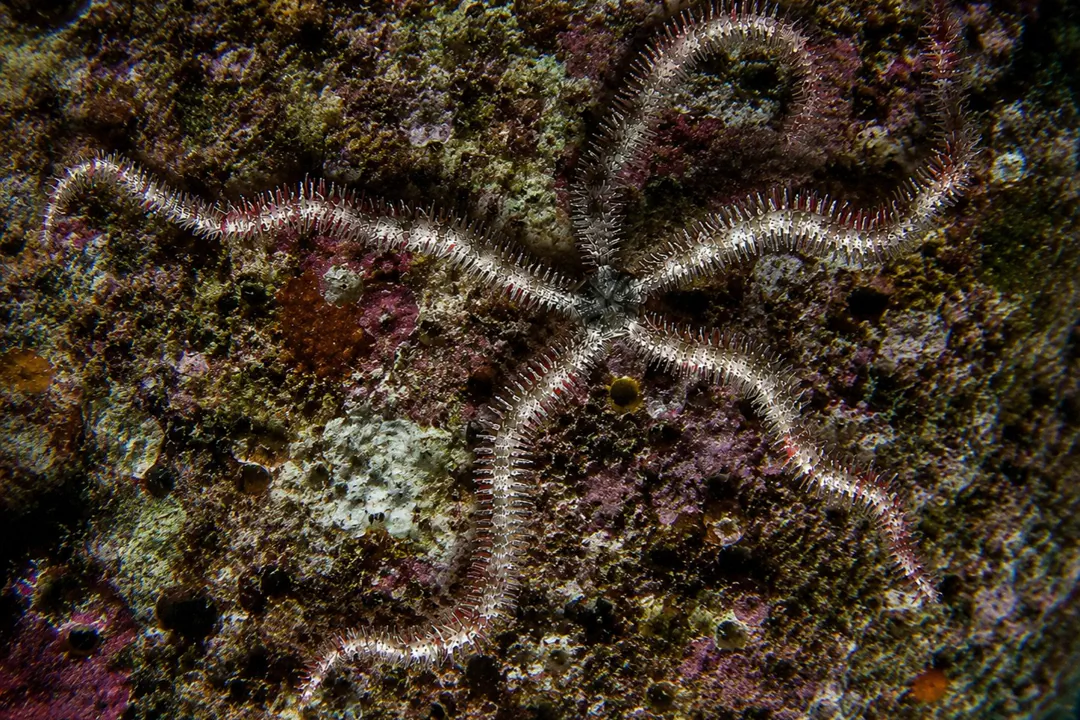
Black Spiny Brittle Star has no known danger to humans. However, always observe marine life responsibly.
Download Seabook free for iOS and Android.