 © Lesley ClementsAll rights reserved
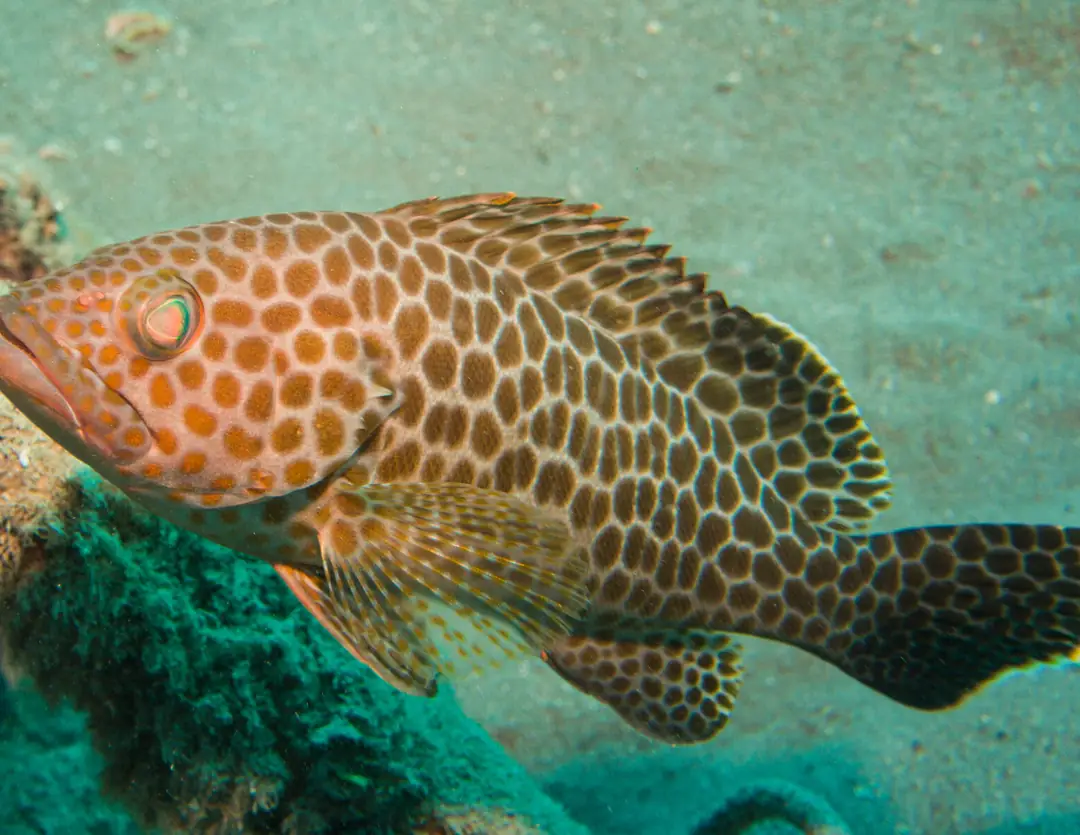
Areolate Rock Cod
Epinephelus areolatus
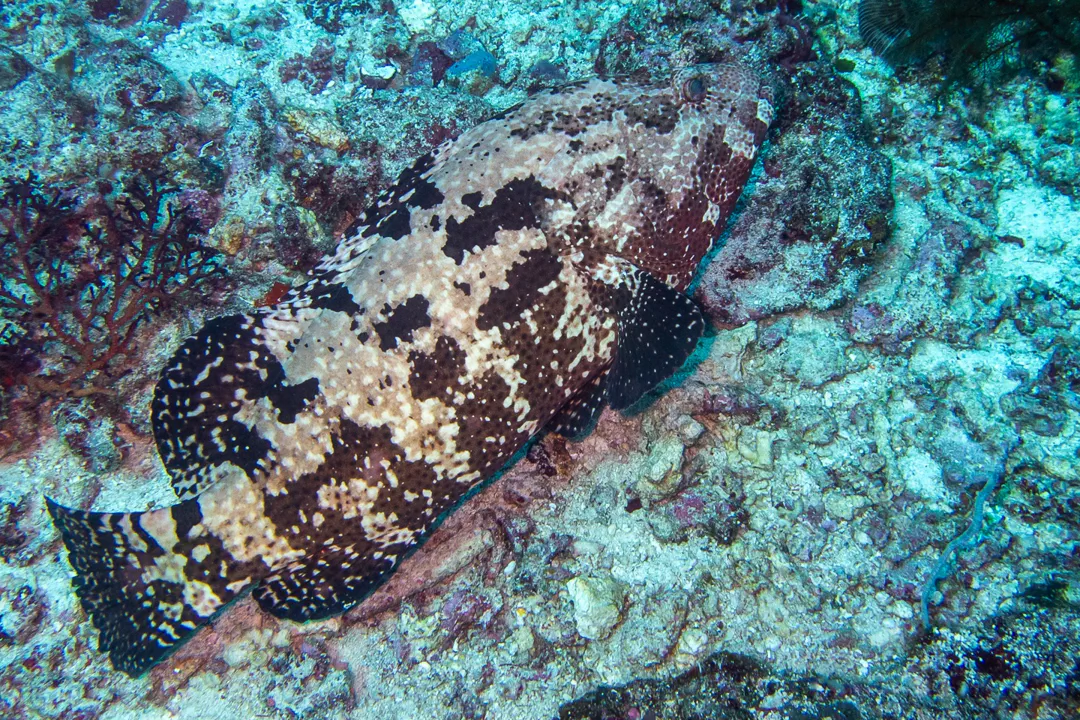
Epinephelus fuscoguttatus
Epinephelus fuscoguttatus is a benthic marine fish which belongs to the family Serranidae or also known as the groupers.
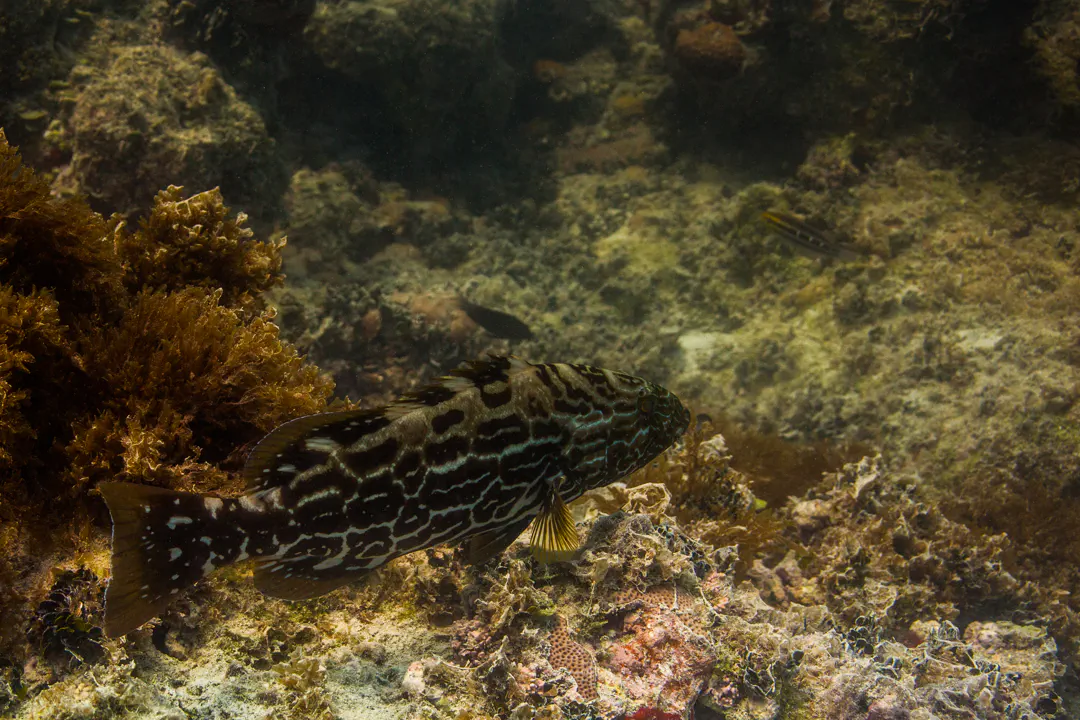
Epinephelus fuscoguttatusis a medium-sized fish which grows up to 120 cm, but the average size mostly observed is 50 cm. Its body has a stocky and robust aspect, is compressed laterally and has a sharp profile for the head. The mouth is big and has a superior position with many small teeth and canine in front. The background coloration is pale yellowish-brown with many irregular in size and shape dark brown or grey blotches.The body is also covered with many small dark brown spots. All the fins are large and round.
The brown-marbled grouper can be easily confused with its close relative Epinephelus polyphekadion. The differences are more obvious on adults specimen. The distinctive characters of the brown-marbled grouper are: a small black saddle on the top of caudal peduncle, when observed on the side a notch above the eyes and the front head is clearly visible, its body is quite thick from the front of the dorsal fin to the bottom of the fish below the pectoral fins.
It is widely distributed throughout the tropical and subtropical waters of the Indo-Pacific,from eastern coasts of Africa to the oceanic islands of the centre of the Pacific Ocean, Red Sea included. However, it's absent from the Persian Gulf, Hawaii and French Polynesia.
Like many of the groupers, the brown-marbled grouper lives in rich clear waters close to coral or rocky reefs, lagoons and external slopes from the surface until 60 metres (200 ft) depth.
The brown-marbled grouper is carnivorous and its diet consists mainly in fishes, crustaceans and cephalopods, it's an ambush predator.
This grouper is solitary, sedentary, it defends a well defined territory, benthic and has an nocturnal which can be maximal at sunrise and/or at sunset.
It has a quite long life span for a fish, it can expect to live until at least 40 years old.
It is protogynous hermaphrodite, which means the female can evolved to male during its life.
The brown-marbled grouper is listed "near threatened" on the IUCN Red List of Threatened Species since 2004. Because of its size and hardiness, this species has a height commercial interest for the live food fish trade.
However,its biological characteristics make this species particularly vulnerable to over-fishing. Especially during mating periods at specific times and places, the brown-marbled grouper forms spawning aggregations which are easy and attractive targets for fishermen. The quite long life span of this grouper and its poor population density in reefs in the wild result in a weak and slow population regeneration capacity. Furthermore, brown-marbled groupers are greatly threatened by the trend of fishermen to target large fish. That concerns especially males so if the sex ratio between males and females is falling, it will have an impact on the fertilization capacity of the species. It will have the same result on over-fishing females breeders that are highly fertile and would not be able to actively contributing to maintain the proportion of young in the population.
Brown-marbled groupers can be cultured by hatcheries but these installations are still getting fishes straight from the wild. This method has also a negative effect on the global population because all the groupers catch in any size category are kept and grown until they reach market size.
One fact helps to preserve a bit the brown-marbled groupers in some geographic areas and it is the ciguatera which affects its flesh.
Over the last few years, some protective measures or/and sustainable fishing methods have been taken by many states where spawning aggregation are known like in Indonesia, Papua New Guinea, Australia, Malaysia, Solomon Islands and Palau.
© Lesley ClementsAll rights reserved  © seabook.appAll rights reserved
  © Lesley ClementsAll rights reserved
  © João D'AndrettaCC BY 4.0 · iNaturalist
  © Ewout KnoesterCC BY-SA 4.0 · iNaturalist
  © Logan JonesCC BY 4.0 · iNaturalist
 Flowery Rockcod is classified as poisonous. Always exercise caution and keep a safe distance.
Flowery Rockcod can be found at depths of up to 60 meters.
Download Seabook free for iOS and Android.