Stonefish
Synanceia verrucosa
Max Size
See in AppMax Weight
See in AppMax Depth
30 m
Description
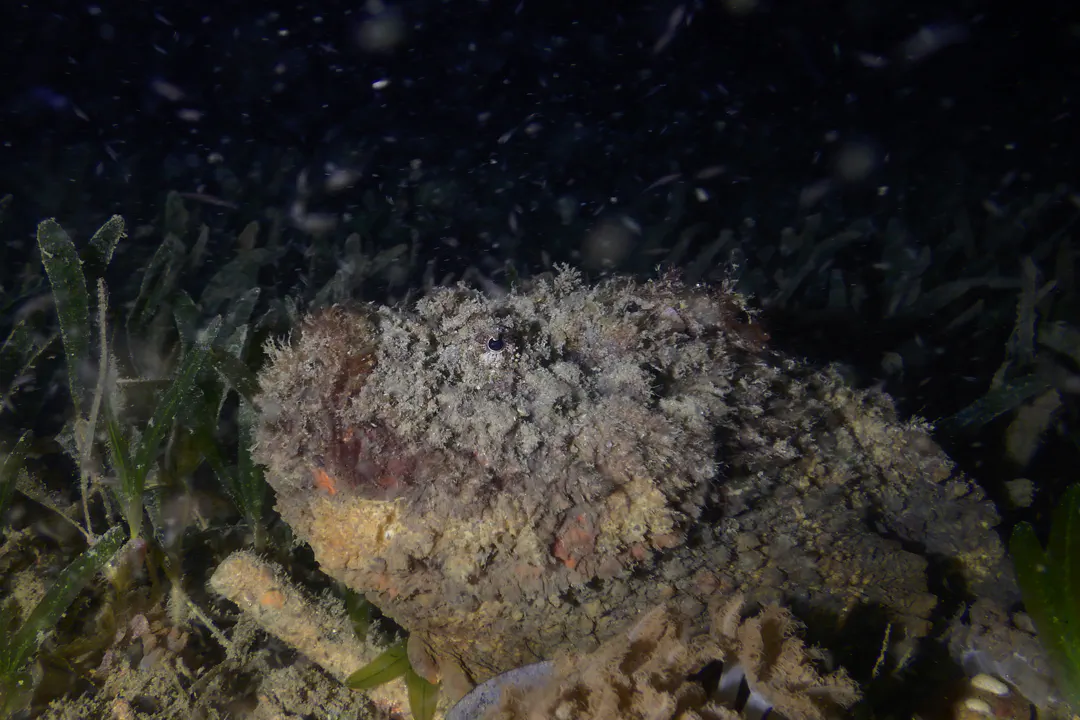
This stonefish is usually brown or gray, and it may have areas of yellow, orange or red. This species reaches 30 to 40 centimeters long; a specimen of 51 centimeters has been recorded.
Distribution and habitat
This stonefish lives primarily above the Tropic of Capricorn. It is the most widespread species in the stonefish family, and is known from shallow tropical marine waters in the Pacific and Indian Oceans from the Red Sea to the Great Barrier Reef.
There is also evidence showing that S. verrucosa may exist within the Mediterranean Sea. An adult specimen was captured in 2010 near Yavne, Israel.
This fish lives in coral reefs. It may settle on and around rocks and plants, or rest on the seabed.
Feeding
The reef stonefish eats mostly small fish, shrimp and other crustaceans.
Human uses
The primary commercial significance of this stonefish is as an aquarium pet. It is also sold for meat in Hong Kong markets. It is consumed in the Philippines, especially in Chinese restaurants, and in Japan as expensive sashimi cuisine called okoze (オコゼ).
Toxicity
Effects of the venom include severe pain, shock, paralysis, and tissue death. A large dose can be fatal to humans, generally young children, the elderly, and those with weakened immune systems. Medical treatment includes the antivenom. A local anesthetic can reduce the pain. First aid includes immersion of the affected limb in hot water; this is thought to help denature the proteins in the venom. The immobilization of venom at penetration site using a tourniquet or firm constrictive bandaging is no longer recommended. Surviving victims may have nerve damage, which can lead to local muscle atrophy.
The venom consists of a mixture of proteins, including the hemolytic stonustoxin, the proteinaceous verrucotoxin, and the cardiotoxic cardioleputin.
Reproduction
The reef stonefish lives most of its life as a solitary animal, and during mating season only aggregates with the opposite sex for a short time. When a female stonefish has reached sexual maturity, she will lay her unfertilized eggs on the floor of the reef. A male will then swim by and release sperm onto the layer of eggs, fertilizing them. Stonefish eggs are fairly large, with young fish hatching well developed. The mating system of the reef stonefish is promiscuity, as the female will not discriminate between which males can lay their sperm on the egg layer. Sexual dimorphism is apparent in reef stonefish, with females being larger than males.
About Synanceiidae
Scorpaenidae, the scorpionfish, are a family of mostly marine fish that includes many of the world's most venomous species. As the name suggests, scorpionfish have a type of "sting" in the form of sharp spines coated with venomous mucus. The family is a large one, with hundreds of members. They are widespread in tropical and temperate seas, but mostly found in the Indo-Pacific. They should not be confused with the cabezones, of the genus Scorpaenichthys, which belong to a separate, though related, family (Cottidae).
Varieties
Some types, such as the lionfish, are attractive as well as dangerous, and highly desired for aquaria. In addition to the name scorpionfish, informal names for family members include firefish, turkeyfish, dragonfish, and stingfish, usually with adjectives added.
General characteristics of family members include a compressed body, ridges and/or spines on the head, one or two spines on the operculum, and three to five spines on the preopercle. The dorsal fin has 11 to 17 spines, often long and separated from each other, and the pectoral fins are well-developed, with 11 to 25 rays. The spines of the dorsal, anal, and pelvic fins all have venom glands at their bases.
Most species are bottom-dwellers that feed on crustaceans and smaller fish. Many inhabit shallow waters, but a few live as deep as 2,200 m (7,200 ft). Most scorpionfish, such as the stonefish, wait in disguise for prey to pass them by before swallowing, while lionfish often ambush their prey. When not ambushing, lionfish may herd the fish, shrimp, or crab into a corner before swallowing. Like many perciform fishes, scorpionfish are suction feeders that capture prey by rapidly projecting a suction field generated by expansion of the fish's buccal cavity.
Scorpaenid systematics are complicated and unsettled. Fishes of the World recognizes 10 subfamilies with a total of 388 species, while (as of 2006) FishBase follows Eschmeyer and has three subfamilies, 25 genera, and 201 species, some of the species being removed to family Sebastidae which other authorities do not follow.
Colors
Habitat and Environment
Benthic
Coral reef
Mud and Sand
Conservation status
(LC) Least concern
Edible
See in SeabookSocial Behaviour
Solitary
Venomous
See in SeabookDanger to human
See in SeabookSimilar Species
Frequently Asked Questions
Is Stonefish dangerous?
Stonefish is classified as: Yes, Yes. Always exercise caution and keep a safe distance.
Where can you find Stonefish?
How deep does Stonefish live?
Stonefish can be found at depths of up to 30 meters.