 © Roger RittmasterCC BY 4.0 · iNaturalist
Bicolour Goatfish
Parupeneus barberinoides
Parupeneus multifasciatus
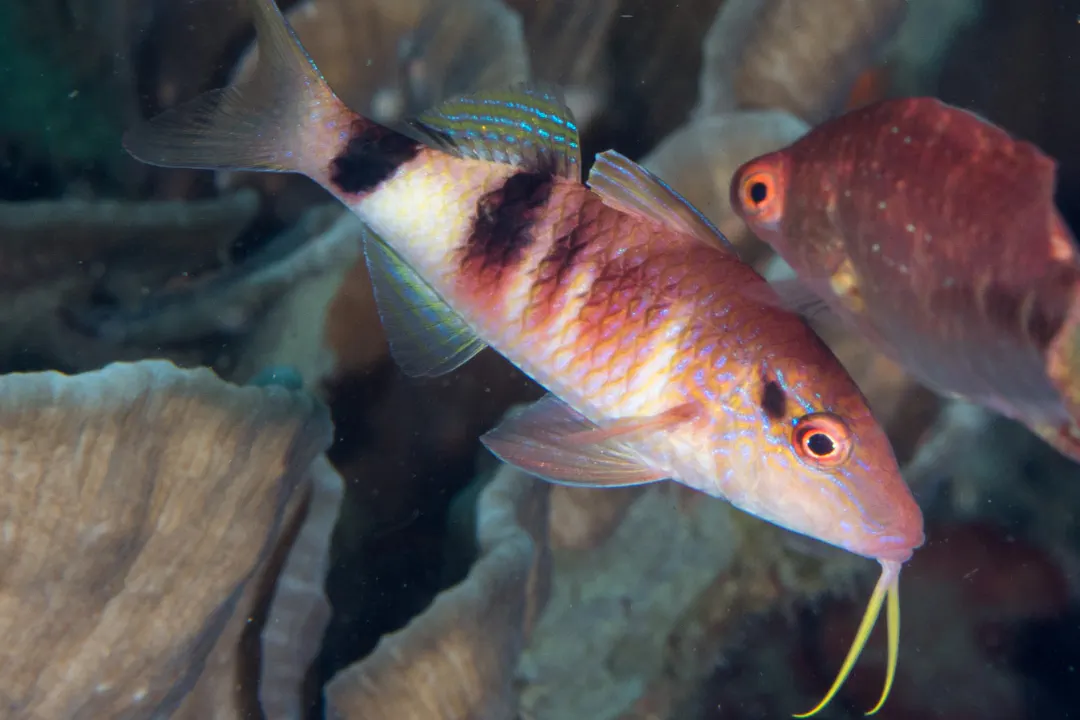
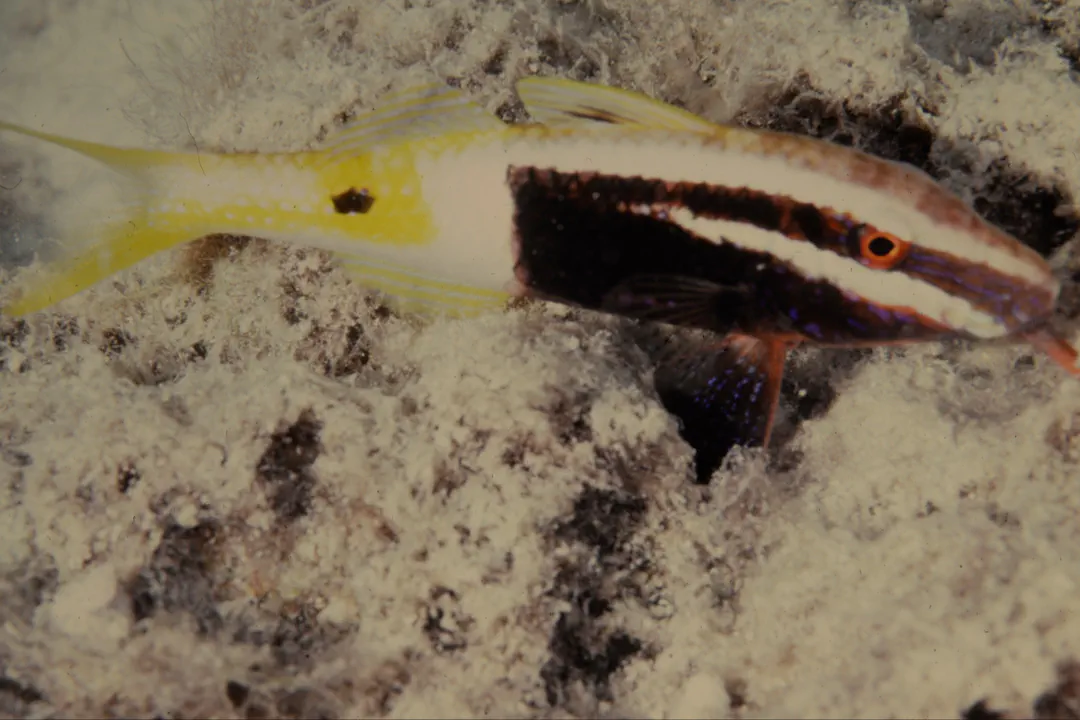
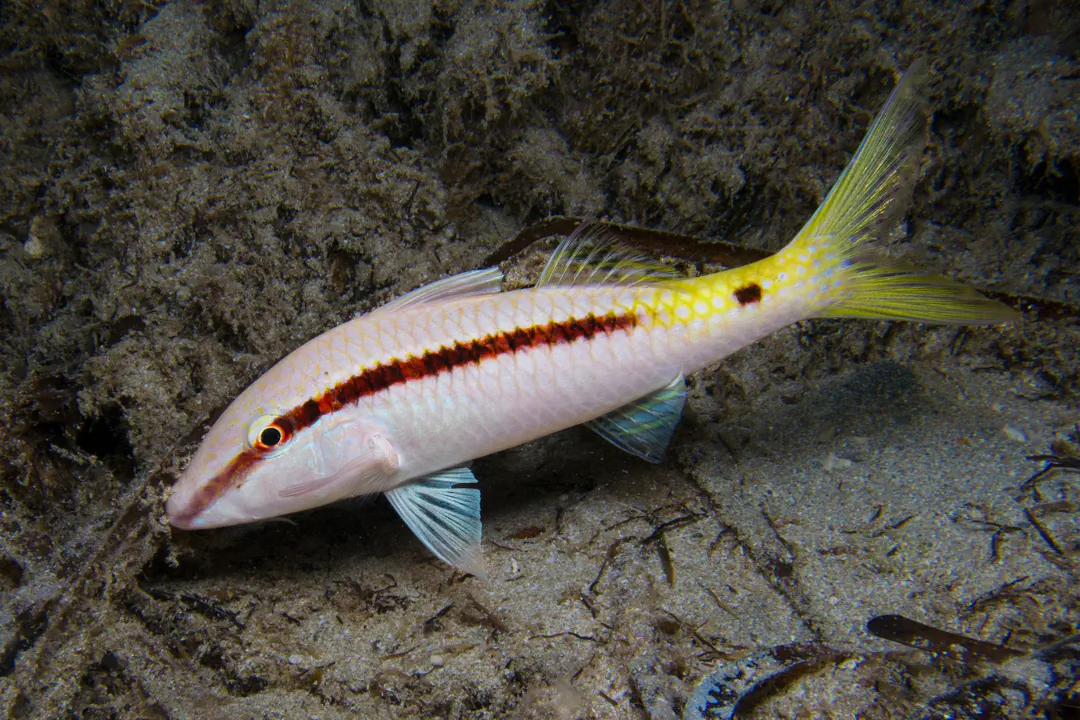
Parupeneus multifasciatus is a species of goatfish native to the eastern Indian Ocean and Pacific Ocean where it is found from Christmas Island to the Hawaiian Islands and from southern Japan to Lord Howe Island.
Males of this species can reach a length of 35 centimetres (14 in) TL while females only reach 17.9 centimetres (7.0 in) SL. Body is pale greyish to brownish-red with alternating dusky-red to blackish and white bars of varying widths, and a dark bar behind the eye. The margins of the scales often yellow, with a broad black bar on caudal peduncle and one beneath anterior part of second dorsal fin, the area between bars paler than rest of body (sometimes white). A narrow dusky bar is often present below interdorsal space, and one or two broad dark bars may be present anteriorly on side of body. Head is usually with a dark brown band from above upper lip through eye to upper end of gill opening. Caudal fin is yellowish to pink with narrow blue lengthwise bands. Basal half of second dorsal fin of adults is dusky anteriorly, black posteriorly, the outer half with narrow dark-edged blue and yellow bands. Anal fin is like outer part of second dorsal fin. Dorsal spines (total): 8; Dorsal soft rays (total): 9; Anal spines: 1; Anal soft rays: 7. Pectoral rays 16 (rarely 15 or 17). Gill rakers 7-10 + 28-33 (total 36-41). Body depth 3.1-3.65 in SL; head length (HL) 2.8-3.1 in SL; dorsal profile of snout straight to slightly concave, the length 1.65-1.95 in HL; barbels long, their length 1.0-1.3 in HL; longest dorsal spine 1.5-1.75 in HL; last dorsal soft ray notably longer than penultimate ray, the latter contained 1.15-1.45 in length of the former; posterior margin of caudal-fin lobes convex; pectoral-fin length 1.35-1.55 in HL; pelvic-fin length 1.25-1.45 in HL.
Christmas Island in the eastern Indian Ocean to the Hawaiian, Line, Marquesan, and Tuamoto islands, north to southern Japan, south to Lord Howe and Rapa Islands.
It is an inhabitant of coral reefs and can be found at depths of from 3 to 161 metres (9.8 to 528.2 ft). This is a commercially important species as well as being sought after as a game fish. It can also be found in the aquarium trade.
© Roger RittmasterCC BY 4.0 · iNaturalist 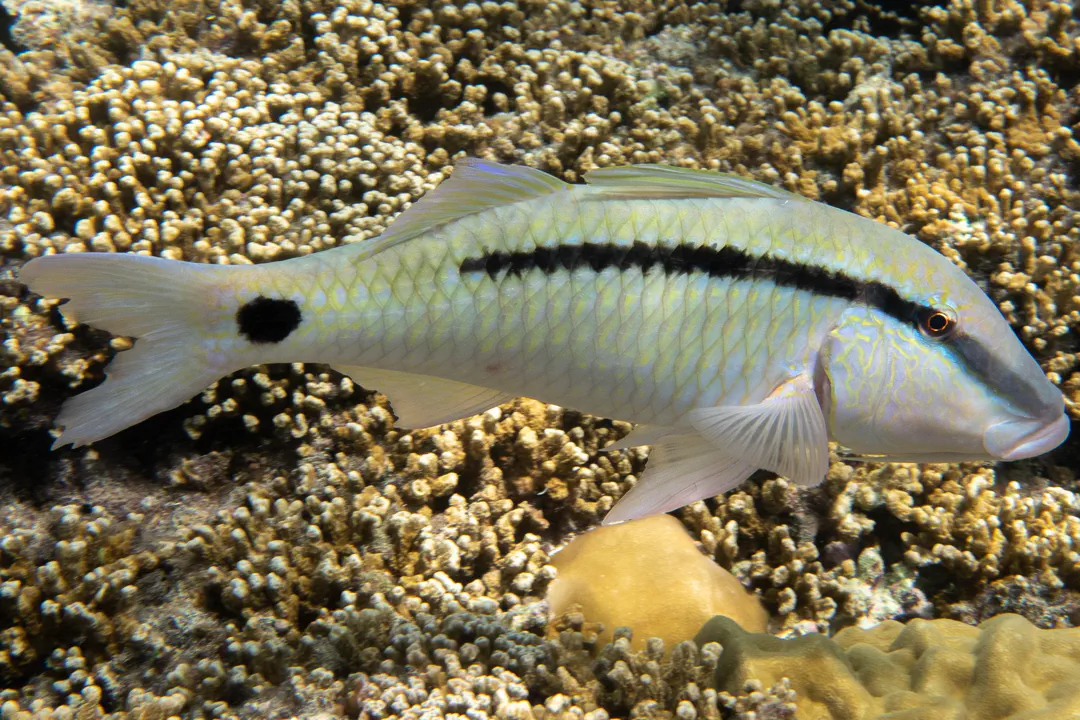 © Storm MartinCC BY 4.0 · iNaturalist
  © seabook.appAll rights reserved
 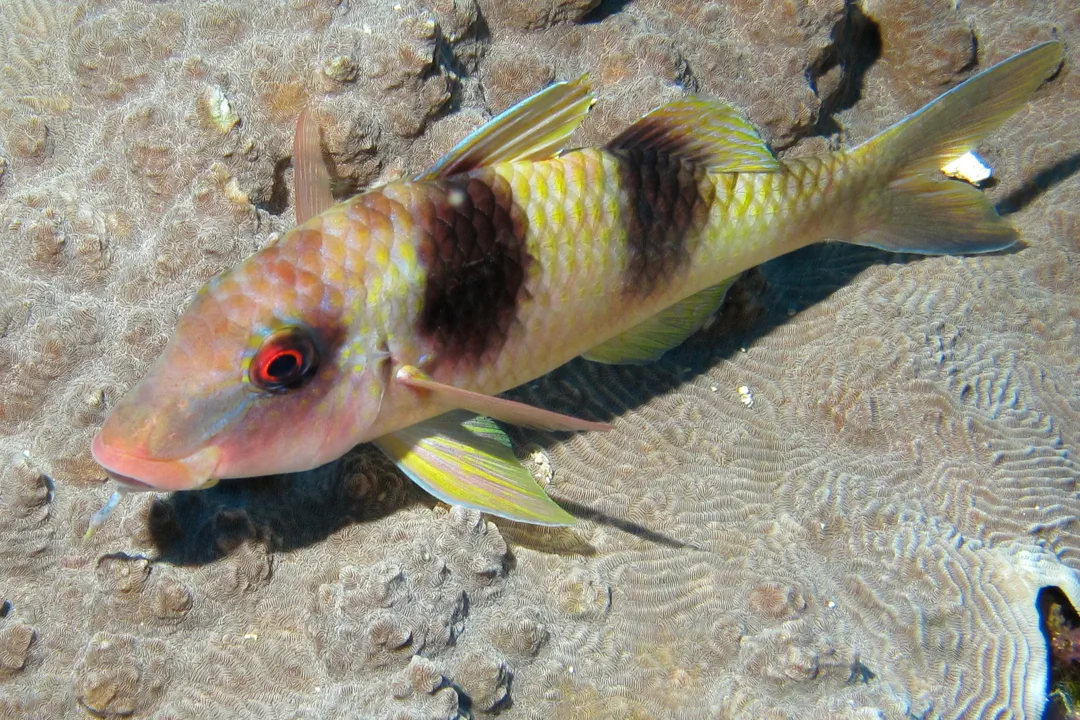 © Bernard DUPONTCC BY 4.0 · iNaturalist
 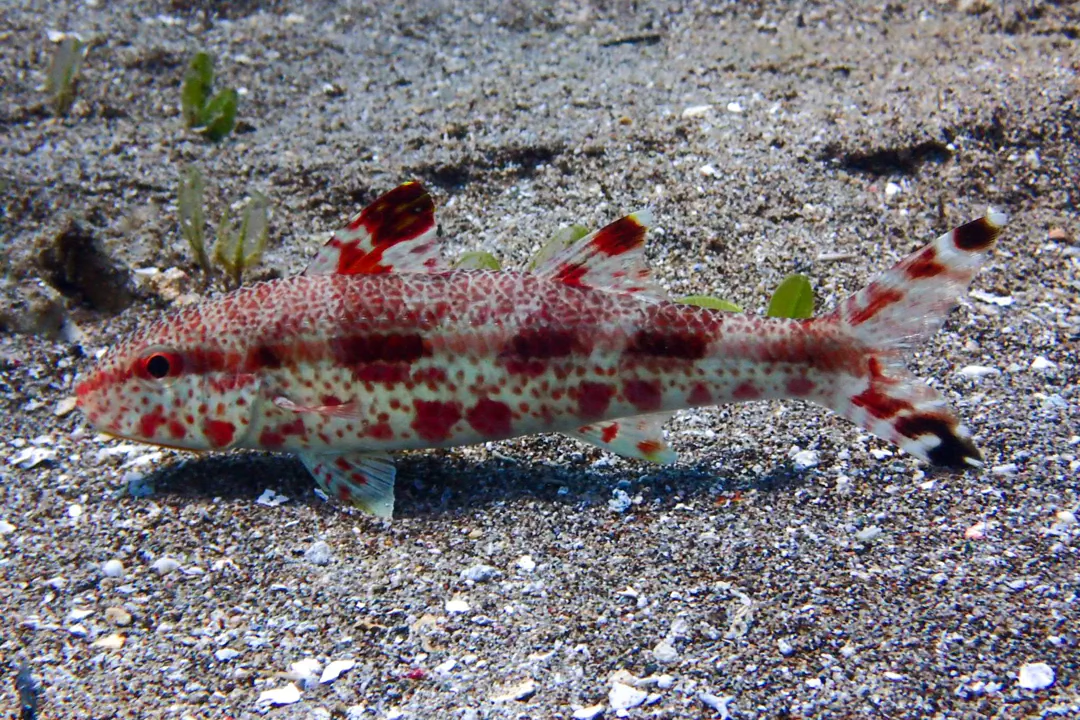 © Dan SchofieldCC BY 4.0 · iNaturalist
 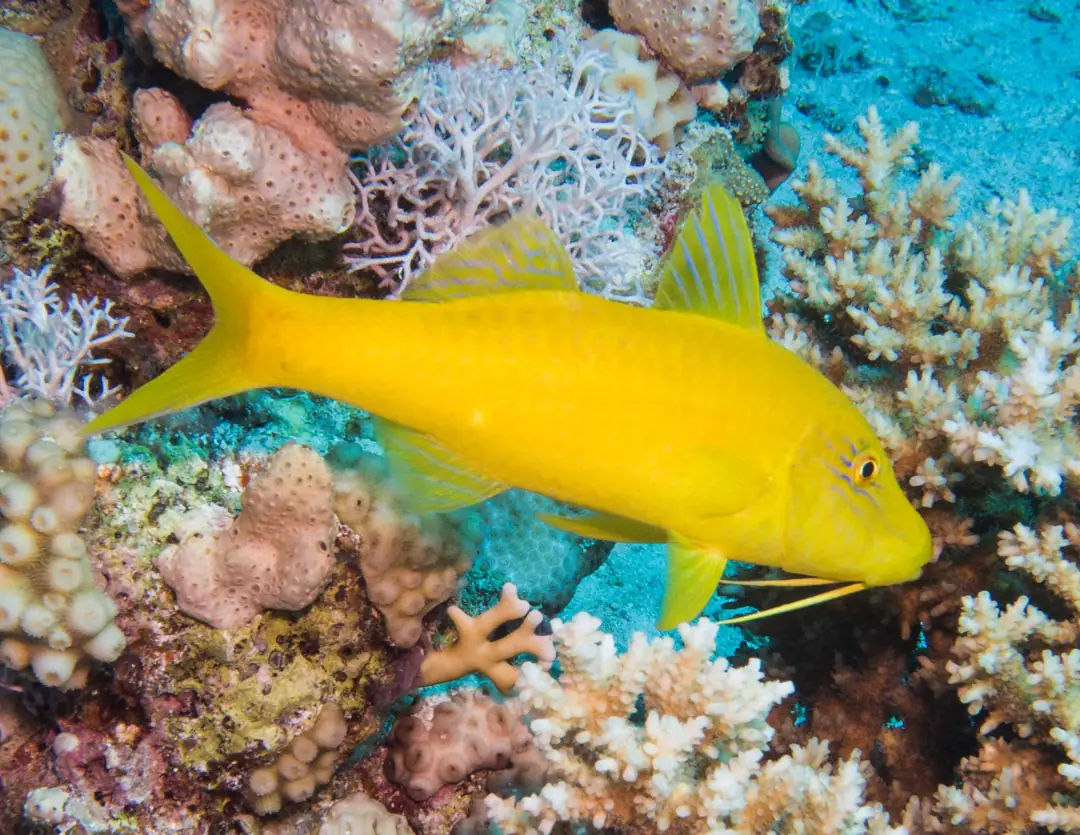 © Lesley ClementsAll rights reserved
 Manybar Goatfish has no known danger to humans. However, always observe marine life responsibly.
Manybar Goatfish can be found at depths of up to 161 meters.
Download Seabook free for iOS and Android.