 © seabook.appAll rights reserved
Common Mola
Mola mola
Mola alexandrini
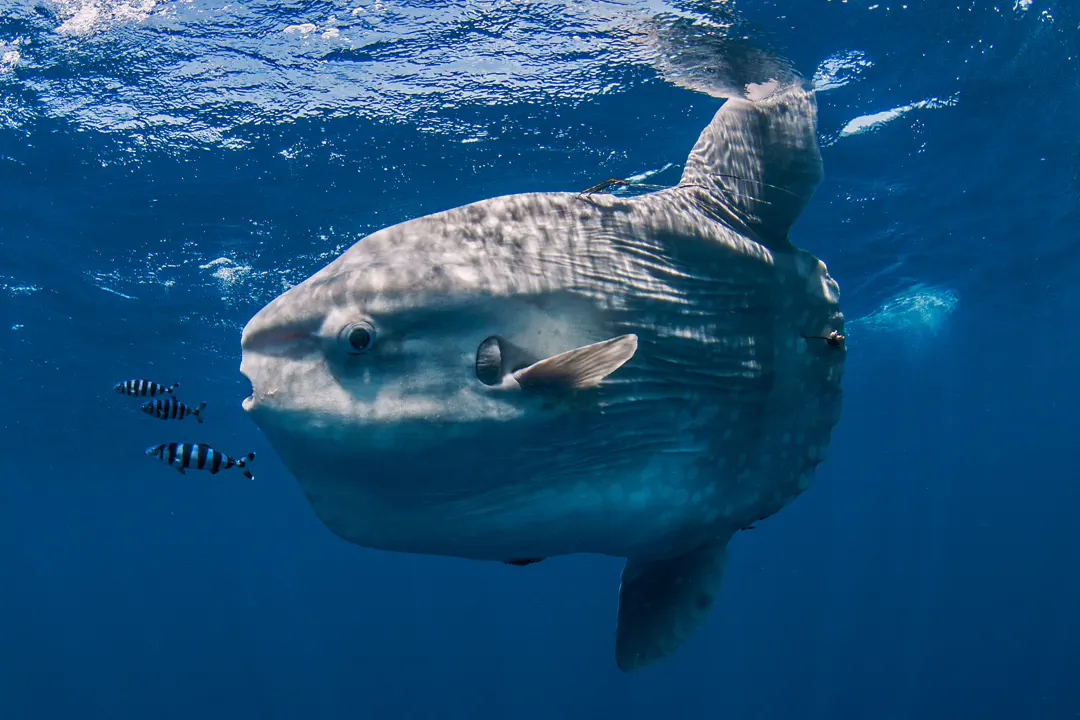
Mola ramsayi (Mola alexandrini) is a fish belonging to the family Molidae. It is closely related to its congener, the larger and much wider known Mola mola, and is found in the Southern Hemisphere. It can be found basking on its side occasionally near the surface, which is thought to be used to re-heat themselves after diving in cold water for prey, recharge their oxygen stores, and attract seagulls to free them of parasites.
Mola ramsayi has a relatively small mouth and its teeth fused into a parrot-like beak. It can reach up to 3.3 m (11 ft) in length and 2,300 kg in mass, making it one of the two heaviest bony fish on Earth, only matched by its congener, the ocean sunfish. Their body is flat and round, with large fins that they swish back and forth to propel themselves with as they swim horizontally. Their skin has rough denticles, leathery texture, with brown and gray coloring with pale blotches until death when they turn white. Both mola species have no caudal bones, ribs, and pelvic fins and have fused vertebrae, leaving only their median fins to propel themselves. It can be recognized from the Mola mola by their lesser number of ossicles and lacking the vertical band of denticles at its base.
M. alexandrini was found to be synonymous with M. ramsayi in July 2017 and can be distinguished by their unique characteristics of head bump, a chin bump, rectangular body scales, and rounded clavus. Although adult sunfish look generally similar, they are distinguishable using the seven characteristics: number of clavus fin rays (Yoshita et al 2009), number of clavus ossicles (Yoshita et al 2009), shape of clavus margin (Yoshita et al 2009), presence of head bump (Yoshita et al 2009), proportion of body length compared to body height (Yoshita et al 2009), shape of body scales (Fraser-Brunner 1951), and the presence of a chin bump (Sawai et al. 2017).
Mola ramsayi is found in the southwest Pacific, especially around Australia and New Zealand, and the southeast Pacific around Chile. Its range also extends to the southeast Atlantic near South Africa. This species is found in pelagic-oceanic temperate waters.
They consume a large amount of jellyfish, as they are in vast amounts despite their low nutritional content, but they will also eat brittle stars, small fish, plankton, algae, salps, and mollusks.
The Molidae comprise the family of the molas or ocean sunfishes, unusual fish whose bodies come to an end just behind the dorsal and anal fins, giving them a "half-fish" appearance. They are also the largest of the ray-finned bony fish, with the ocean sunfish Mola mola recorded at up to 15 ft (4.6 m) in length and 2,000 kg (4,400 lb) in weight.
Molidae have the fewest vertebrae of any fish, with only 16 in Mola mola. They also completely lack all caudal bones, and most of their skeletons are made of cartilage. No bony plates occur in the skin, which is, however, thick and dense like cartilage and is fairly rough. They also lack swim bladders.
Molids mostly swim by using their anal and dorsal fins; the pectoral fins are probably just stabilizers. To steer, they squirt a strong jet of water out of their mouths or gills. They can also make minor adjustments in the orientation of the anal fin or the dorsal fin so as to control the amount of force it produces and the angle at which the force is produced. In this respect, they use their fins much like a bird uses its wings.
Molids are said to be able to produce sound by grinding their pharyngeal teeth, which are long and claw-like. Typical of a member of Tetraodontiformes, their teeth are fused into a beak-like structure, making it impossible for them to close their mouths. Despite this, they feed mainly on soft-bodied animals, such as jellyfish and salps, although they also take small fish or crustaceans.
Molids have been filmed interacting with other species. Since molids are susceptible to skin parasites, they make use of cleaner fish. A molid in need of cleaning will locate a patch of floating algae or flotsam that is home to halfmoon. The molid then signals a readiness for cleaning by swimming almost vertically with its head near the surface of the water. It waits for the smaller cleaner fish to feed on the parasite worms. Similarly, the molid may break the surface of the water with its dorsal fin and beak to attract the attention of a gull or similar seabird. The seabird will then dig worms and other stubborn parasites out of the molid's skin.
The known fossil history of this genus extends back to the Eocene with the genus Eomola containing the species E. bimaxillaria Tyler and Bannikov, 1992 known from the Upper Eocene of the North Caucasus. The fossil genus Austromola containing one species, A. angerhoferi Gregorova, Schultz, Harzhauser & Kroh, 2009, is known from the Lower Miocene Ebelsberg Formation near Pucking, Austria. This species was a resident of the Paratethys Sea and is estimated to have reached a length around 320 cm (130 in). At least one fossil species of Mola, M. pileata (van Beneden, 1881), is known from the Upper and Middle Miocene of Europe with a possible second species known from the Lower Miocene of North Carolina, USA. The genus Ranzania has five known fossil species: R. grahami Weems, 1985 and R. tenneyorum Weems, 1985, both from the Middle Miocene Calvert Formation of Virginia, USA; R. zappai Carnevale, 2007 from the Middle Miocene of Italy; R. ogaii Uyeno & Sakamoto, 1994 from the Middle Miocene of Japan; and an as yet unnamed species from the Upper Miocene of Algeria.
Only four species in three genera are described:
© seabook.appAll rights reserved Short Sunfish has no known danger to humans. However, always observe marine life responsibly.
Short Sunfish can be found at depths of up to 480 meters.
Download Seabook free for iOS and Android.