 © Dan SchofieldCC BY 4.0 · iNaturalist
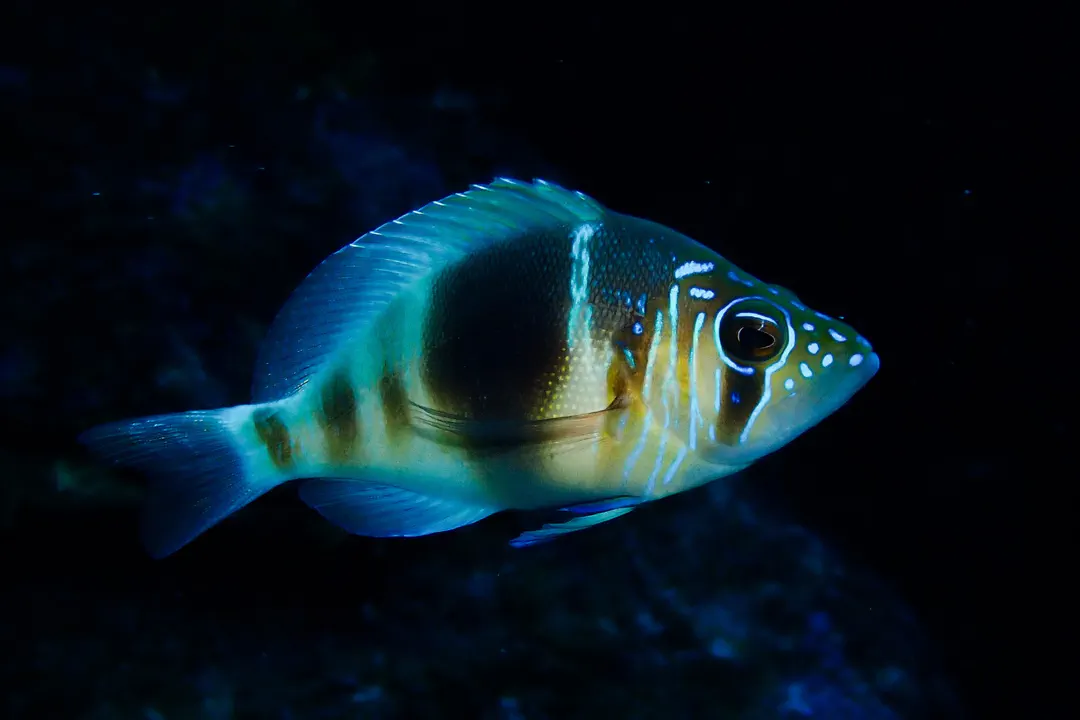
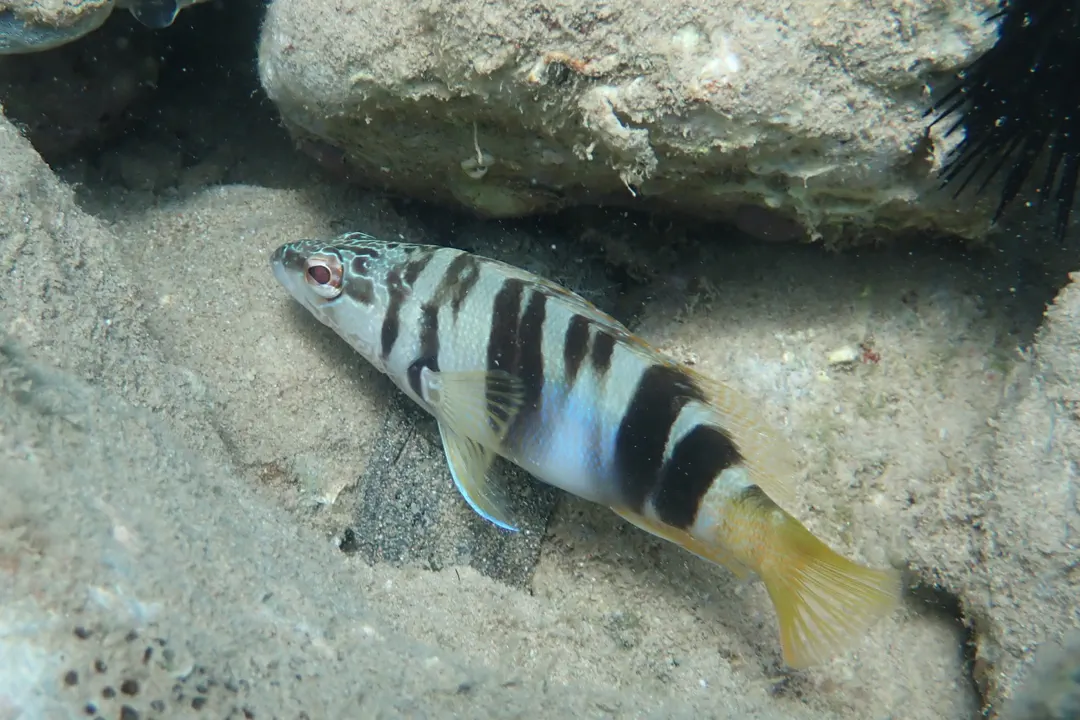
Barred Hamlet
Hypoplectrus puella
Hypoplectrus unicolor
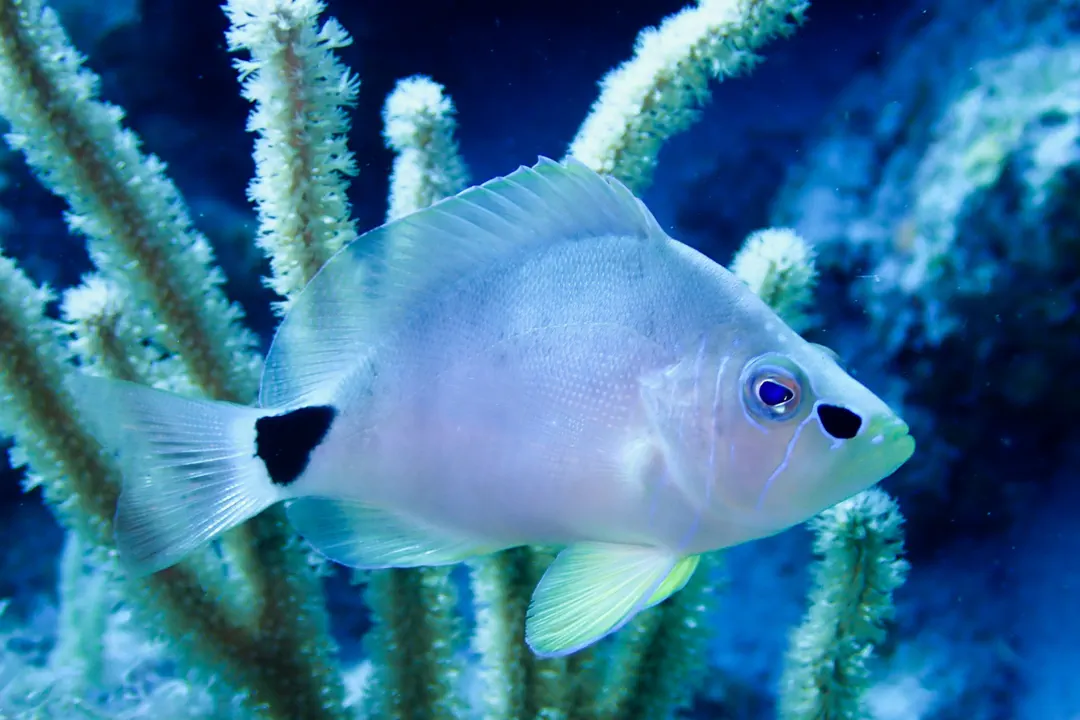
Hypoplectrus unicolor is a hamlet from the Western Central Atlantic and is found in Florida, the Bahamas and throughout the Caribbean. It is absent from the Gulf of Mexico. It occasionally makes its way into the aquarium trade. It grows to a size of 13 cm in length.
Hypplectrus unicolor has a deep body and head which is highly laterally compressed with a straight forehead and a rather short snout and a protrusible upper jaw. It has an angular preoperculum which has serrations on its edge and a number of small forward pointing spines on its lower margin close to the angle. The continuous dorsal fin has ten spines and 14-17 soft rays. It has long pelvic fins which extend as far as or beyond the anus. The caudal fin is slightly forked. The body is greyish white to yellow in colour with the back being darker, with a sizeable black saddle-like marking on the base of the caudal fin, this extends over the lateral line on each side. Horizontal, iridescent blue lines run along the head, occasionally these extebd as far as front edge of the pelvic fins. There is an obvious blue line around the eye. Some individuals may show two black spots on the snout. The pelvic fins are yellowish in colour while the pectoral fins are transparent.
Hypoplectrus unicolor is found in the western Atlantic. It extends from Cape Canaveral in Florida south to the Bahamas and into the Gulf of Mexico as far west as Cedar Key and along the mainland coast of Mexico from Tuxpan to the northern Yucatan Peninsula and from northwestern Cuba south through the Caribbean Sea.
Hypoplectrus unicolor is found on shallow fringing reef faces, the front slopes of reefs, and under piers. It is normally found at depths between 3 to 25 metres (9.8 to 82.0 ft). It is a carnivorous species which has a diet largely consisting of crustaceans and smaller fishes. The juveniles are frequently observed in mangroves. The species in the genus Hypoplectrus are synchronous hermaphrodites and they have the ability to move between "male" and "female" roles when spawning. It has been suggested that H. unicolor is a mimic of the foureye butterflyfish (Chaetodon capistratus) and this proposition was based on resemblances in their colour patterns and general shape, their shared use of similar habitats in shallow waters and the comparative scarcity of H. unicolor and their prey preferences, H. unicolor feeds on mobile benthic animals while C. capistratus preys on sessile benthic invertebrates. However, H. unicolor varies in colour and pattern geographically whereas C. capistratus does not and their juveniles do not resemble each other either. There is a relationship between the two however, as individuals which follow feeding pairs of the butterflyfish have a higher success rate in capturing prey than hamlets that do not associate with butterflyfish.
© Dan SchofieldCC BY 4.0 · iNaturalist  © Sarah FaulwetterCC BY 4.0 · iNaturalist
  © Brian GratwickeCC BY 4.0 · iNaturalist
  © Sarah FaulwetterCC BY 4.0 · iNaturalist
 Butter Hamlet (juvenile) has no known danger to humans. However, always observe marine life responsibly.
Butter Hamlet (juvenile) can be found at depths of up to 25 meters.
Download Seabook free for iOS and Android.