 © Susan PriorCC BY 4.0 · iNaturalist
Bluestripe Lizardfish
Synodus dermatogenys
Synodus variegatus
Synodus variegatus is a lizardfish of the family Synodontidae found in the western Pacific and Indian Oceans, at depths from 4 to 90 m.
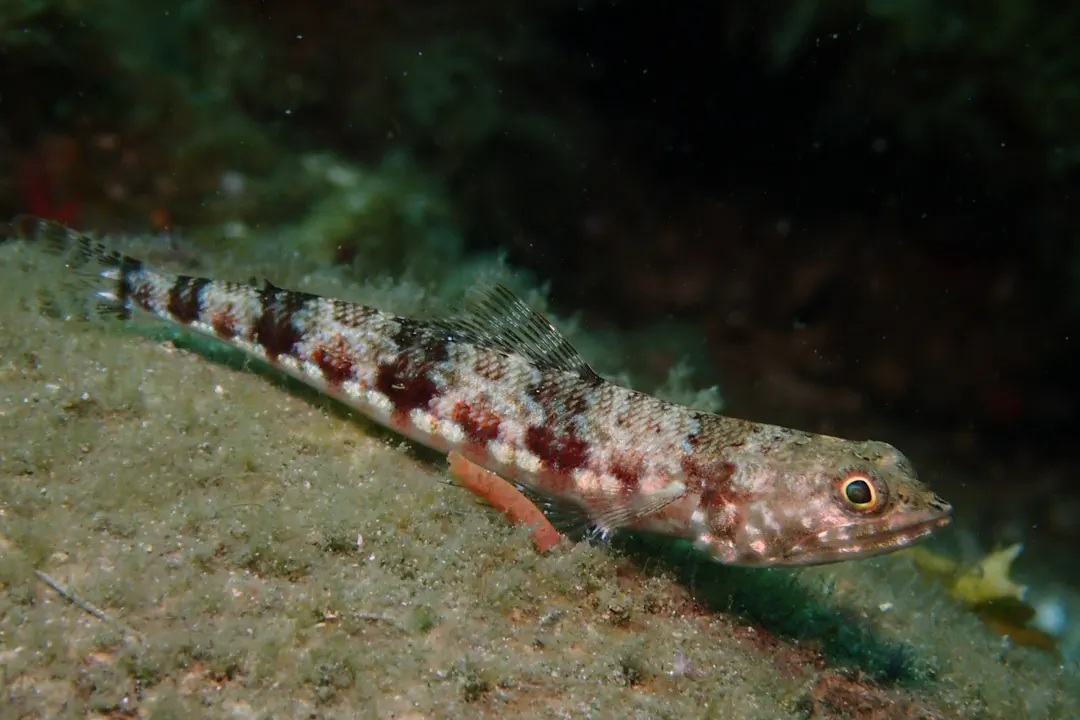
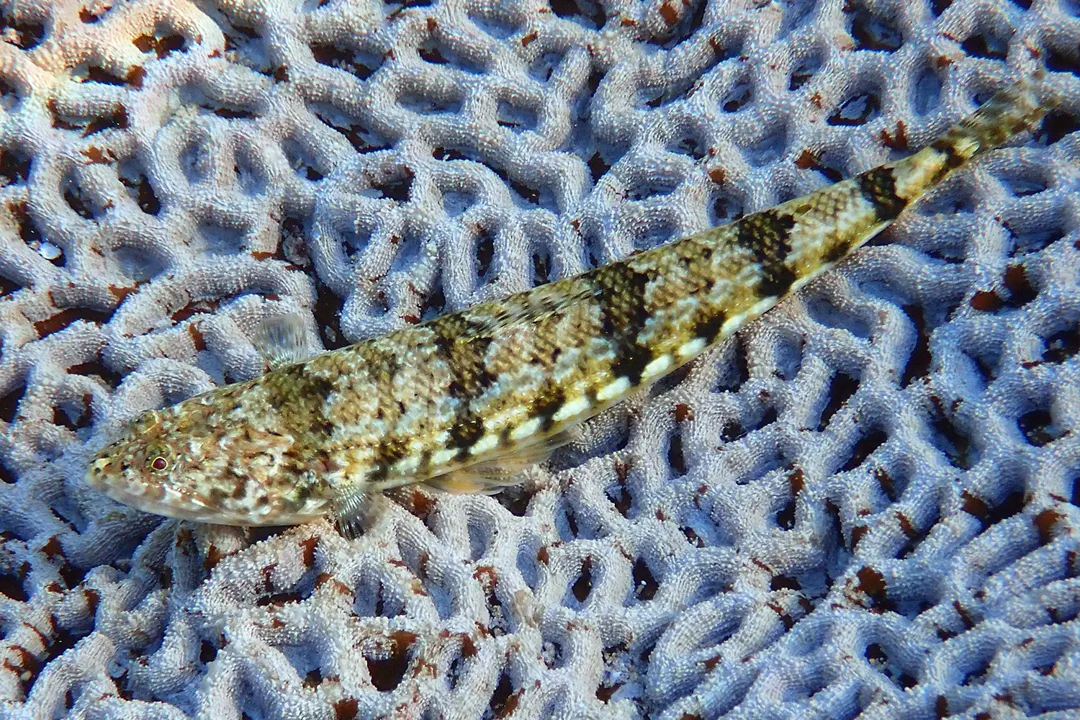
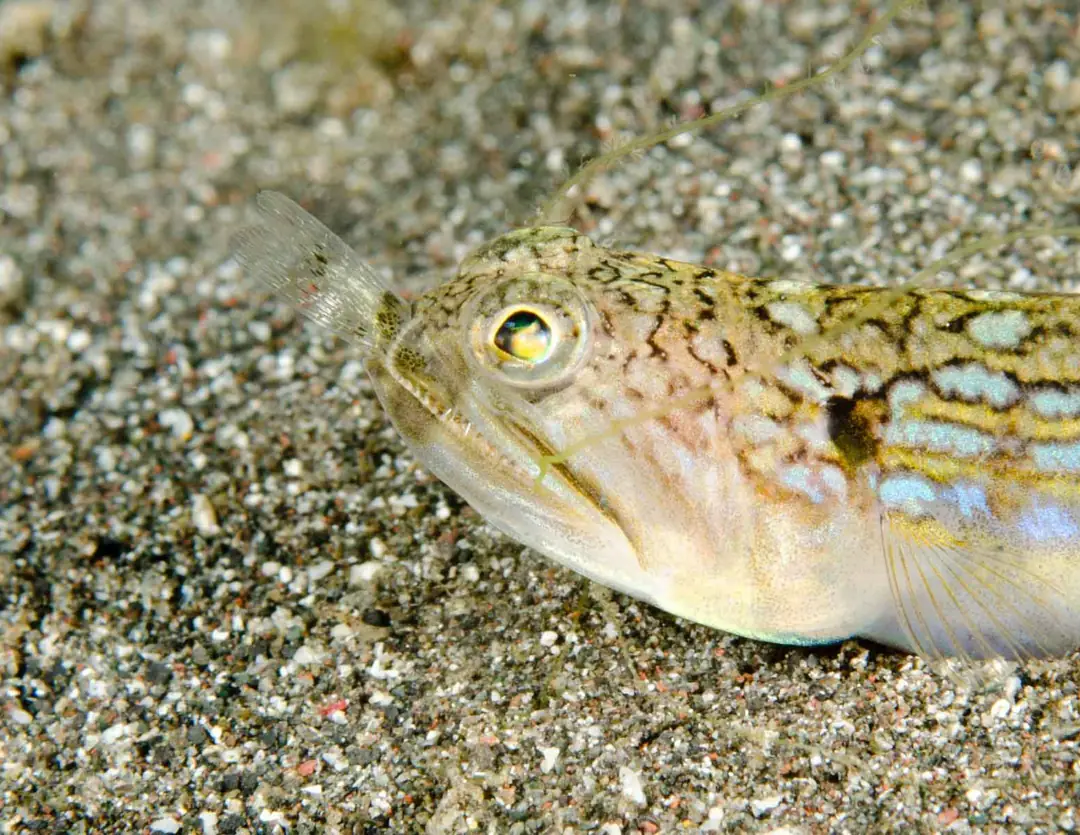
The variegated lizardfish is rounded in cross-section with a broad, moderately flattened head and a large, wide mouth. The jaws protrude equally. Both jaws and all the mouth bones are covered with conical, barbed teeth. The strong, thick pelvic fins serve as props when the fish is resting on the bottom waiting for prey. The variegated lizardfish varies in color from grey to red, with hourglass-shaped markings. On some individuals, the hourglass- or saddle-shaped markings along its side may be obliterated by an almost solid dark red band. Large individuals are often thick-bodied, giving a hump-backed appearanceIt can reach a maximum length of 40 cm.
Indo-Pacific: Red Sea and East Africa to the Hawaiian, Line, Marquesan, and Ducie islands, north to the Ryukyu Islands, south to the Lord Howe, Kermadec and Rapa islands. Reported from New Zealand and Persian Gulf.
Inhabits deep lagoon and seaward reefs; sometimes found on sandy bottoms concealing itself in the sand. Prefers to rest on hard surfaces and frequently occurs in pairs. Benthic. Feeds on small fishes by seizing these from passing schools, also shrimps.
The species Synodus dermatogenys was once misidentified as S. variegatus, while the true S. variegatus was referred to as S. englemani Schultz, 1953 by many authors, including Gosline & Brock (1960) and Cressey (1981). However, Waples and Randall (1989) showed that S. variegatus is a senior synonym of S. englemani, and that S. dermatogenys is the correct name for the lizardfish that Cressey (1981) identified as S. variegatus.
© Susan PriorCC BY 4.0 · iNaturalist 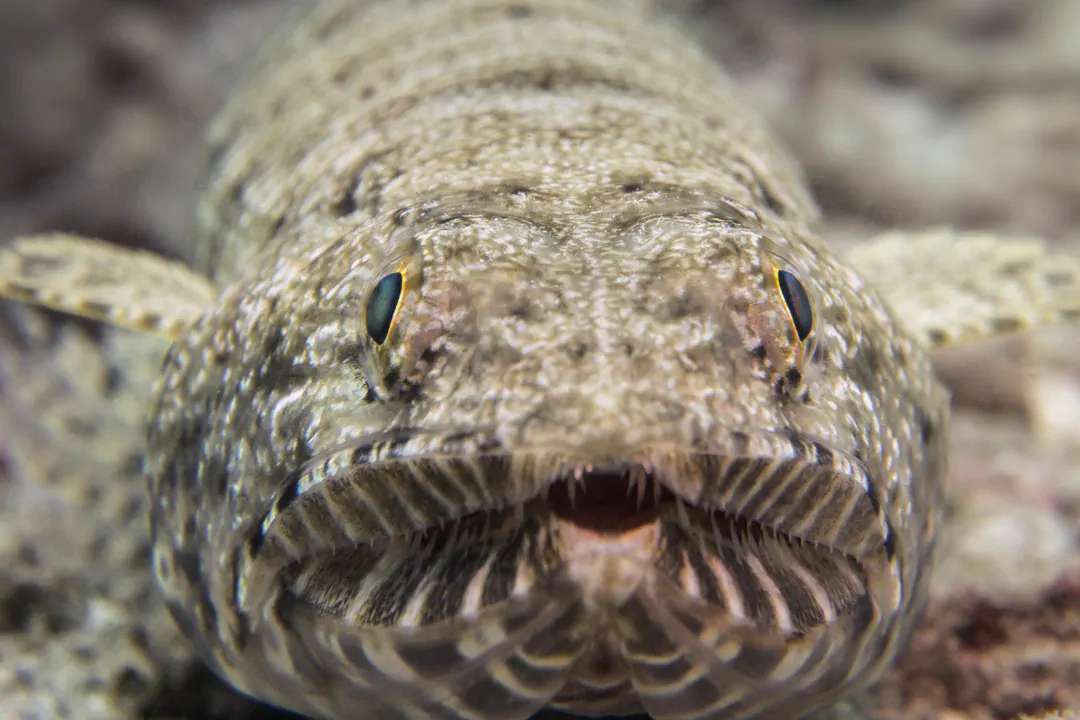 © Ewout KnoesterCC BY-SA 4.0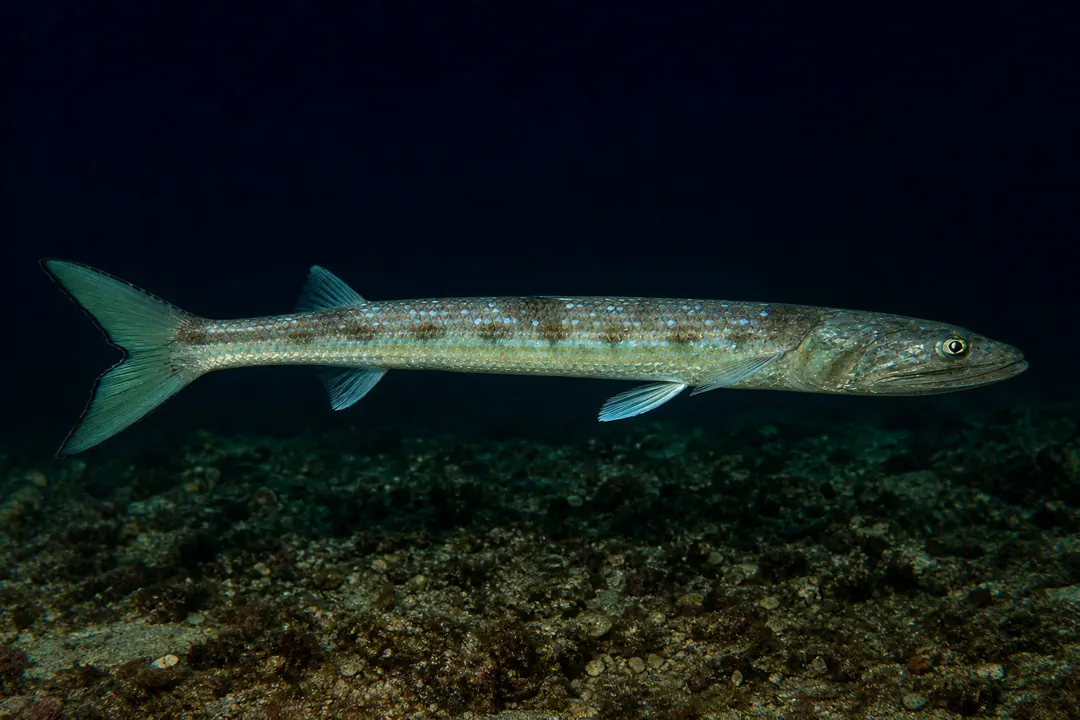
 © Ian ShawAll rights reserved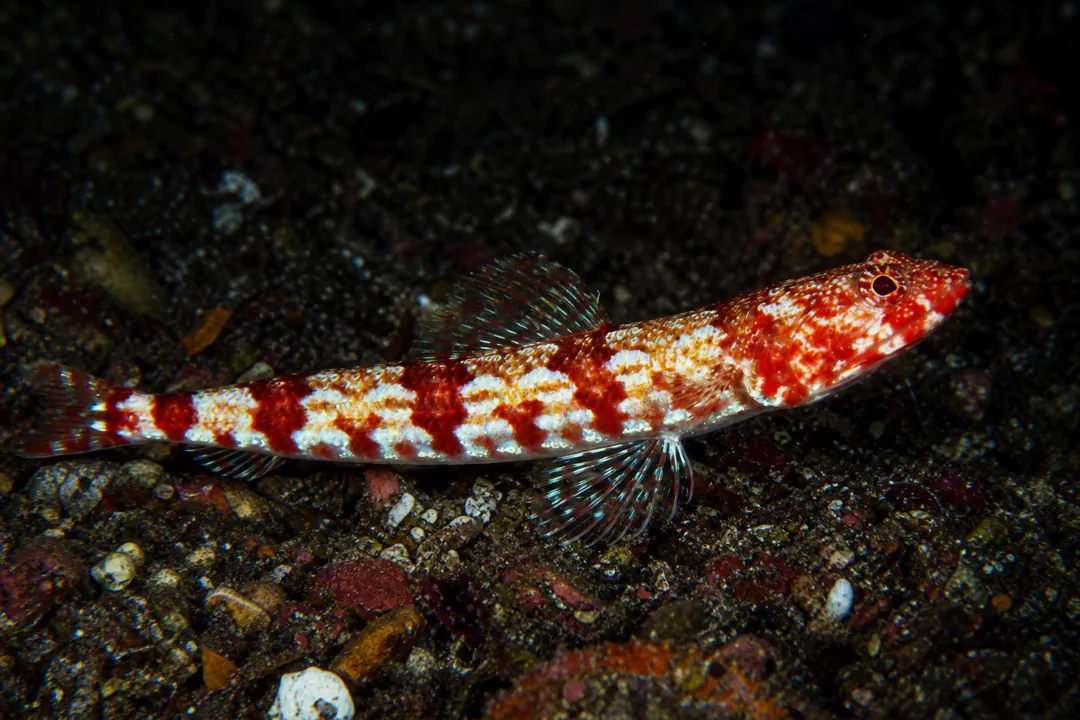
Variegated Lizardfish has no known danger to humans. However, always observe marine life responsibly.
Variegated Lizardfish can be found at depths of up to 121 meters.
Download Seabook free for iOS and Android.