 © Ian ShawAll rights reserved
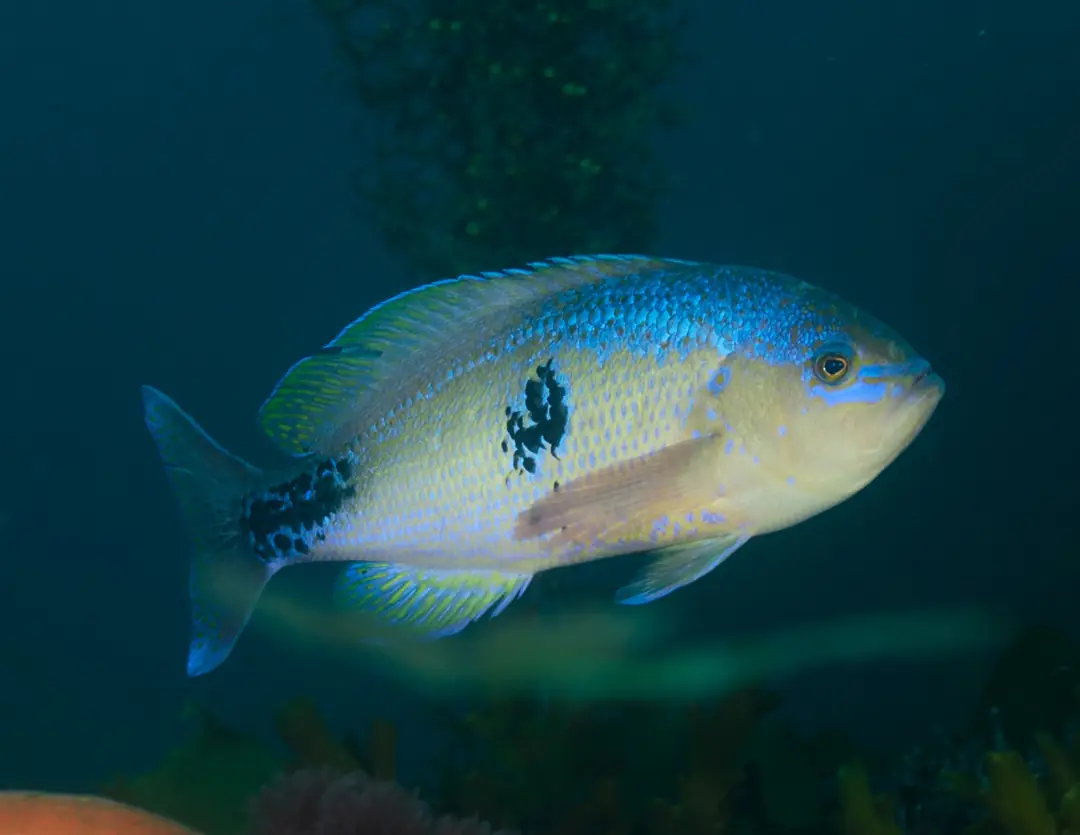
Barber Perch
Caesioperca rasor
Hypoplectrodes nigroruber
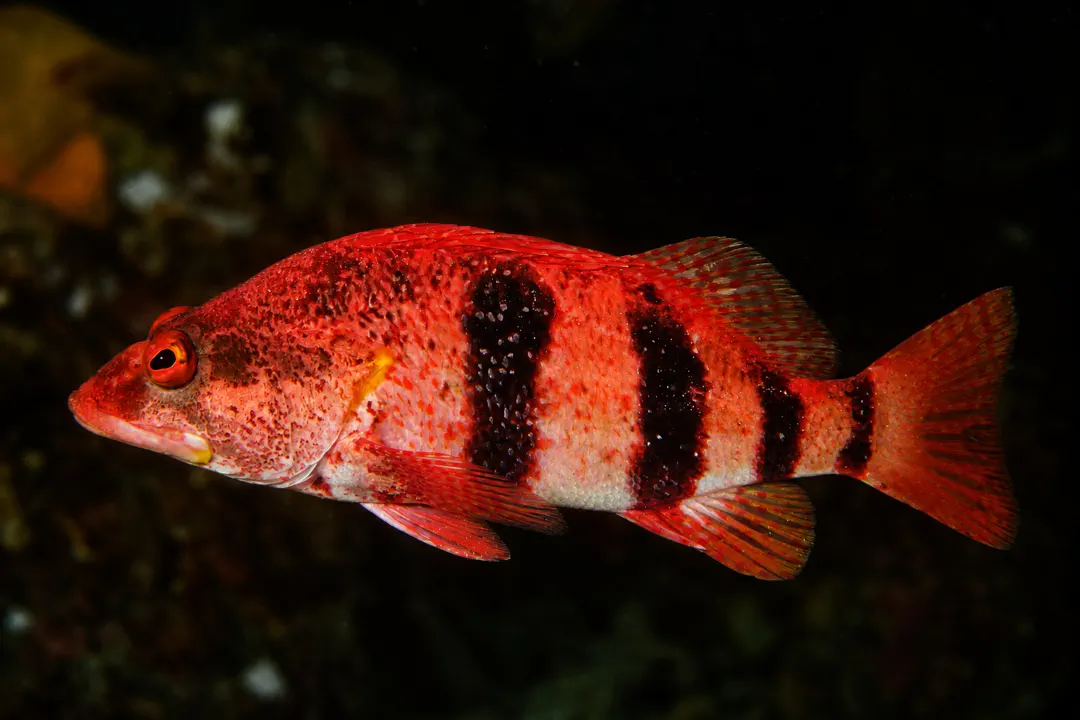
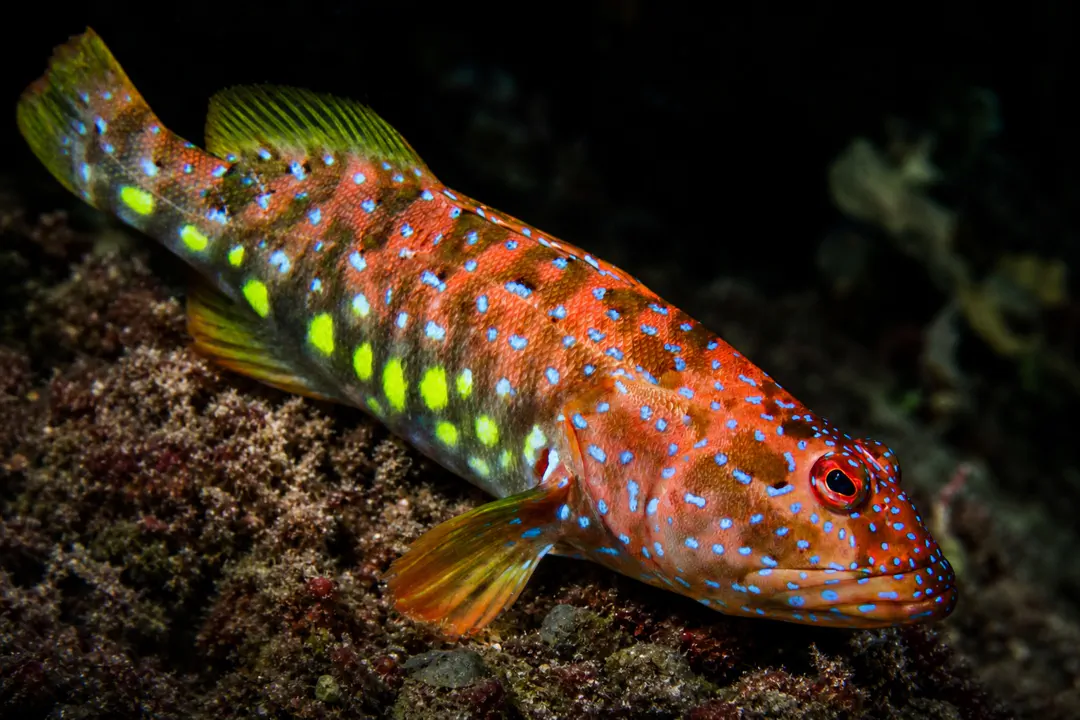
Hypoplectrodes nigroruber, commonly known as the Banded Seaperch, is a member of the family Serranidae and is endemic to temperate Australian waters. The species reaches a maximum length of 30 cm and is characterized by deep red to brown or yellowish grey coloration above, with four darker red to black vertical bands over the posterior half of its body.
The species was first described by Georges Cuvier in 1828 under the original name Plectropoma nigrorubrum. The currently accepted scientific name is Hypoplectrodes nigroruber, with the species epithet meaning 'black-red' in Latin. The genus name Hypoplectrodes is derived from Greek, meaning 'under sting' or 'similar to a spur'. The genus Hypoplectrodes was established by Theodore Gill in 1862. Later sources also treat the spelling Hypoplectrodes nigrorubrum as a synonym.
The Banded Seaperch has a robust body shape with large bulging eyes set high on the head. It is best identified by its four broad dark vertical bands crossing the body, with the last band at or near the base of the tail. The background colour of the species can vary and may include red, brown, yellowish-grey, green, pink, or white. The upper parts of the head and body are densely mottled with dark spots, while the underside is typically paler, often white. A yellow posterior margin of the gill cover is reported in some accounts of the species. The bulging eyes on top of the head help distinguish the Banded Seaperch from many similarly coloured reef fish. It can be confused with wrasses such as Pseudolabrus semifasciatus or Pseudolabrus torotai, but the Banded Seaperch is characterized by its four strong dark body bands and high-set bulging eyes. Compared to H. jamesoni, which is described as variable brownish-grey and smaller, the Banded Seaperch is more obviously banded rather than plain or lightly marked. The combination of four bands, mottling, and variable reddish-brown colour is the best cue for identifying Hypoplectrodes nigroruber specifically. Juveniles may appear whitish with black bands, making colour alone an unreliable identification feature.
The Banded Seaperch lives on coastal rocky reefs and other reef habitats rather than open water. It is reported from depths of 0–40 m, with a shallower range of up to 30 m noted by the Australian Museum. The geographic distribution of the species is temperate Australasia, and it is endemic to Australia. The reported Australian range spans northern New South Wales around southern Australia, including Tasmania, to south-western/central Western Australia.
The Banded Seaperch is reported as a solitary reef fish, generally seen at depths below 30 m on protected offshore coastal rocky reefs. Diver reports describe the Banded Seaperch as a 'loner on the reef.' The available sources do not provide strong evidence for a detailed day–night activity rhythm for this species. No species-specific reproductive behavior was given in the retrieved sources for the Banded Seaperch. It is often observed only by scuba divers because it lives deeper than 30 m, implying it may be encountered by divers, but the sources do not describe a specific response such as avoidance or tameness.
The Banded Seaperch is carnivorous and is reported to eat small fish. It is characterized as a predator that preys on unwary small fish, implying active ambush or opportunistic predation.
There is no evidence of a substantial commercial or recreational fishery targeting the Banded Seaperch, as it is not considered an important fisheries species. The available sources do not indicate that the Banded Seaperch is traded in the aquarium industry. One source suggests that the Banded Seaperch can be good eating, but this is not supported by evidence of a formal fishery or widespread market use. The conservation status of the Banded Seaperch is listed as Not Evaluated by the IUCN, indicating a lack of formal assessment for this species.
© Ian ShawAll rights reserved  © seabook.appAll rights reserved
  © Deb AstonAll rights reserved
  © Storm MartinCC BY 4.0
  © seabook.appAll rights reserved
  © AlbeerAll rights reserved
 Banded Seaperch has no known danger to humans. However, always observe marine life responsibly.
Download Seabook free for iOS and Android.