 © Tom HeijnenCC BY 4.0 · iNaturalist
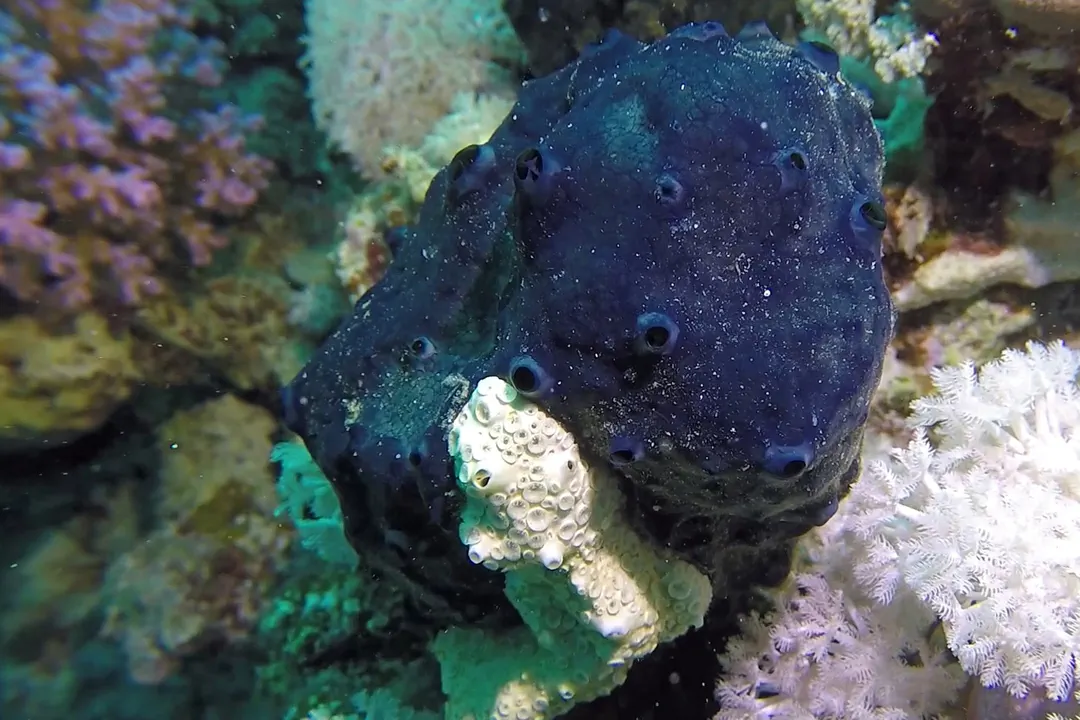
Arabian Crust Sponge
Hemimycale arabica
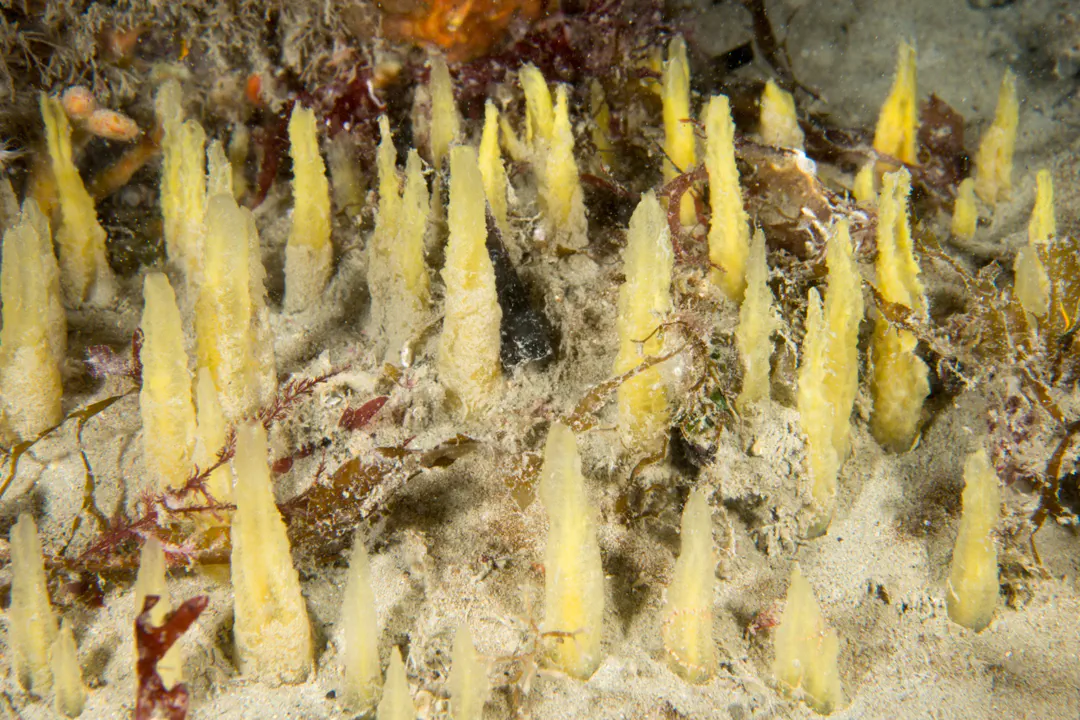
Ciocalypta penicillus
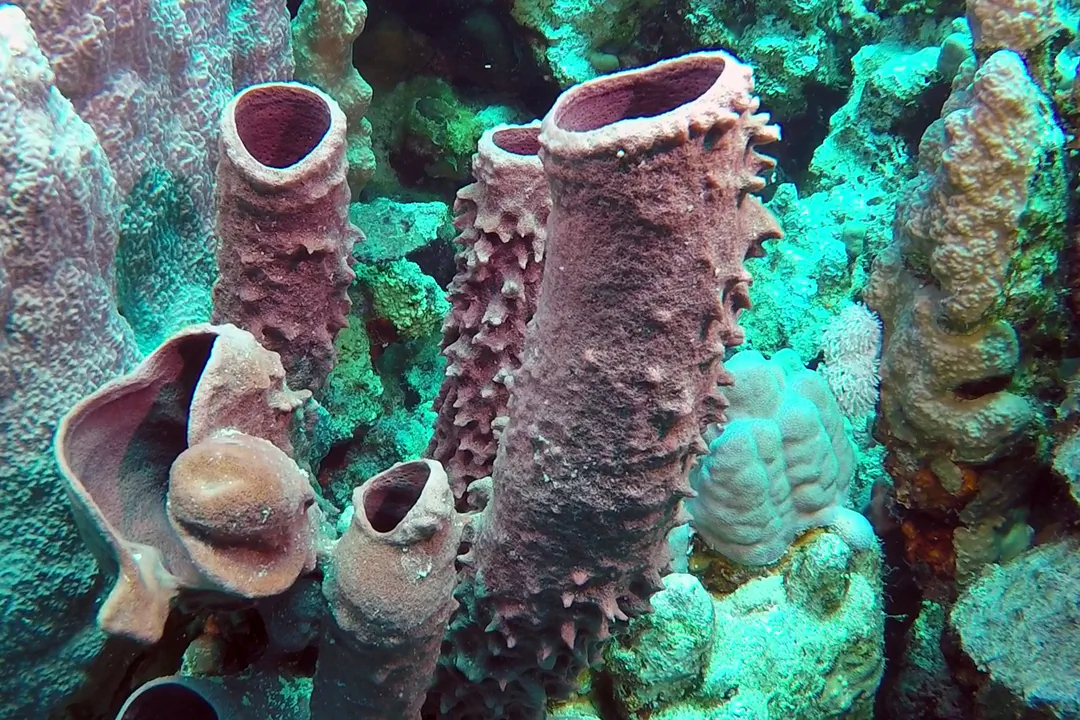
Ciocalypta penicillus is a very characteristic sponge with its massive base buried in the substrate (sand or gravel) and half a dozen or more conical, erect and firm fistules protruding above it.
Coloration is white-cream to cream-yellow to grey, both cushions and papillae. Very characteristic. The sponge consists of a basal cushion of up to 10 cm in diameter buried in sand or gravel, from which project large conical, translucent, ridged, thick walled, non-contractile fistules, normally up to about 5-9 cm high, 0.5-0.6 mm in diameter. The surface of the fistule has a glassy, translucent appearance, through which vertical spicule fibres can be seen with the unaided eye (Ciocalypta penicillus MCS2). These are responsible for the vertical ridges. Oscules are on top of some of the fistules (which are therefore exhalant processes). The oscules can be seen only when the sponge is undisturbed—underwater. Consistency: basal cushions are moderately firm, moderately elastic. Most of the fistules can be bent through 90 degrees without breaking, although some do break. Contraction not noticeable. Spicules: (Ciocalypta penicillus spics) The spiculation is simple, consisting of large and small slender styles and occasional oxeas. These are incompletely differentiated into two size categories, averaging between 200 and 630 µm long. There are no microscleres. The spicules frequently have telescoped or distorted extremities, and it is possible that the oxeas are none other than modified styles. No microscleres. Skeleton: (Ciocalypta penicillus skel) The main skeleton is an irregular, confused reticulation consisting mostly of larger spicules, with a tendency to form ascending fibres. In the fistules there is a central condensation with radially arranged ascending fibres. The ectosomal skeleton is a tangential reticulation (sometimes very diffuse), with smaller spicules predominant. There may be sub-surface spaces. Spongin is scarce.
May be confused with Polymastia species, especially Polymastia penicillus. However, large conical papillae with a translucent, glassy appearance and visible central core are characteristic of Ciocalypta.
In the North-Western Atlantic, the English Channel and the Mediterranean Sea.
It is usually found attached to upward facing rock surfaces typically covered in clean sand or gravel but sometimes more silty sediment.
© Tom HeijnenCC BY 4.0 · iNaturalist  © Albert KokCC BY-SA 4.0 · iNaturalist
  © Pierre PericardCC BY 4.0 · iNaturalist
  © Tom HeijnenCC BY 4.0 · iNaturalist
  Jean-Paul BoerekampsCC0 · iNaturalist
  © Julien RenoultCC BY 4.0 · iNaturalist
 Brush Sponge has no known danger to humans. However, always observe marine life responsibly.
Download Seabook free for iOS and Android.