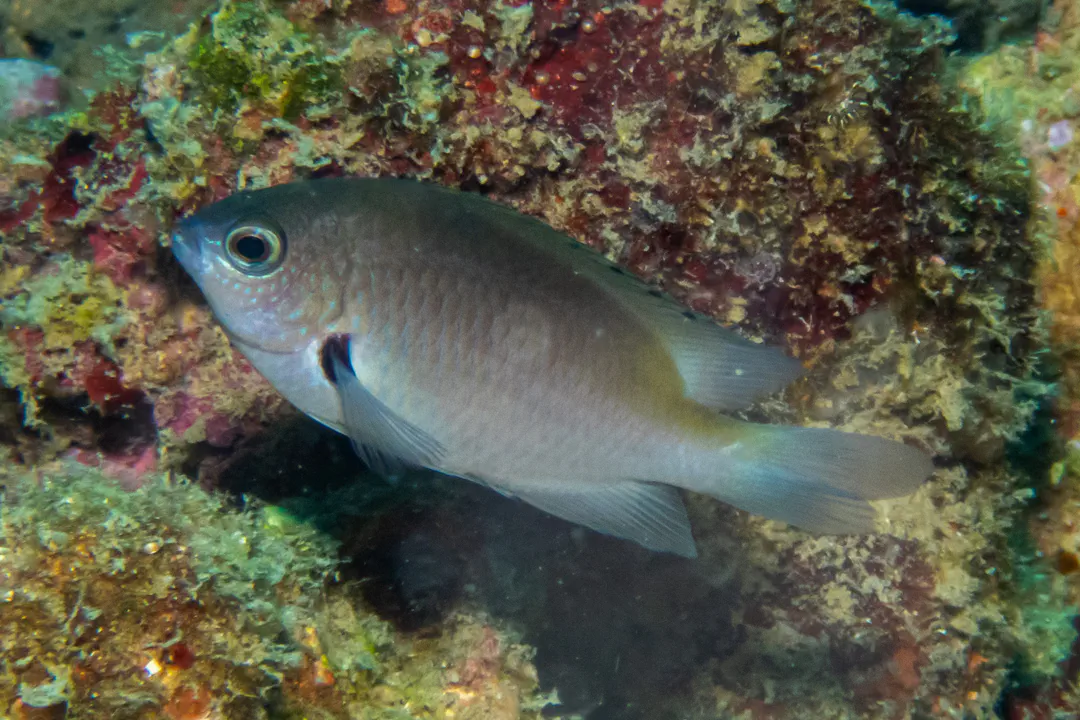
 © portioidCC BY 4.0
Alexander's Damsel
Pomacentrus alexanderae
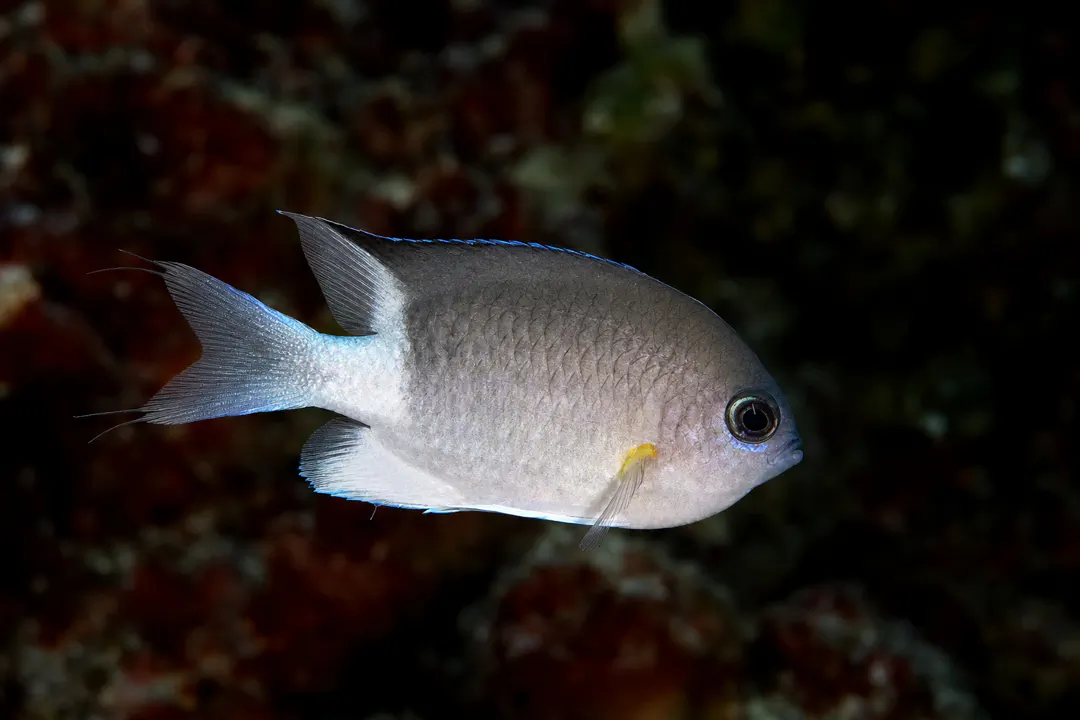 © seabook.appAll rights reserved
Pycnochromis flavipectoralis
Chromis flavipectoralis is a species of fish in the family Pomacentridae.
Head and body are brownish grey. It has bluish white ventral and caudal fins. Faint yellow spot is on pectoral fin base. Dorsal spines (total): 12; Dorsal soft rays (total): 11-12; Anal spines: 2; Anal soft rays: 11 - 12. Lenght is 8 cm.
Indian Ocean: from Maldives to Indonesia.
Adults are found in seaward reef slopes. Also in sheltered coral reefs along upper slopes. Usually seen singly or in loose groups. Oviparous, distinct pairing during breeding. Eggs are demersal and adhere to the substrate. Males guard and aerate the eggs.
Pomacentridae is a family of perciform fish, comprising the damselfishes and clownfishes. They are primarily marine, while a few species inhabit freshwater and brackish environments (e.g., Neopomacentrus aquadulcis, N. taeniurus, Pomacentrus taeniometopon, Stegastes otophorus). They are noted for their hardy constitutions and territoriality. Many are brightly colored, so they are popular in aquaria.
Around 385 species are classified in this family, in about 29 genera. Of these, members of two genera, Amphiprion and Premnas (subfamily Amphiprioninae), are commonly called clownfish or anemonefish, while members of other genera (e.g., Pomacentrus) are commonly called damselfish. The members of this family are classified in four subfamilies: Amphiprioninae, Chrominae, Lepidozyginae, and Pomacentrinae.
The name of the family is derived from the Greek words; poma roughly translates to the English "cover", referring to the fishes' opercula, and kentron is Greek for sting. The name refers to the serrations found along the margins of the opercular bones in many members of this family.
Pomacentrids are found primarily in tropical seas, with a few species occurring in temperate waters (e.g., Hypsypops rubicundus). Most species are found on or near coral reefs in the Indo-West Pacific (from East Africa to Polynesia). The area from the Philippines to Australia hosts the greatest concentration of species. The remaining species are found in the Atlantic or eastern Pacific. Some species are native to freshwater or brackish estuarine environments.
Most members of the family live in shallow water, from 2 to 15 m (6 ft 7 in to 49 ft 3 in) in depth, although some species (e.g., Chromis abyssus) are found below 100 m (330 ft). Most species are specialists, living in specific parts of the reef, such as sandy lagoons, steep reef slopes, or areas exposed to strong wave action. In general, the coral is used as shelter, and many species can only survive in its presence.
The bottom-dwelling species are territorial, occupying and defending a portion of the reef, often centered on shelter. By keeping away other species of fish, some pomacentrids encourage the growth of thick mats of algae within their territories, leading to the common name farmerfish.
Pomacentrids have an orbiculate to elongated body shape, which is often laterally compressed. They have interrupted or incomplete lateral lines and they usually have a single nostril on each side (some species of Chromis and Dascyllus have two on each side). They have small- to medium-sized ctenoid scales. They have one or two rows of teeth, which may be conical or spatulate.
They display a wide range of colors, predominantly bright shades of yellow, red, orange, and blue, although some are a relatively drab brown, black, or grey. The young are often a different, brighter color than adults.
Pomacentrids are omnivorous or herbivorous, feeding on algae, plankton, and small bottom-dwelling crustaceans, depending on their precise habitats. Only a small number of genera, such as Cheiloprion, eat the coral where they live.
They also engage in symbiotic relationship with cleaner gobies of genus Elacatinus, allowing the gobies to feed off of ectoparasites on their body.
Before breeding, the males clear an area of algae and invertebrates to create a nest. They engage in ritualised courtship displays, which may consist of rapid bursts of motion, chasing or nipping females, stationary hovering, or wide extension of their fins. After being attracted to the site, the female lays a string of sticky eggs that attach to the substrate. The male swims behind the female as she lays the eggs, and fertilises them externally. Varying by species, brood sizes range from 50 to 1000 eggs.
The male guards the nest for the two to seven days that it takes for the eggs to hatch. The transparent larvae are 2 to 4 mm (0.079 to 0.157 in) long. They go through a pelagic stage which, depending on the species, can last as little as a week or more than a month. When they arrive at a suitable environment, the young settle and adopt their juvenile colors.
In captivity, pomacentrids live up to 18 years, but they probably do not live longer than 10 to 12 years in the wild.
About 28 genera in four subfamilies are recognized:
© portioidCC BY 4.0 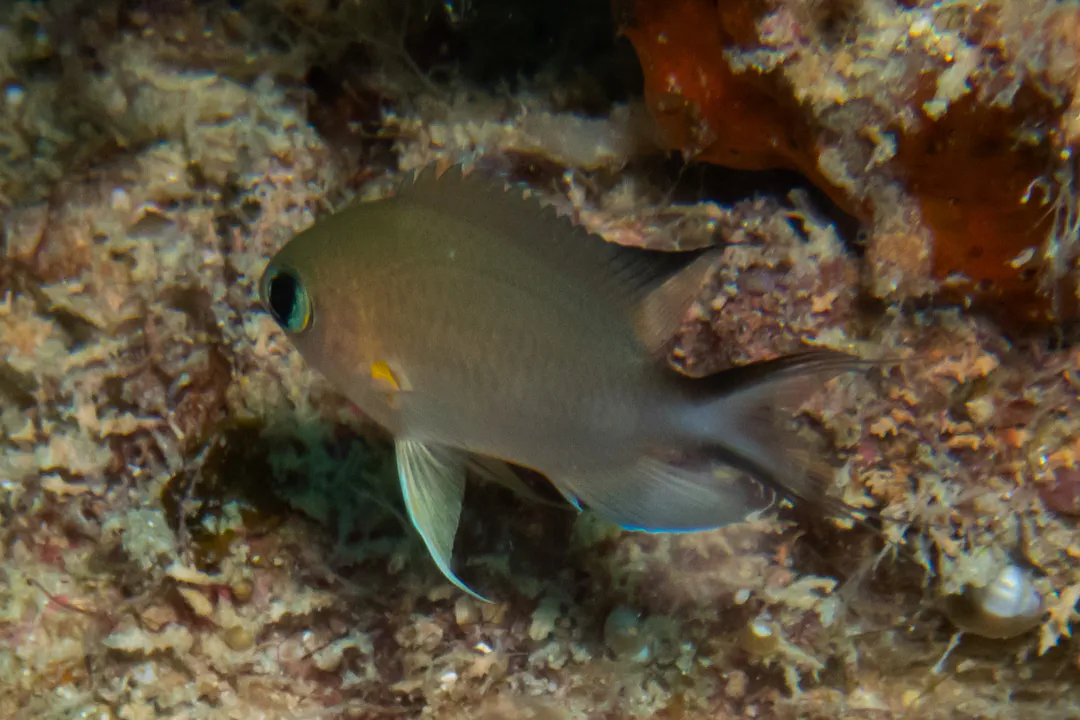 © portioidCC BY 4.0
 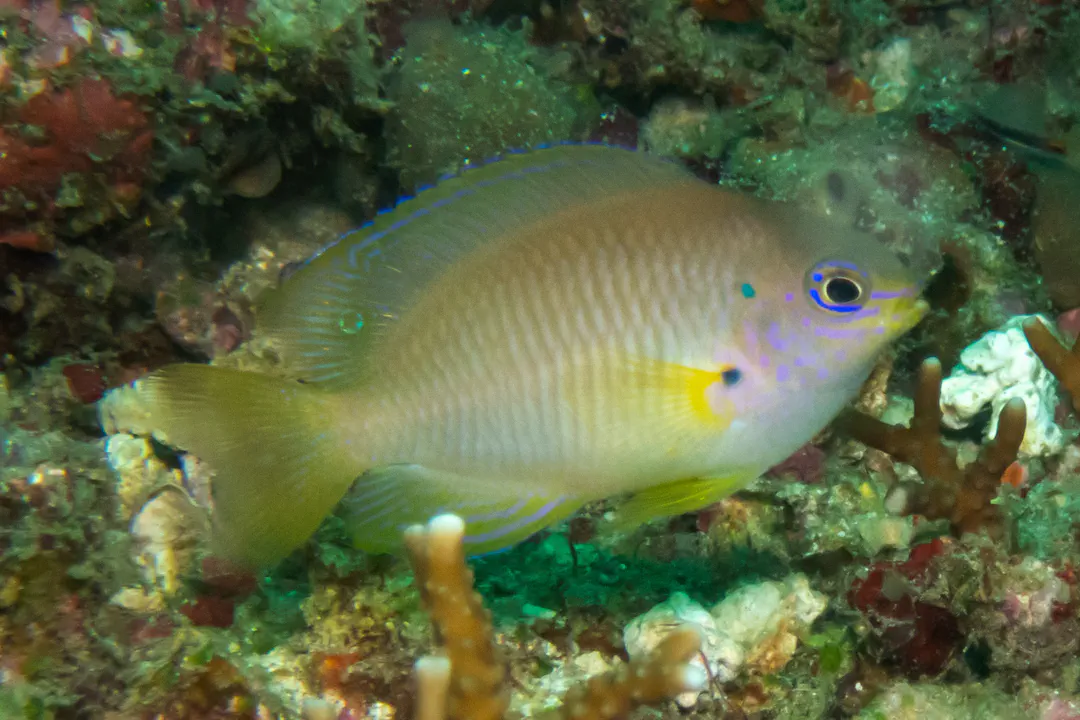 © portioidCC BY 4.0 · iNaturalist
 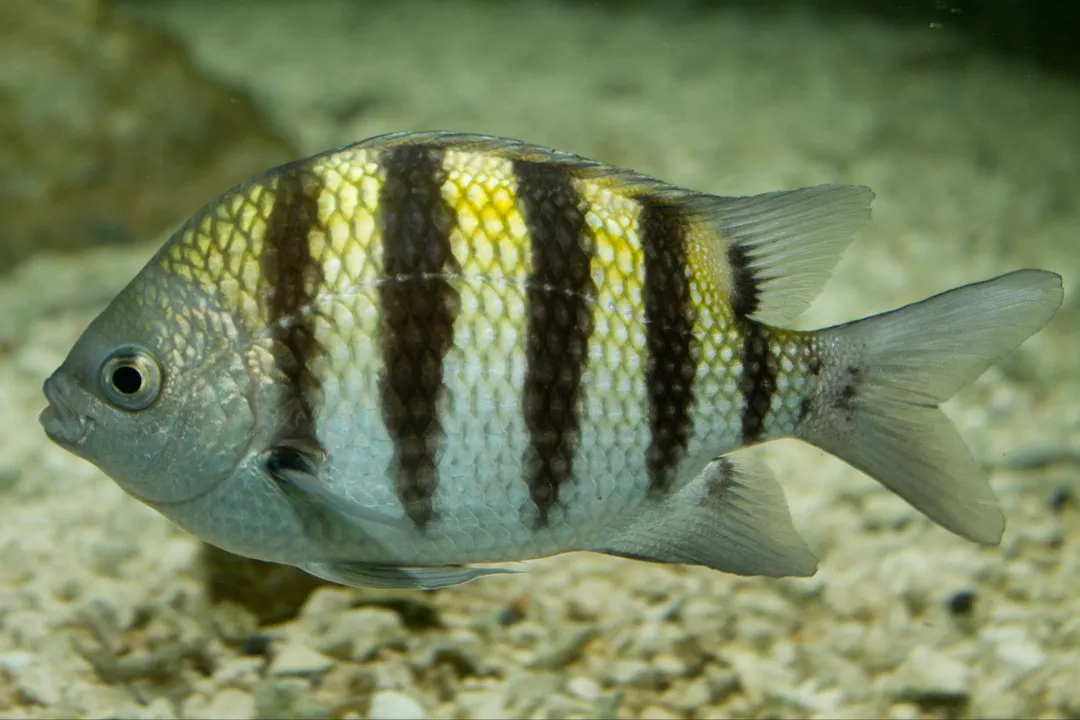 © Brian GratwickeCC BY 4.0 · iNaturalist
 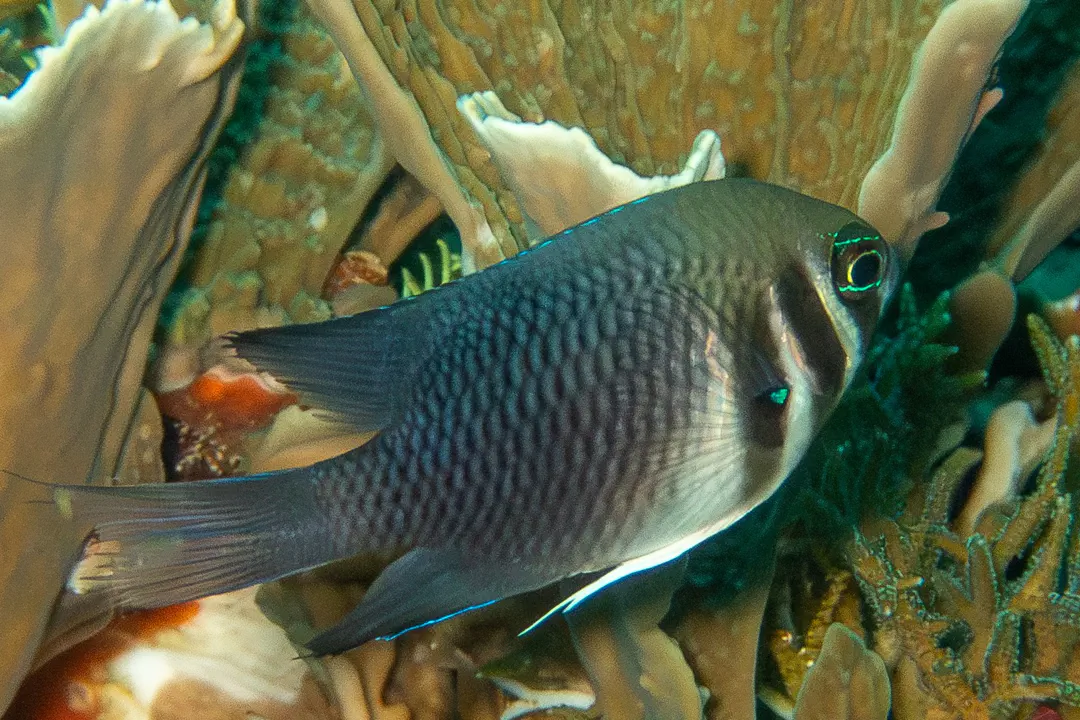 © Piotr LukasikCC BY 4.0 · iNaturalist
 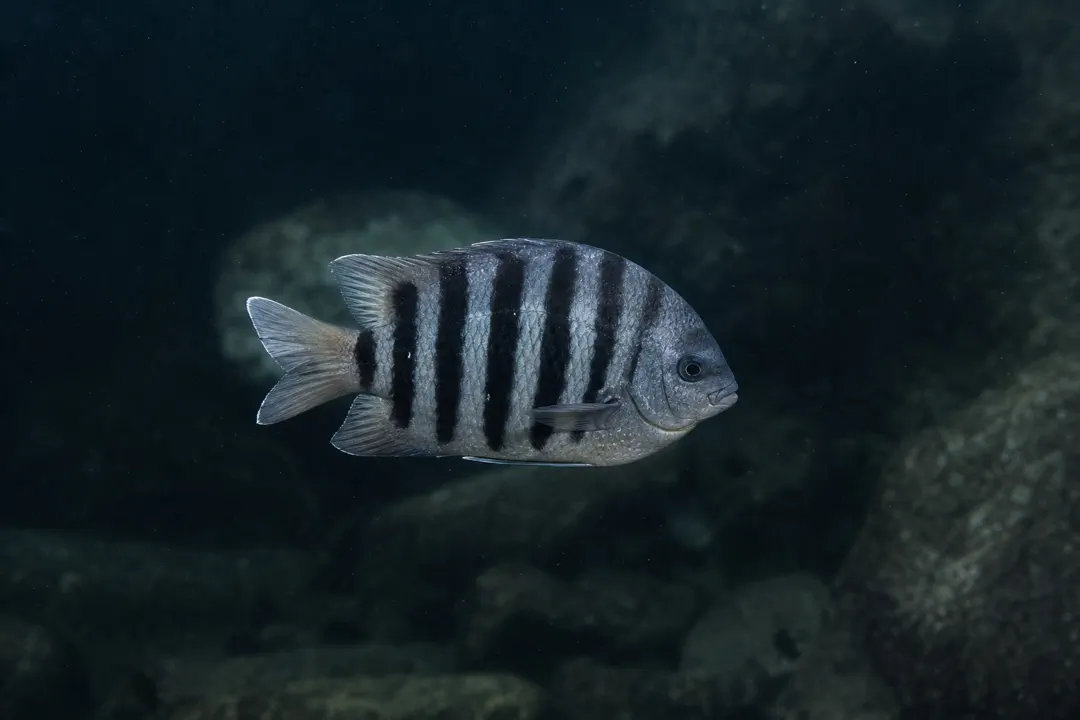 © seabook.appAll rights reserved
 Malayan Chromis has no known danger to humans. However, always observe marine life responsibly.
Malayan Chromis can be found at depths of up to 15 meters.
Download Seabook free for iOS and Android.