 © Ian DugdaleCC BY 4.0 · iNaturalist
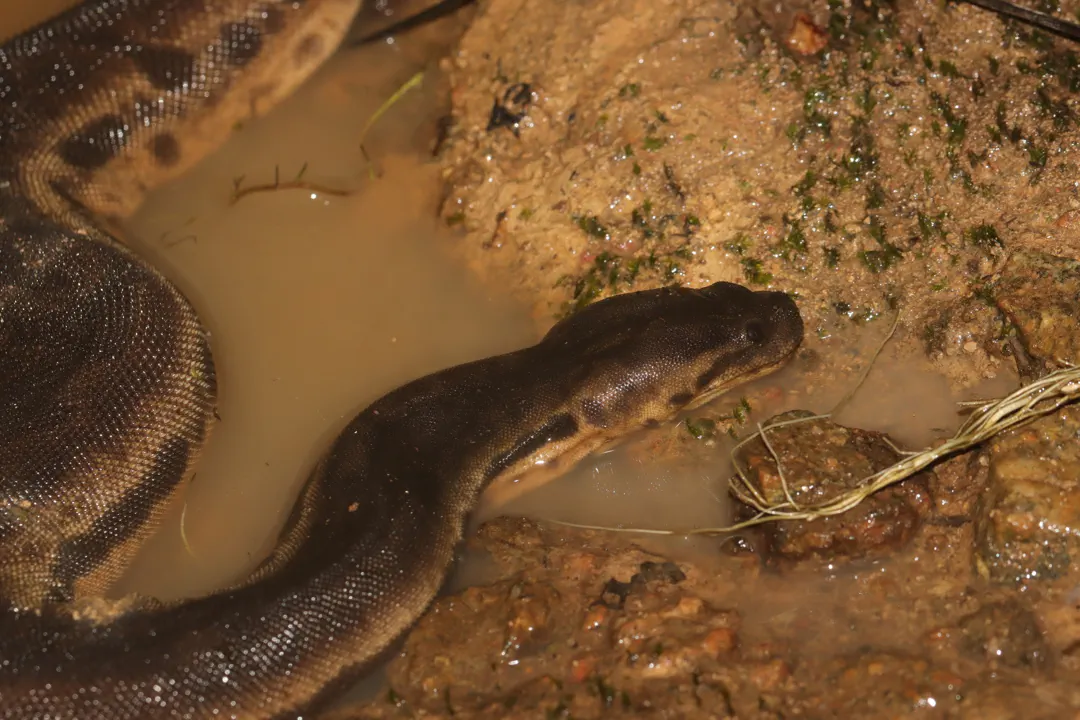
Elephant Trunk Snake
Acrochordus javanicus
Laticauda colubrina
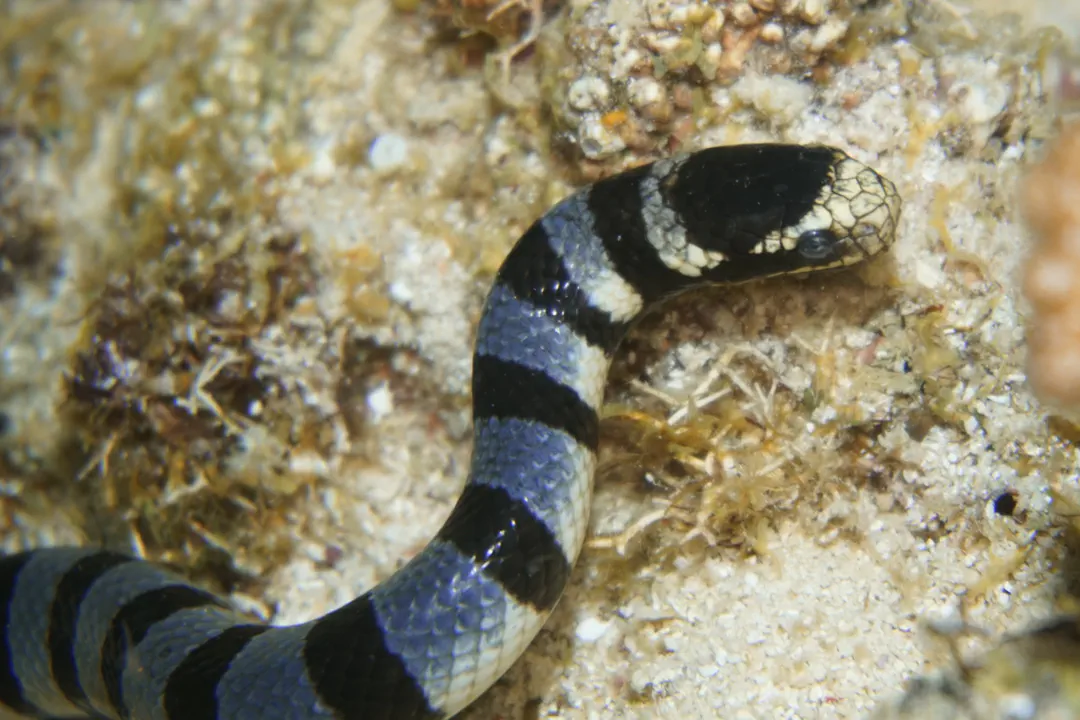
Laticauda colubrina is a species of venomous sea snake found in tropical Indo-Pacific oceanic waters. It has distinctive black stripes and a yellow snout.
Ventrals are large (wide), one-third to more than half the width of the body; nostrils are lateral; nasals are separated by internasals; 21–25 longitudinal rows of imbricate dorsal scales are found at midbody; an azygous prefrontal shield is usually present; and the rostral is undivided.
The body is subcylindrical, only slightly laterally compressed. The rostral is higher than broad; an azygous shield separates the prefrontals, but sometimes is absent; the frontal is considerably longer than its distance from the end of the snout; one preocular and two postoculars are present; there are 7–8 supralabials, the 3rd–4th touching the eye; temporals are 1+2; five infralabials are in contact with the genials, both pairs of which are usually well developed and in contact with one another, the anterior pair smaller than the posterior; a double series of elongated scales, the inner series the larger, occur at the oral margin. Dorsal scales are in 21–23 rows (rarely 25). Ventrals number 213 to 245, and are about four times as wide as long. Subcaudals in males number 37–47, and in females 29–35.
Total length: males 875 mm (34.4 in), females 1,420 mm (56 in); tail length: males 130 mm (5.1 in), females 145 mm (5.7 in).
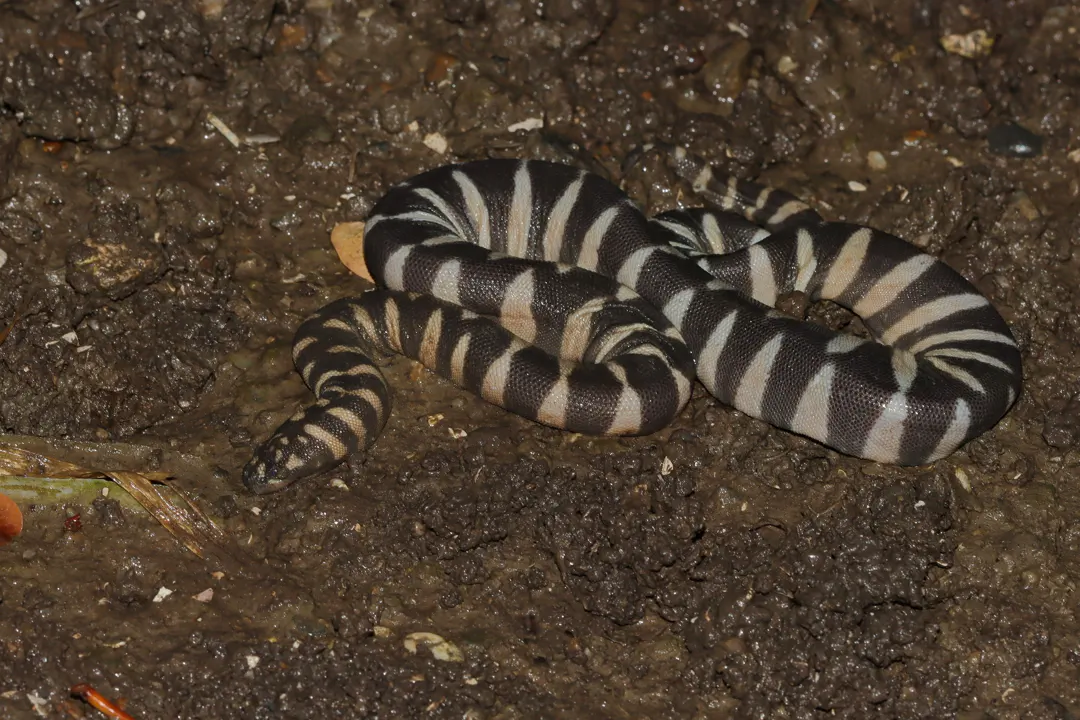
In colour these snakes are light or dark bluish grey above, yellowish below, with black rings more or less of uniform width throughout or narrowing on the belly (some of them interrupted below). The upper lip is yellow, and the snout is yellow, the colour extending backward on each side of the head above the eye as far as the temporal shields, leaving a dark bar in between.The rest of the head is black.
Banded sea kraits when collected near the tip of Borneo had heavy tick infections.
Banded sea kraits are often seen in large numbers in the company of hunting parties of giant trevally (Caranx ignobilis) and goatfish. Their cooperative hunting technique is similar to that of the moray eel, with the kraits flushing out prey from narrow crevices and holes. Kraits need to drink fresh water and regularly come onto land for that purpose.
While probing crevices with their head and thus unable to observe approaching predators, banded sea kraits can fool their potential enemies to believe that their tail is the head. This is based on both colouration and tail movements, such that the lateral aspect of tail corresponds to the dorsal view of the head.
Male banded sea kraits come ashore early in the evening and wait at the high tide line for the females. Female kraits are much larger and many males will escort and intertwine around a single female.
There are fewer recorded bites from this species compared to other venomous species such as cobras and vipers as it is less aggressive and tends to avoid humans. If they bite, it is usually in self-defence when accidentally grabbed. Many fishermen are bitten each year when they try to clear sea snakes from their nets.
The venom of this elapid, Laticauda colubrina, is a very powerful neurotoxic protein, with a subcutaneous LD50 in mice of 0.45 mg/kg body weight. The venom is an α-neurotoxin that disrupts synapses by competing with acetylcholine for receptors on the postsynaptic membrane, similar to erabutoxins and α-bungarotoxins. In mice, lethal venom doses cause lethargy, flaccid paralysis, and convulsions in quick succession before death. Dogs injected with lethal doses produced symptoms consistent with fatal hypertension and cyanosis observed in human sea snake bite victims.
Some varieties of eels, which are a primary food source for yellow-lipped sea kraits, may have coevolved resistance to yellow-lipped sea krait venom. Gymnothorax moray eels taken from the Caribbean, where yellow-lipped sea kraits are not endemic, died after injection with doses as small as 0.1 mg/kg body weight, but Gymnothorax individuals taken from New Guinea, where yellow-lipped sea kraits are endemic, were able to tolerate doses as large as 75 mg/kg without severe injury.
The banded sea krait is a widespread species in eastern Indian Ocean and Western Pacific. It is found from eastern coast of India east through coasts of Bay of Bengal (Bangladesh, Mayanmar) and SE Asia to Malay Archipelago and to southern China, Taiwan, and the Ryukyu Islands of Japan. Vagrant individuals have been recorded in Australia, New Caledonia, and New Zealand.
Banded sea kraits rest and nest on rocky headlands and beaches of Sabah, Borneo. They can be seen in the wild at Pulau Tiga, the tip of Borneo and Mabul Island. They are, however, seen on many other rocky headlands around Sabah that are harder to access. Occasionally, they come ashore at Tanjung Aru close to Kota Kinabalu. They can be seen in captivity at The Green Connection, an aquarium in Kota Kinabalu.
Yellow-lipped sea kraits are semiaquatic. Juveniles stay in water and on adjacent coast, but adults are able to move further inland and spend half their time on land and half in the ocean. Adult males are more terrestrially active during mating and hunt in shallower water, requiring more terrestrial locomotive ability. On the other hand, adult females are less active on land during mating and hunt in deeper water, requiring more aquatic locomotive ability. Because males are smaller, they crawl and swim faster than females.
Body adaptations, especially a paddle-like tail, help yellow-lipped sea kraits to swim. These adaptations are also found in more distantly related sea snakes (Hydrophiinae) because of convergent evolution. However, because of the differences in motion between crawling and swimming, these same adaptations impede the snake's terrestrial motion. On dry land, a yellow-lipped sea krait can still move, but, on average, at only slightly more than a fifth of its swimming speed. In contrast, most other non-Laticauda sea snakes are virtually stranded on dry land.
When hunting, yellow-lipped sea kraits frequently head into deep water far from land, but return to land in order to digest, shed skin, and reproduce. Individual yellow-lipped sea kraits return to their specific home islands, exhibiting philopatry. One study found that when yellow-lipped sea kraits on Fijian islands were relocated to different islands 5.3 km away, all recaptured individuals were found on their home islands in an average of 30.7 days.
Yellow-lipped sea kraits collected near the tip of Borneo had heavy tick infections.
Hunting is often performed alone, but L. colubrina may also do so in large numbers in the company of hunting parties of giant trevally and goatfish. This cooperative hunting technique is similar to that of the moray eel, with the yellow-lipped sea kraits flushing out prey from narrow crevices and holes, and the trevally and goatfish feeding on fleeing prey.
While probing crevices with their head, yellow-lipped sea kraits are unable to observe approaching predators and can be vulnerable. The snakes can deter predators, such as larger fish, sharks, and birds, by fooling them into thinking that their tail is their head, because the color and movement of the tail is similar to that of the snake's head. For example, the lateral aspect of the tail corresponds to the dorsal view of the head.
Yellow-lipped sea kraits primarily feed on varieties of eels, but also eat small fish. Males and females exhibit sexual dimorphism in hunting behavior, as adult females, which are significantly larger than males, prefer to hunt in deeper water for larger conger eels, while adult males hunt in shallower water for smaller moray eels. In addition, females hunt for only one prey item per foraging bout, while males often hunt for multiple items. After hunting, yellow-lipped sea kraits return to land in order to digest their prey.
© Ian DugdaleCC BY 4.0 · iNaturalist 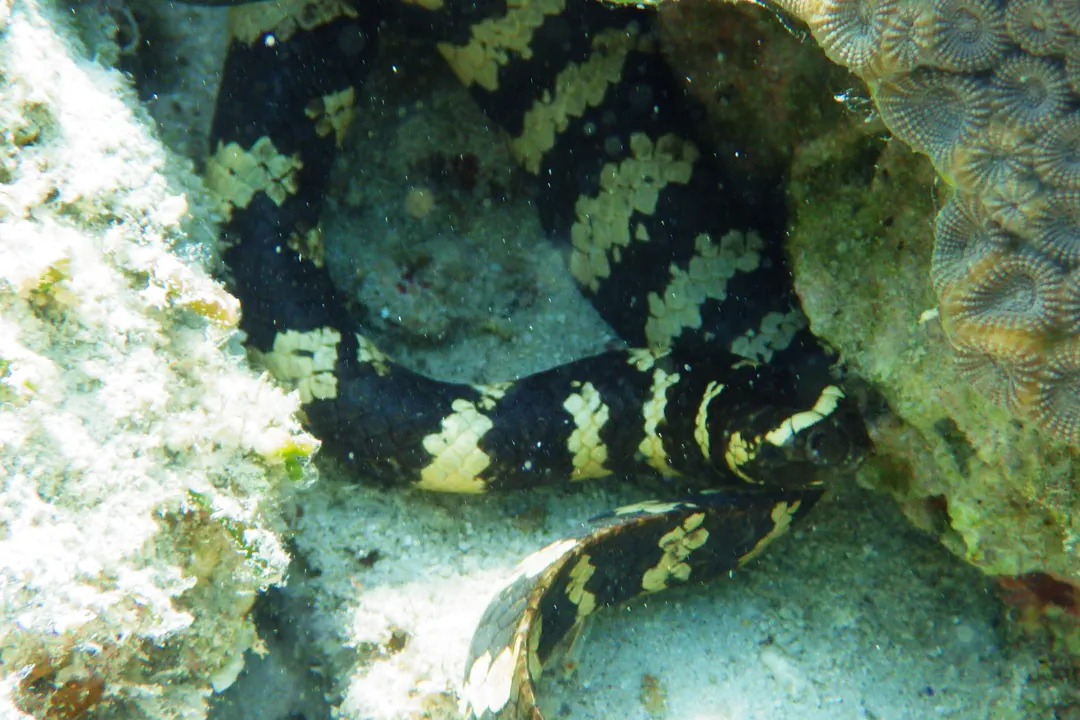 © B. P. WhiteCC BY-SA 4.0 · iNaturalist
  © Ian DugdaleCC BY 4.0 · iNaturalist
 Banded Sea Krait is classified as venomous, dangerous to humans. Always exercise caution and keep a safe distance.
Banded Sea Krait can be found at depths of up to 10 meters.
Download Seabook free for iOS and Android.