 © Stas KuryanAll rights reserved
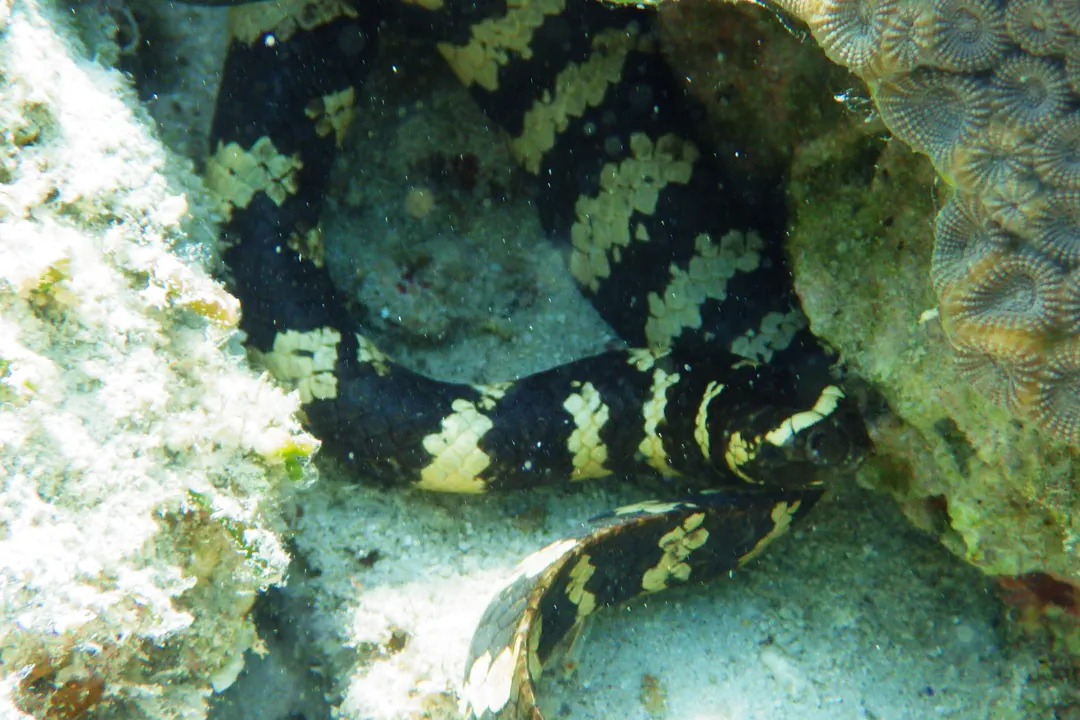
Banded Sea Krait
Laticauda colubrina
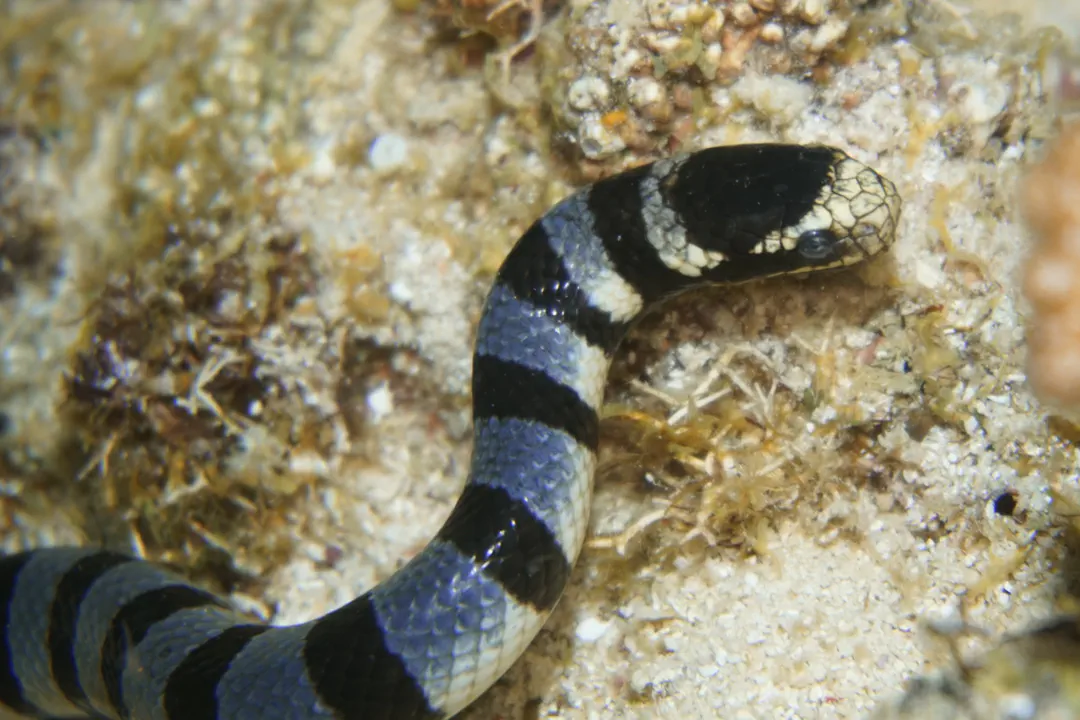
Emydocephalus ijimae
Emydocephalus ijimae, called commonly the Ijima's sea snake, Ijima's turtleheaded sea snake, is a species of snake in the family Elapidae. The species is endemic to East Asia.
The specific name, ijimae, is in honor of Japanese zoologist Isao Ijima (1861–1921).
E. ijimae is found on the coasts of China, Taiwan, Japan (Ryukyu Islands), Indonesia, Philippines and Moluccas, West Pacific Ocean from Japan in the north to Samoa in the south
E. ijimae is viviparous.
Small snake; total length up to 85 cm. There are 15-19 (17-19 at mid-body) rows of scales, which are smooth and imbricated, and there is a row of large hexagonal scales along the vertebral line. Head is small, cuboidal, and not distinct from neck; body is moderately stout and highly compressed laterally; tail is laterally compressed, sides with vertically elongated scales. Nostril (with a lid) faces upward. Eye is medium-sized. Fangs are degenerated. There are 2 prefrontals and no internasals or loreals. Head is black and marked with a cross band of yellow to orange anterior to eyes, extending backward and downward to the base of jaw. Body and tail are yellow to orange, encircled by black, wave-edged bands; the black band is slightly broader than or similar to the yellow-orange one in width. Anal scale is divided and subcaudals are paired.
This diurnal snake inhabits coral reefs and rocky ocean floors. Females give birth to about 2 young in a litter.
It feeds exclusively on fish eggs: "With their reduced compliment of stiffened labial scales, they scrape the eggs off rocks, and also use the spike on the snout tip to dig eggs out of the substrate. Their jaw musculature is unique (probably because they employ suction to get the eggs into the mouth), and they have a strongly reduced dentition."
© Stas KuryanAll rights reserved  © Ian DugdaleCC BY 4.0 · iNaturalist
  © Ian DugdaleCC BY 4.0 · iNaturalist
 Ijima's Sea Snake is classified as venomous. Always exercise caution and keep a safe distance.
Download Seabook free for iOS and Android.