 © Bernard PictonCC BY 4.0 · iNaturalist
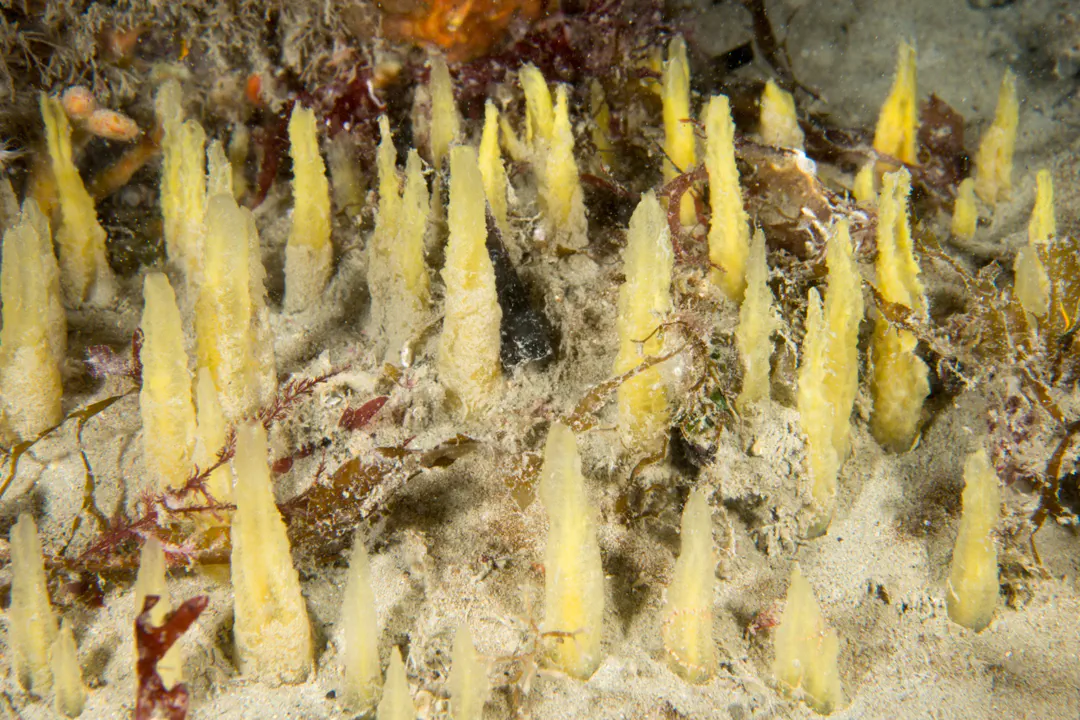
Brush Sponge
Ciocalypta penicillus
Hemimycale arabica
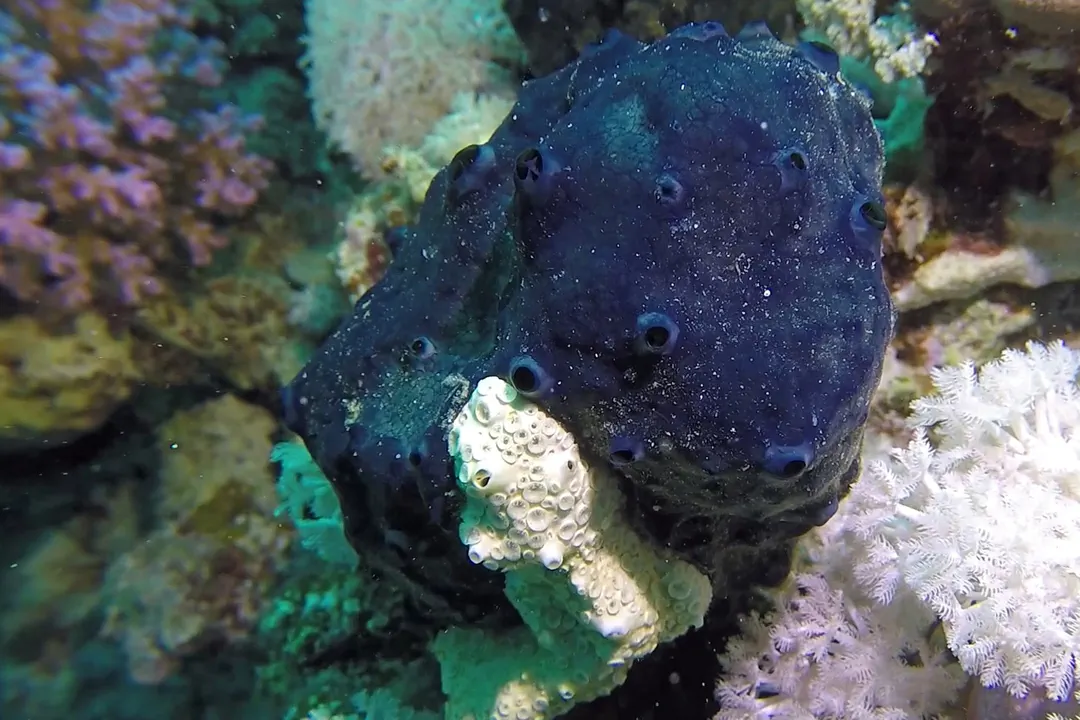
Hemimycale arabica, known as the Arabian crust sponge, is a marine demosponge belonging to the family Hymedesmiidae and is found in the Red Sea, including Ras Um Sid and Eilat in the Gulf of Aqaba.
The Arabian crust sponge was formally described in 2004 by M. Ilan, A. Gugel, and R. W. M. van Soest. The original name of the species is Hemimycale arabica Ilan, Gugel & van Soest, 2004, and it was described as a new species, not as a recombination from another published species. The type locality for the species is the northern Gulf of Aqaba, at Eilat, Israel, in the Red Sea region. The species has also been reported from Ras Um Sid, Egypt. The name arabica is a Latin geographic epithet meaning 'Arabian' or 'of Arabia', chosen due to the species' occurrence beside the Arabian Peninsula. Earlier, Frank Nobbe had recognized and informally described the sponge but did not publish it, and he intended the name in connection with Aqaba. The 2004 description lists earlier records as 'Hemimycale sp.' in Vacelet et al. (1987) and van Soest et al. (1996), which are misidentified or informal references and not formal synonyms of the species. The genus Hemimycale was formerly associated with Hymeniacidonidae in Halichondrida but was later placed in Hymedesmiidae, Poecilosclerida, based on morphological and larval characters. Molecular work subsequently found Hemimycale to be polyphyletic and suggested that its family placement might require further revision, but it did not formally rename H. arabica.
The Arabian crust sponge is best recognized as a thin to moderately thick encrusting sponge, usually forming a soft mass about 1–3 cm thick over rock or dead coral. Its surface is typically deep blue to blue-black or blue-green, while the interior is yellow-green, often visible through the surface. The blue pigment is concentrated in a thin surface layer and may fade to beige after collection or preservation. The species has numerous rounded or angular, slightly depressed pore fields that create a reticulated or honeycomb-like surface, which are generally not surrounded by raised rims. Small oscules may project as short tubes from the surface of the sponge. The body shape of the Arabian crust sponge is encrusting to cushion-like, soft, fleshy, compressible, and easily cut, lacking rigidity or high elasticity. Compared with Hemimycale columella and related Mediterranean forms, the Arabian crust sponge has a blue exterior and irregular, rim-free pore fields, while similar species are commonly orange to pinkish with more circular pore fields bordered by raised rims. The Arabian crust sponge can be distinguished from Phorbas fictitius, which lacks the light-coloured ring around the depressed pore areas characteristic of the Arabian crust sponge. Reliable species-level identification may require spicule examination, as Hemimycale arabica has straight strongyles plus a relatively notable proportion of true styles—about 15% of its spicules.
The Arabian crust sponge is associated with shallow tropical coral reefs in the Red Sea. It is reported from reef habitats, including reef walls, and is generally characterized as shallow-water. This species forms an encrusting to cushion-like soft mass on rocks and dead coral, and it also grows on live or dead branching stony corals and fire coral. The documented depth range of the Arabian crust sponge begins at approximately 1–2 m and extends to at least 35 m, with it being most frequently reported at 15–35 m. Confirmed records of the Arabian crust sponge are from various locations in the Red Sea, including the Brother Islands and Elphinstone Reef in Egypt, as well as the Saudi Arabian coast near Jazan.
The Arabian crust sponge is sessile, and observable pumping or feeding activity may occur continuously, but a species-specific diel pattern is not established. It is not known to form social groups or colonies in the behavioural sense, although individuals commonly grow on branching stony corals or fire coral and may host numerous sabellid tube worms. The species is hermaphroditic and viviparous, with spermatic cysts occurring within the choanosome and embryos and larvae developing inside the sponge. Reproductive tissues of the Arabian crust sponge are bright orange and distinguishable from the pale-yellow choanosome, with embryos recorded from May through October and no apparent winter reproduction in the studied population. No published, species-specific evidence was located describing responses to divers, cameras, lights, touch, bubbles, or nearby movement, making a behavioural reaction to divers unknown.
The Arabian crust sponge feeds on organic material carried in seawater, probably including dissolved organic matter and filtered suspended particles; the exact particle types and proportions for Hemimycale arabica are unknown. As a sponge, it most likely feeds by filter feeding, where water enters through microscopic pores, and suspended particles and dissolved nutrients are processed by internal cells, especially choanocytes.
The Arabian crust sponge is not a target species in commercial, subsistence, or recreational fisheries due to its small, sessile nature. There is no reliable evidence of an established aquarium-trade market for the Arabian crust sponge. The Arabian crust sponge should not be considered edible, as it has been reported as unpalatable or not eaten by various benthic predators. No documented human poisonings or clinically established hazards specific to the Arabian crust sponge have been found. Extracts from the Arabian crust sponge contain bioactive hydantoin alkaloids with antimicrobial and cell-growth-inhibitory activity, suggesting caution in handling or ingestion. The IUCN Red List status of the Arabian crust sponge is unknown or not established, indicating a lack of a species-specific global conservation assessment. Local collection and habitat damage of the Arabian crust sponge may still be regulated under applicable Red Sea or coral-reef conservation rules.
© Bernard PictonCC BY 4.0 · iNaturalist  © Albert KokCC BY-SA 4.0 · iNaturalist
  © Pierre PericardCC BY 4.0 · iNaturalist
  © Tom HeijnenCC BY 4.0 · iNaturalist
  Jean-Paul BoerekampsCC0 · iNaturalist
  © Julien RenoultCC BY 4.0 · iNaturalist
 Arabian Crust Sponge has no known danger to humans. However, always observe marine life responsibly.
Download Seabook free for iOS and Android.