 © Zakqary RoyCC BY 4.0 · iNaturalist
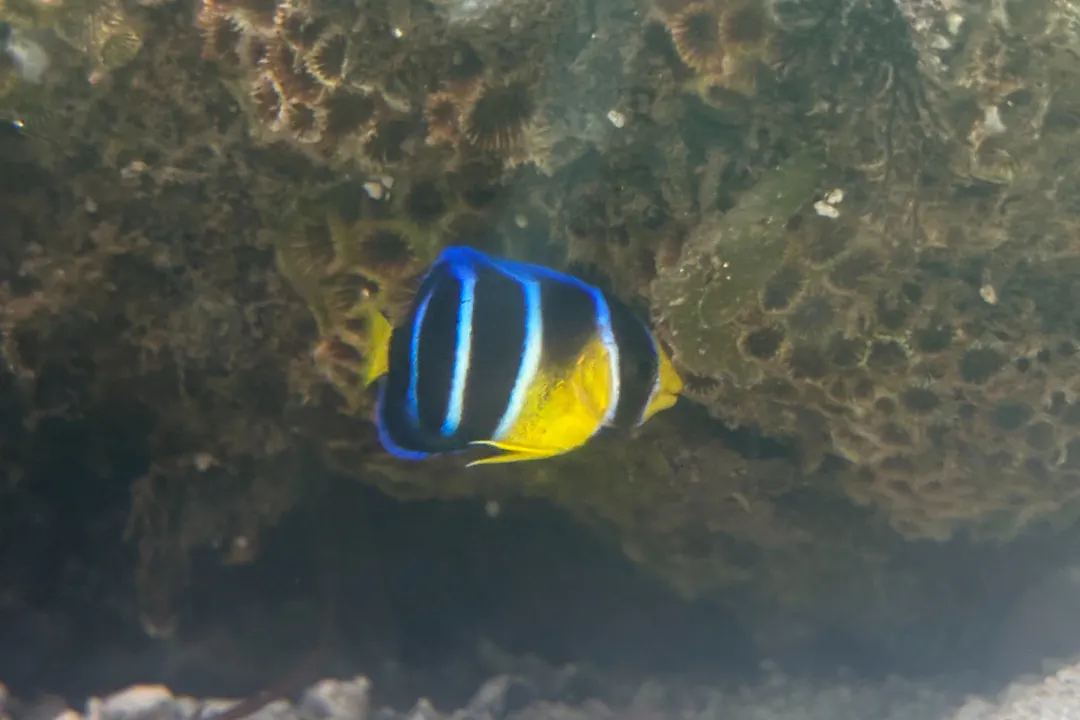
Bermuda Blue Angelfish (juvenile)
Holacanthus bermudensis
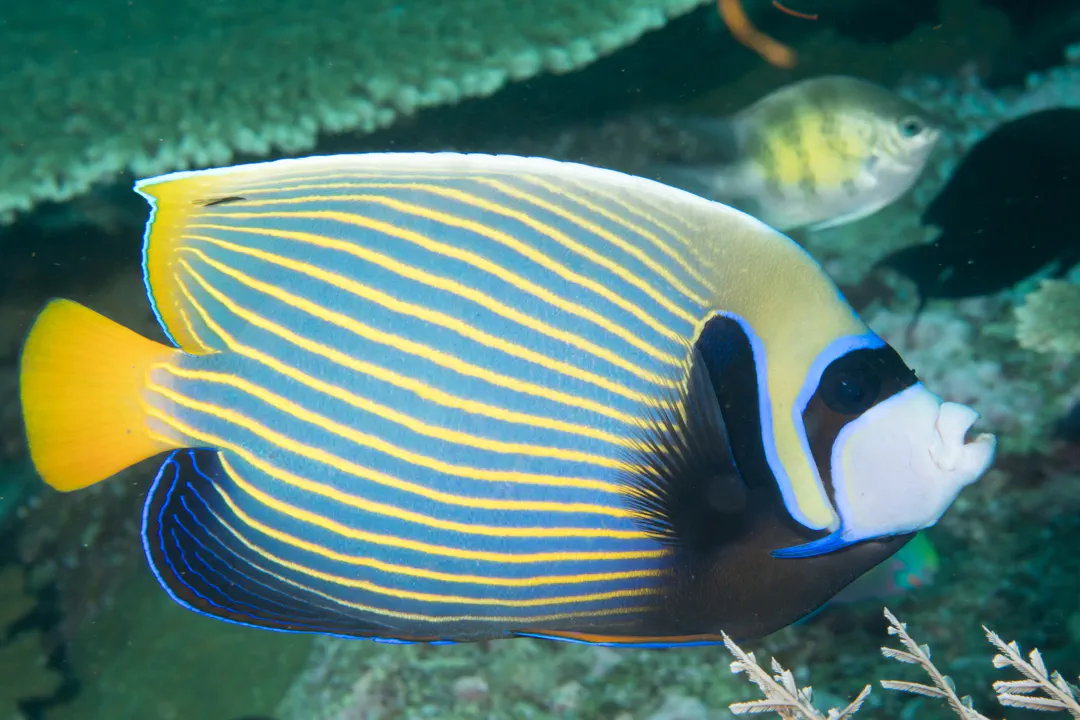
Pomacanthus imperator
Pomacanthus imperator is a species of marine angelfish.
The adult are deep bodied and slightly elongated. They have yellow and blue horizontal lines throughout their body that start from just behind the gills to the area just before the tail fin which is yellow. Starting at the top of the dorsal fin to the anal fin, it is blue and can have some blue striping. The dorsal fin is trimmed in white. The mouth and snout area are white, which is sharply cut off by a black mask that covers the eyes. The mask is black, trimmed in blue. There is a yellow vertical bar that extends from the yellow in the head downward. It divides the black mask from a thicker vertical black band that starts about 1/4 of the way down the body and continues down into the pelvic fins. This black band is in the same area of vertical space as the pectoral fins and gills. Adult male and female Emperor Angelfish differ in color. Males will have darker coloration just behind their eyes and female colors overall tend to be less vibrant. Without having a sexually mature male and female next to each other, it is very hard to differentiate the sexes. Males also tend to be slightly larger than adult females. Juvenile Emperor Angelfish are black with vertical lines in light blue and white on the face. Behind the gill area are 3 thicker white bands. The first is a curved band that starts from the dorsal fin to the anal fin, the second forms a “C” shape, and the third forms a white circle near the tail fin. In between these white bands are thinner light blue bands. The dorsal and anal fins have a honeycomb patterning that is black in the center and trimmed in light blue. The top dorsal fin has a white top edge. Sub-adult looks like the juvenile Emperor, except the tail fin starts to develop yellow in the patterning. Yellow vertical dashes start to appear on the body, blending into the juvenile pattern. The sub adult also becomes more deep bodied and rounder, like the adult. The color begins to change at a body length of about 8 centimeters. It takes about 24 to 30 months for an emperor angelfish to acquire its adult coloring.
They can grow up to 40 cm in the wild, yet in captivity, they will generally only reach about 30 cm. Angelfish from the Pomacanthus genus have a lifespan of over 21 years in captivity.
It is a reef-associated fish, native to the Indian and Pacific Oceans, from the Red Sea to Hawaii and the Austral Islands. It ranges from coastal East Africa and the Red Sea in the west, to the Tuamotu Islands and Line Islands. Rare sightings have been recorded in the Hawaiian Islands, Puerto Rico, and Florida. These appearances are most likely due to aquarium release. Some populations have been observed as far as southern Japan to the Great Barrier Reef in Australia, New Caledonia, and the Austral Islands. This species is generally associated with stable populations and faces no major threats of extinction. It is a favorite among photographers, artists, and aquarists because of its unique, brilliant pattern of coloration.
Emperor angelfish dwell in reef-associated areas at depths ranging from 1-100 m. Juveniles live alone and inhabit outer lagoon patch reefs or semi-protected exposed channels and reef flats. They tend to hang out at shrimp cleaning stations, feeding off parasites and dead skin of larger fish species. Subadults move to reef front holes and surge channels, while mature adults are found in caves in areas of rich coral growth on clear lagoon, seaward, or channel reefs. Males are territorial and will defend their habitat as well as the females living with them. An angelfish territory can be as large as 10,760 square feet. Adults are also known for making a low-frequency “knocking” sound if disturbed or threatened by divers.
At dusk, a pair of emperor angelfish will rush to the surface, away from the reef, to mate in area where fertilized eggs can be taken away on currents, and then they then scurry back down to the reef. This mechanism not only prevents egg-eating predators from seeing their release, but the eggs are now able to disperse in areas where new populations of emperor angelfish can form. This trade-off between parental investment and fecundity allows for maximum fitness of this species.
Emperor angelfish are omnivorous, feeding on both small invertebrates and plants. Sponges and algae are their primary diet. They have bulky, strong jaws that are able to chew up the sponges, which are made up of tiny, needle-like pieces of silica (this would be the equivalent of a human chewing on small shards of glass). The digestive tract of an emperor angelfish coats its food with a layer of mucus in order to further protect itself from the sharp silica.
© Zakqary RoyCC BY 4.0 · iNaturalist  © Daniel BenákCC BY 4.0 · iNaturalist
  © Piotr LukasikCC BY 4.0 · iNaturalist
 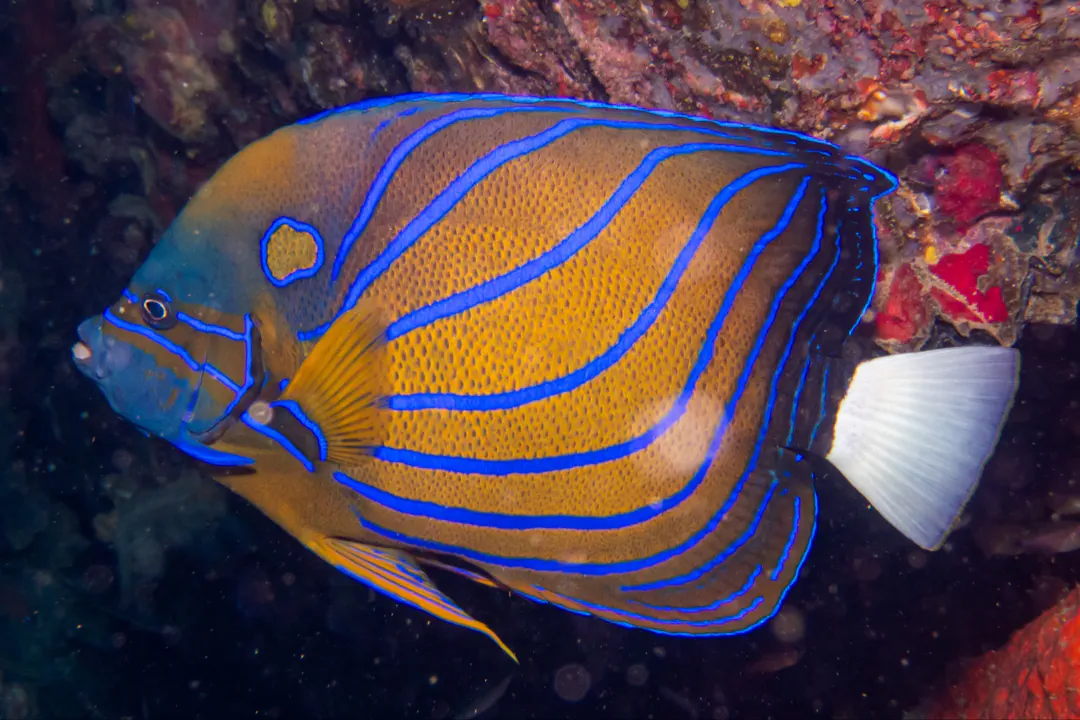 © portioidCC BY 4.0 · iNaturalist
 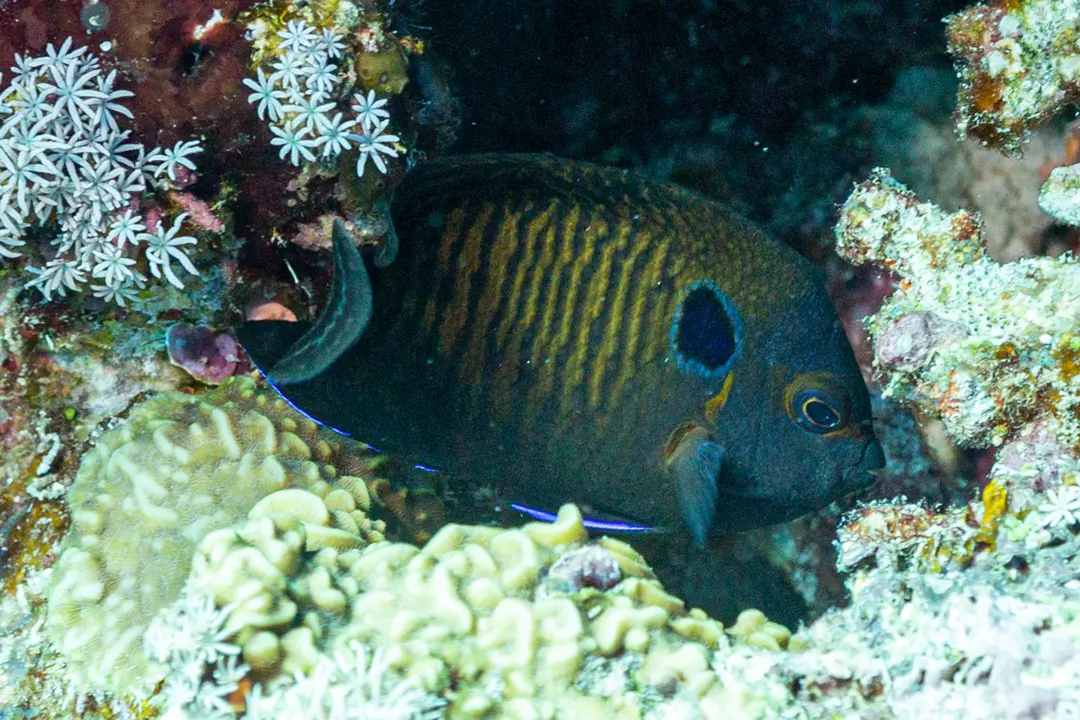 © R VasconcellosCC BY 4.0 · iNaturalist
 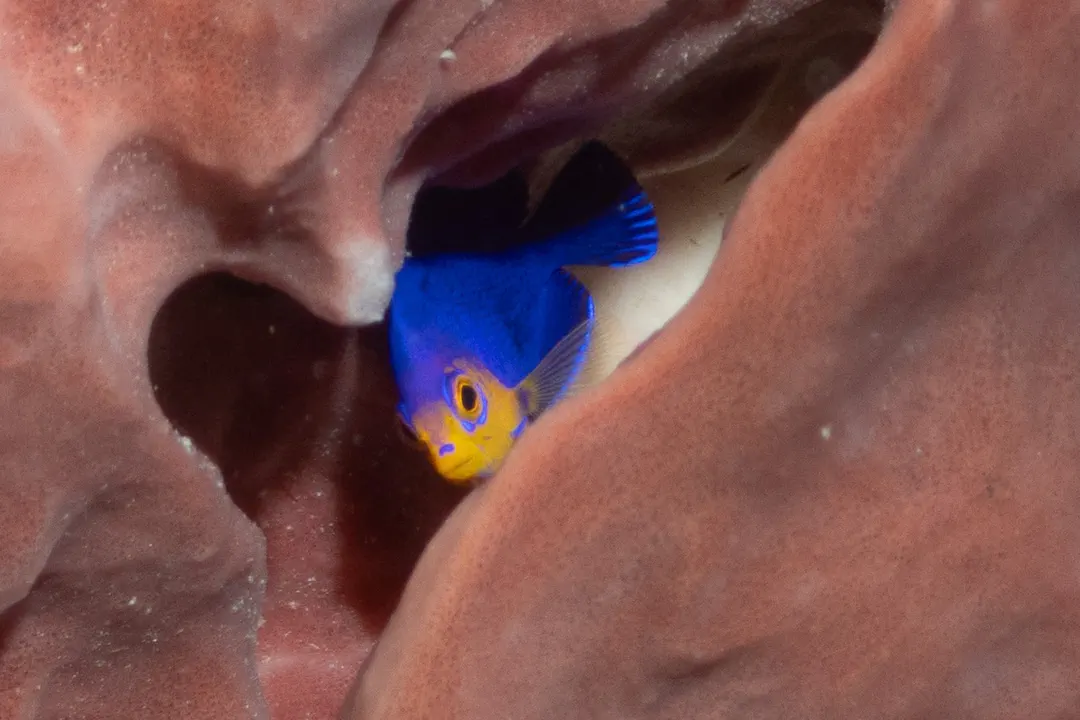 Justin PhilboisCC0 · iNaturalist
 Emperor angelfish has no known danger to humans. However, always observe marine life responsibly.
Emperor angelfish can be found at depths of up to 100 meters.
Download Seabook free for iOS and Android.