 © Zakqary RoyCC BY 4.0 · iNaturalist
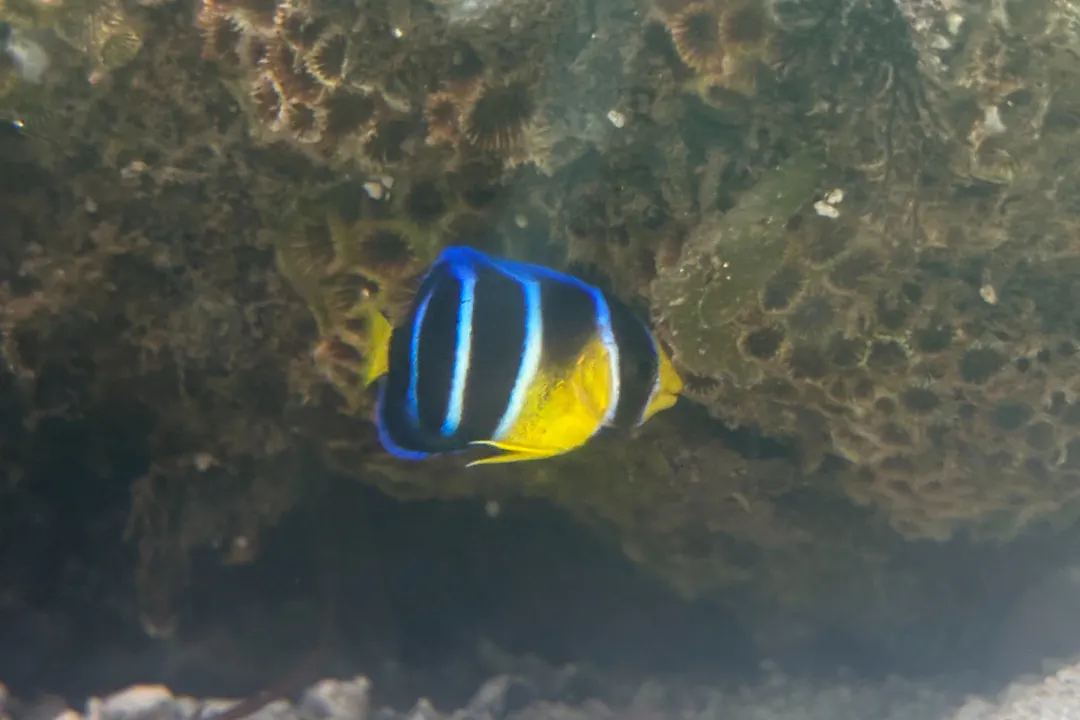
Bermuda Blue Angelfish (juvenile)
Holacanthus bermudensis
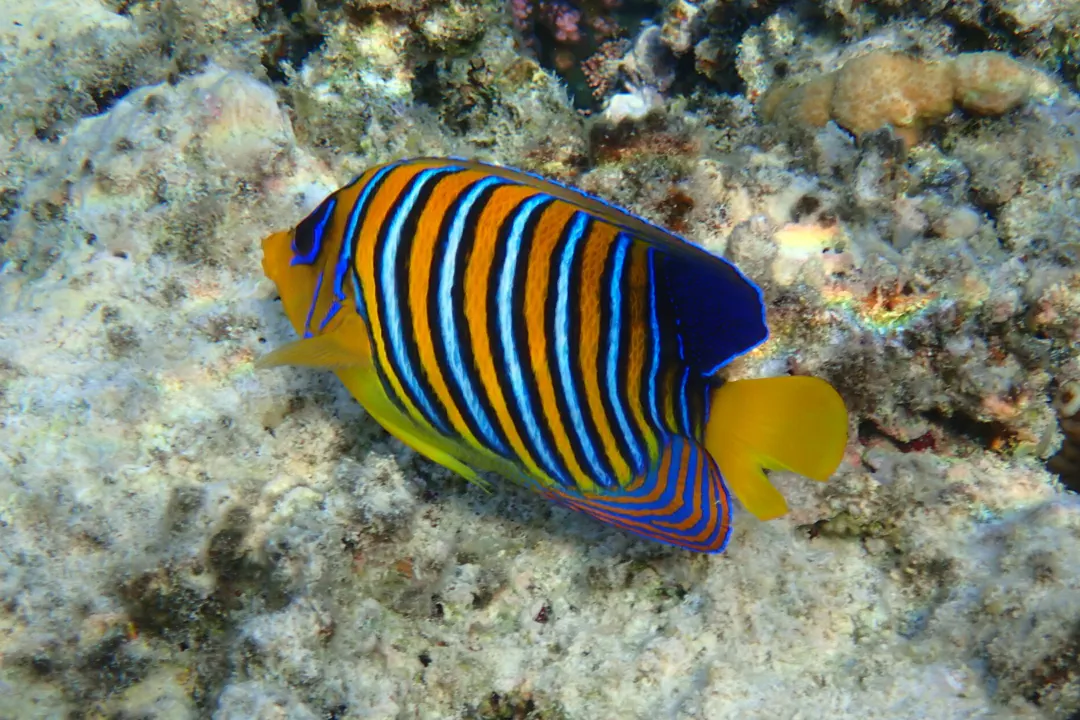
Pygoplites diacanthus
Pygoplites diacanthus is a species of marine angelfish of the family Pomacanthidae, and the monotypic genus Pygoplites. It is found in tropical Indo-Pacific oceans. Its can grow as long as 25 cm.
The body of the Regal Angelfish is moderately elongate and is very compressed. The preorbital bone convex and has no strong spines. There is 1 prominent spine at an angle at the preopercal. The ventral edge of the interopercle is smooth. The eyes are moderately small along with the mouth that is terminal. The mouth is also protractile. They have a maximum length of 25.0 cm. They have a total of 14 dorsal spines, and 17-19 soft dorsal rays. They have 3 anal spines and 17-19 anal soft rays. They also have 16-17 pectoral fin rays. Their caudal fin is rounded. The precise coloration of this fish can vary as regional differences can occur, most notably in populations from the Indian Ocean, Red Sea, and South Pacific Ocean. A commonality, however, is a body edged in narrow blue-white and orange stripes that are narrow and angle backward. The posterior portion of dorsal fin is black or blue with close-set blue dots, and the posterior portion of anal fin has alternating yellow and blue bands running parallel to body contour. The caudal fin is yellow. Juveniles are colored with a large dark spot on basal portion of the soft dorsal fin. They have been reported of living 15 years. Recent research indicates that the Pygoplites comprises two morphs, with the variants potentially hybridizing at Christmas Island.
The Regal Angelfish is widely distributed throughout the Indo-Pacific. The species can be found in the Red Sea and Indian Ocean around East Africa and the Maldives, stretching to the Tuamoto Islands, New Caledonia, and Great Barrier Reef. The northernmost limits of its range ends in the southern East China Sea around Taiwan and the Ryukyu Islands and Ogasawara Islands of Japan.
Pygoplites diacanthus occurs at depths ranging from 0 to 80m, in coral rich areas of lagoons, reefs, and are also often found in the vicinity of caves. It is a carnivorous species that feeds on sponges and tunicates located throughout reefs and underwater caves. They are a non-migratory species that can be found solitary, in pairs, or groups. The juveniles usually shelter in cracks and crevices.
Although it is frequently exported through the aquarium trade it rarely survives in the aquarium.
Usually specimens abused during shipment, more likely caught by drugging, will refuse to eat anything, including live fare.
However, given the right environment, specifically with smaller and docile tankmates like gobies and dwarf angels, it will start feeding within days when fed brine shrimp, brine shrimp plus flakes, and further progressing to regular frozen foods and a certain brand of cichlid pellets which this species seem to crave.
With a hostile environment with fellow large angels, puffers, and triggers, and certain clowns, it will almost certainly fail to acclimate and slowly die of starvation due to its shyness to start feeding.
Survivability of feeding specimens seem to equal to the other Pomacanthids.
Fresh water dips may be required to rid newly arrived specimens of flukes and ick which this species is especially prone to.
The prior myth that only yellow-bellied variations from Sri Lanka and the Red Sea will survive points to the fact that specimens from the Philippines and Indonesia are often abused when collected.
© Zakqary RoyCC BY 4.0 · iNaturalist  © Daniel BenákCC BY 4.0 · iNaturalist
  © Piotr LukasikCC BY 4.0 · iNaturalist
 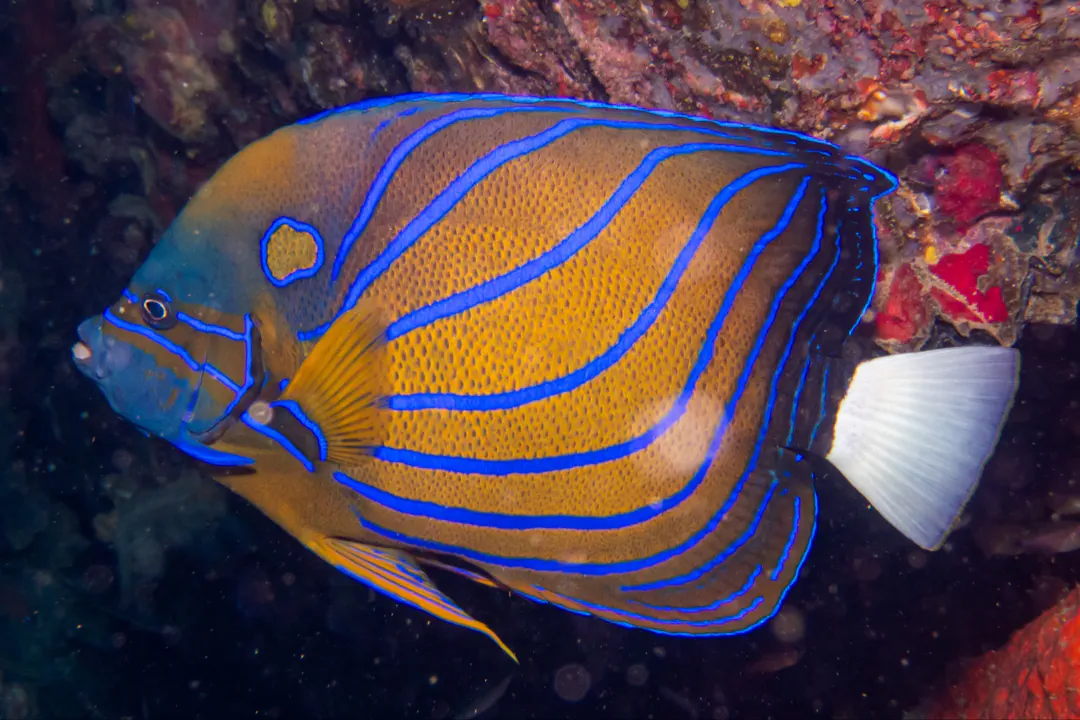 © portioidCC BY 4.0 · iNaturalist
 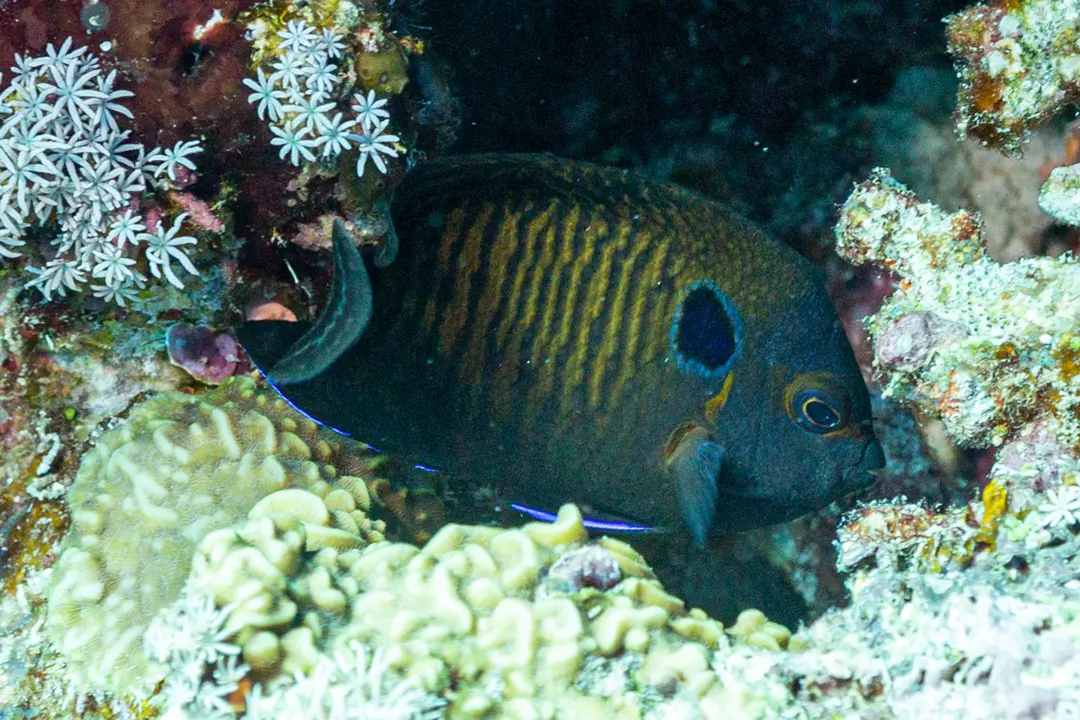 © R VasconcellosCC BY 4.0 · iNaturalist
 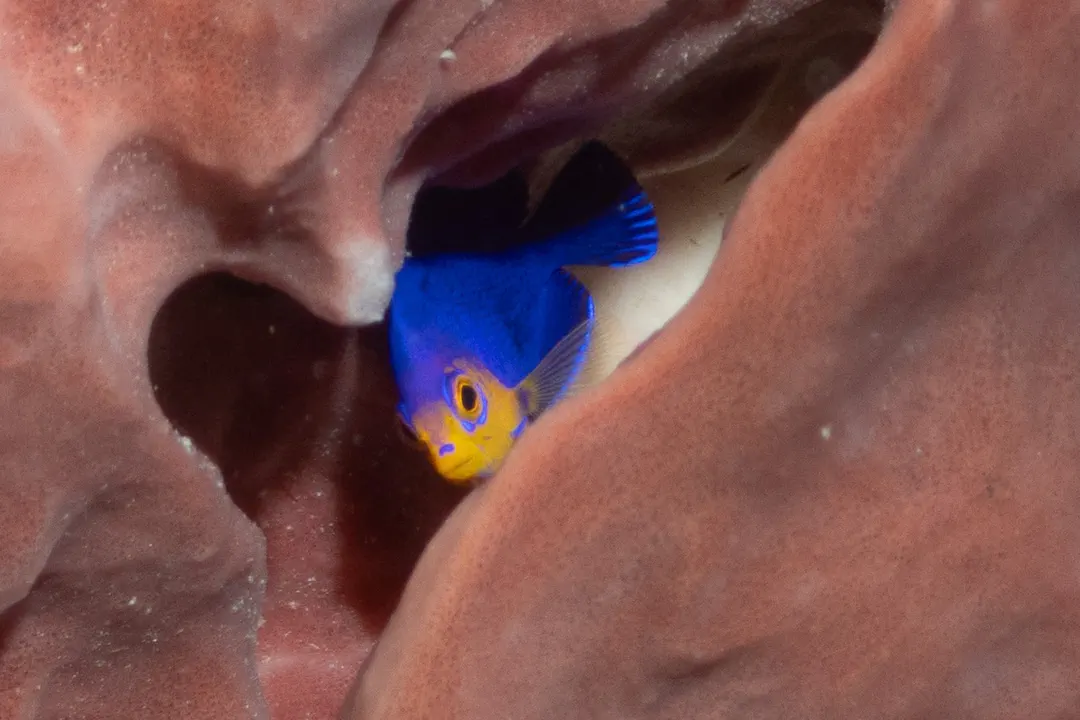 Justin PhilboisCC0 · iNaturalist
 Royal Angelfish has no known danger to humans. However, always observe marine life responsibly.
Royal Angelfish can be found at depths of up to 110 meters.
Download Seabook free for iOS and Android.