
At a depth of 14 meters over the sandy slopes of Blue Heron Bridge in Florida, sunlight filters through light green water onto a flat shadow buried in the sediment. Twin spiracles pulse behind yellow eyes as water pumps through hidden gills beneath the sand. With a gentle stroke of broad pectoral wings, the creature lifts off the bottom, revealing a pale underside and a stout tail lined with thorn-like denticles.
Distinguishing the difference between rays and skates underwater comes down to a few distinct anatomical features and reproductive traits. Both groups belong to the batoid superorder of cartilaginous fish, encompassing over 600 living species worldwide. While stingrays typically feature long, whip-like tails equipped with venomous stings and give birth to live young, skates possess shorter, fleshier tails with small dorsal fins, non-venomous thorns, and lay leathery egg cases.
Divers encountering these benthic animals will notice rays dominating tropical coral reefs and open warm ocean waters, while skates reach their peak diversity in cool temperate basins and deeper continental slopes. Recognizing snout geometry, pelvic fin structure, and resting posture allows observers to quickly classify what they see without disturbing the animal. Whether scanning shallow sandy shallows or navigating cold kelp forests, mastering these field markers turns every seabed encounter into an accurate marine life identification.
What Is the Main Difference Between Rays and Skates?
The fundamental distinction between rays and skates lies in their taxonomic classification within the batoid superorder. True skates belong exclusively to the order Rajiformes, forming a tightly bound group adapted primarily to seabed habitats. Rays are far more taxonomically diverse, spanning several distinct orders including Myliobatiformes, Torpediniformes, and Pristiformes. Smithsonian Ocean, Shark Cousins: The Skates and Rays, 2023 notes that batoids comprise more than 600 living species, all sharing cartilaginous skeletons, ventral gill openings, and spiracles located behind the eyes.
Despite their distinct evolutionary paths, both groups share an underlying body plan optimized for a benthic or benthopelagic existence. Their pectoral fins are enlarged and fused to the sides of the head, forming the characteristic flattened disc. On the underside of this disc, five or six pairs of gill slits allow respiration, while their mouths are positioned ventrally to crush benthic prey. Because their mouths rest against the sand, both rays and skates draw oxygenated water through top-mounted spiracles directly into the branchial chamber.
Field identification requires observing how these structural elements combine in the water. Skates generally exhibit an angular or triangular disc outline with a rigid, pointed rostrum projecting forward from the snout. Rays show greater morphological variation, ranging from the diamond-shaped discs of stingrays to the broad, wing-like pectoral fins of pelagic manta rays. Observing disc shape alongside tail anatomy provides immediate clarity during a dive.
How Do Tail Structures Differ Between Rays and Skates?
Examining the tail offers the fastest way to separate rays from skates in the field. Skates feature short, relatively thick tails that taper gradually from the main body disc toward the tip. Along the dorsal surface of the tail, skates bear two small dorsal fins positioned close to the tail tip, accompanied by rows of hardened denticles or thorns known as bucklers. These structures are non-venomous and serve as physical armor against predators.
In contrast, many ray species possess slender, whip-like tails that extend significantly beyond the margin of the body disc. As documented by Florida Museum of Natural History, Skates & Rays FAQ, skates are generally egg-laying and have dorsal fins and thicker tails, whereas many rays give birth to live young and have more whip-like tails. Rays typically lack dorsal fins at the tail tip, carrying instead one or more serrated, venomous spines near the base or midpoint of the tail.
Divers must remain cautious when inspecting tail structures underwater because ray spines can remain hidden under thin layers of sand. The venomous spine of a stingray is a modified dermal denticle lined with tissue that releases toxins when shed or driven into a target. Skates lack any venom-producing glands or stingers, relying entirely on their rough skin and thick tail musculature for protection. Recognizing these structural differences prevents accidental misinterpretation of defense mechanisms.
Reproductive Differences: Mermaids' Purses vs Live Birth
Reproduction provides a definitive biological divide between true skates and most ray families. Skates are exclusively oviparous, meaning females deposit fertilized eggs encased in tough, fibrous capsules directly onto the seafloor. According to The Shark Trust, Skates & Rays, skates and rays use spiracles behind the eyes to breathe while buried, and true skates lay egg cases. These egg cases anchor to seabed debris, sponges, or macroalgae using curling tendrils or corner horns while embryos develop over several months.
Commonly referred to as mermaids' purses, these empty egg cases frequently wash ashore on temperate beaches after the juvenile skates hatch. Each capsule consists of structural keratin that resists decomposition, protecting the embryo from scavengers and shifting currents. Inspecting an intact egg case underwater may reveal a yolk sac or a moving embryo inside, visible when backlit by ambient sun rays filtering through shallow water.
Most rays employ aplacental viviparity, giving birth to free-swimming live young. Female stingrays, eagle rays, and mantas retain eggs internally, where embryos absorb yolk reserves before secreting nutrient-rich fluids called histotroph within the uterus. When birth occurs, fully formed juvenile rays emerge ready to swim and forage independently. This reproductive strategy results in fewer offspring per cycle compared to the high egg output of skates.
Pelvic Fin and Body Shape Field Markers
Subtle anatomical markers on the lower body disc allow divers to confirm an identification when tail features are concealed. Skates possess two-lobed pelvic fins divided by a distinct notch along the outer margin. This anatomical feature enables some skate species to perform a specialized form of locomotion called punting, using the anterior pelvic fin lobes to push off and walk across muddy ocean bottoms.
Rays exhibit single-lobed pelvic fins with smooth, continuous outer edges that lack a central dividing notch. Their locomotion relies almost entirely on undulating or flapping the broad pectoral disc rather than pushing against the substrate with pelvic structures. Furthermore, skates possess a reinforced rostral cartilage that creates a firm, pointed snout, whereas many ray species have soft, flexible snouts or broad, rounded disc margins.
Coloration patterns and skin texture also help separate these two groups on the seabed. Skates frequently display complex mottled brown, gray, and yellow patterns adorned with dark rings or ocelli designed to mimic pebble substrates. Rays often feature uniform coloration, bright blue spots, or stark dark dorsal countershading. Scanning the outline of the pelvic fins while observing bottom movement provides an accurate identification clue.
Common Ray Species Divers Encounter
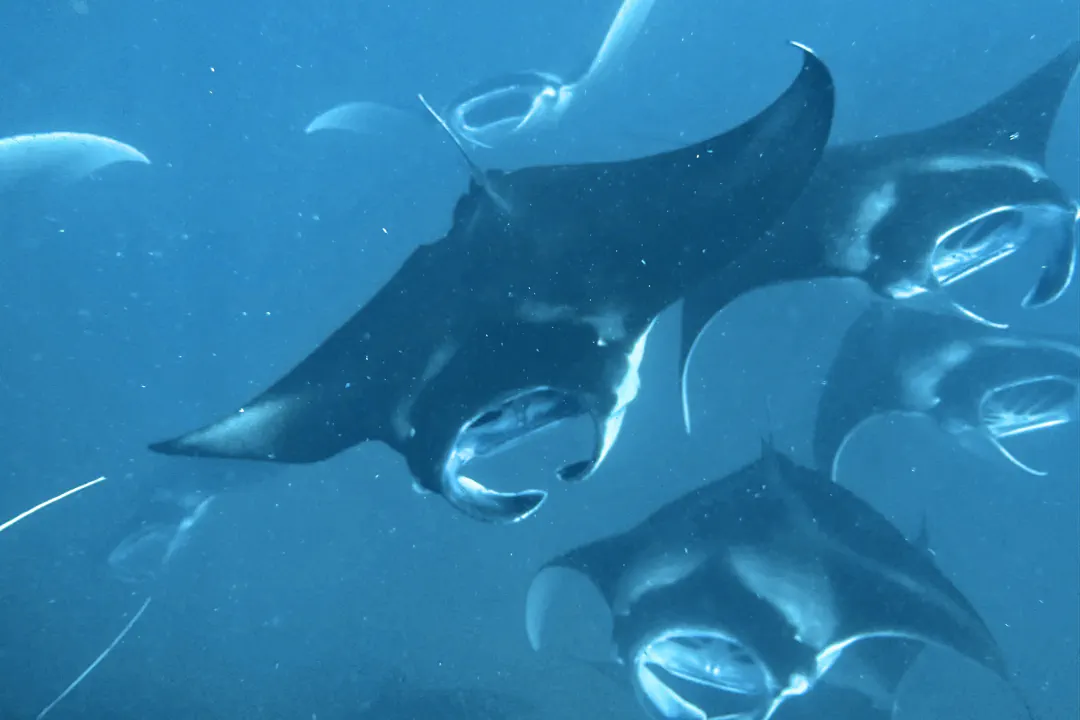
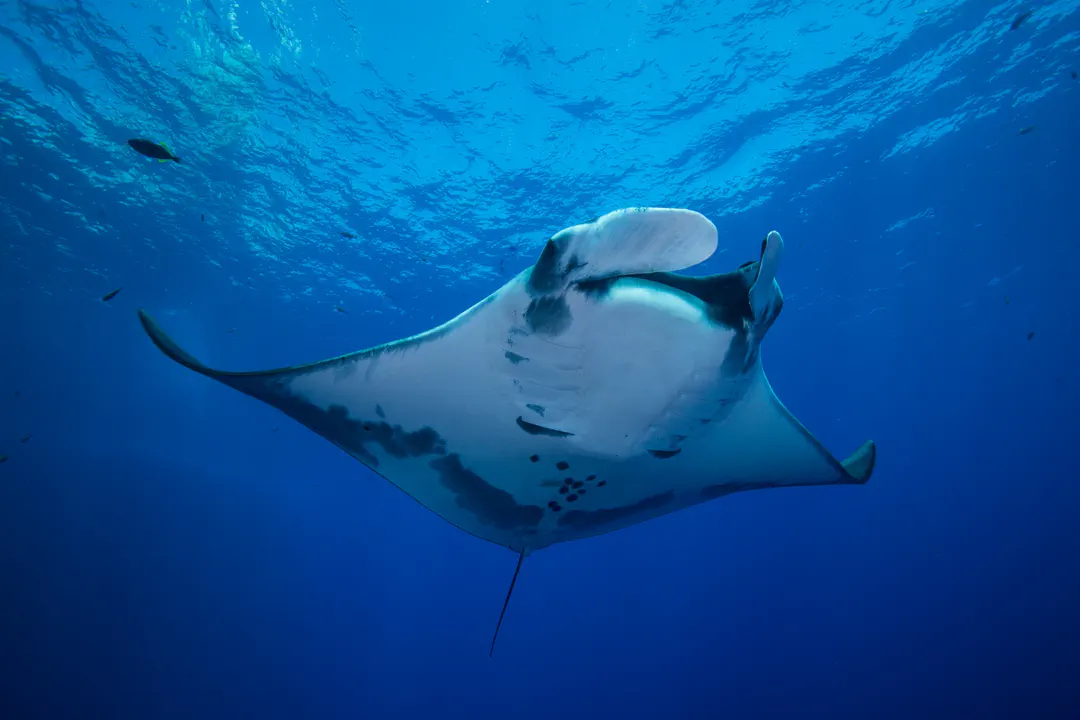
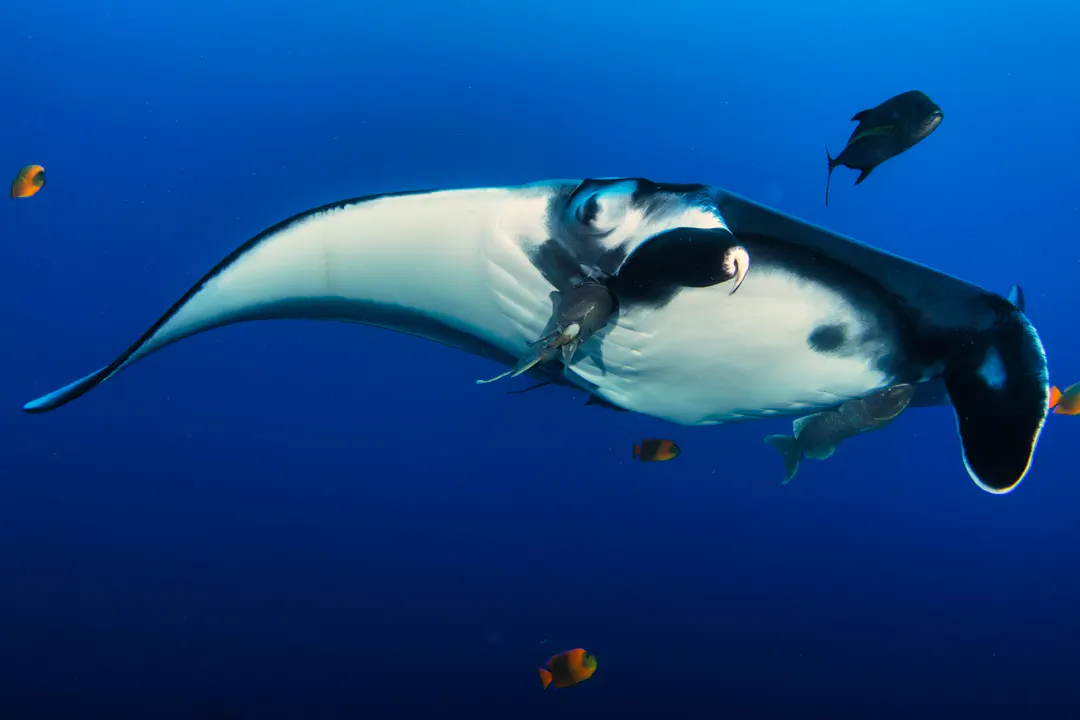
Tropical reefs and warm temperate sand flats host a wide array of ray species that divers encounter on shallow dives. The reef manta ray, Mobula alfredi, glides through coastal passages and visits reef cleaning stations, using cephalic fins to channel plankton-laden water into its mouth. In pelagic zones, the oceanic manta ray, Mobula birostris, reaches massive proportions. The IUCN Red List assessment for Mobula birostris records a maximum disc width of about 700 cm, with anecdotal reports up to about 910 cm, making it the largest ray in the ocean.
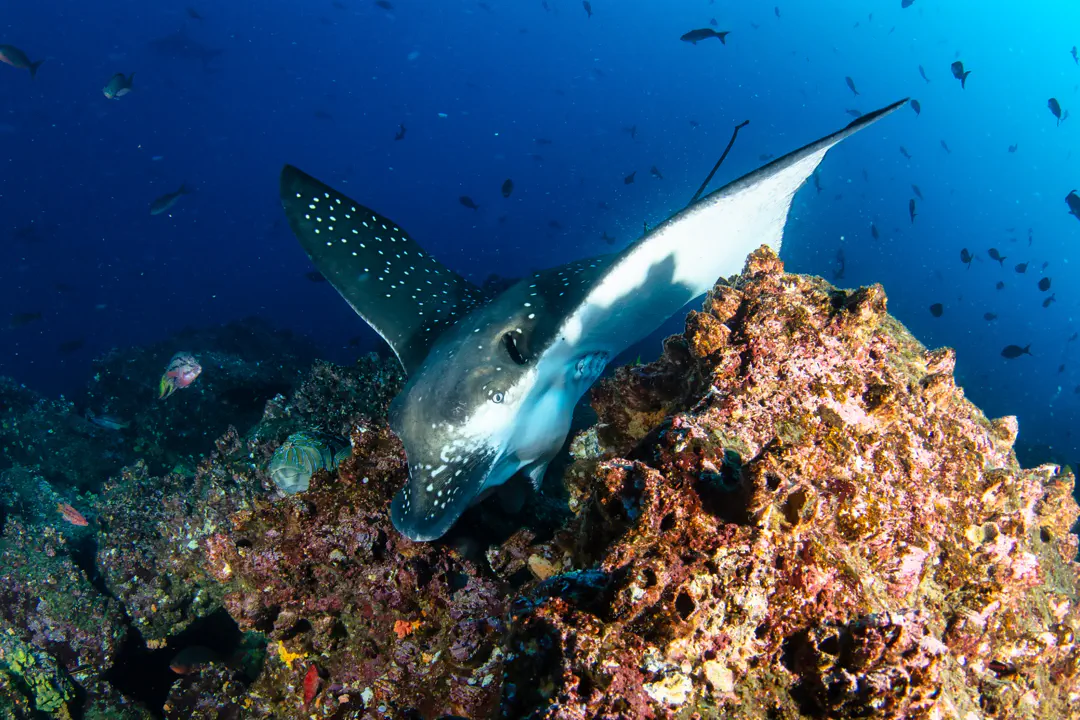
On warm sandy bottoms, the spotted eagle ray, Aetobatus narinari, uses its duck-billed snout to unearth buried mollusks, while the blue-spotted ribbontail ray, Taeniura lymma, tucks under coral ledges displaying vivid blue spots. In the western Atlantic, the southern stingray, Hypanus americanus, buries itself in fine sediment with only its eyes exposed. Other distinctive species include the porcupine ray, Urogymnus asperrimus, covered in blunt defensive tubercles, and the feather-tail stingray, Pastinachus sephen, recognized by its prominent tail fold.
Logging these encounters in the Seabook mobile app helps divers record exact species details, body shapes, and depth distributions across different ocean basins. Observing how rays swim reveals marked behavioral differences between pelagic filter feeders and benthic foragers. Keeping a respectful distance allows divers to watch these animals unearth crustaceans or navigate current channels without triggering defensive responses.
 © seabook.appAll rights reserved
 © seabook.appAll rights reserved
 © seabook.appAll rights reserved
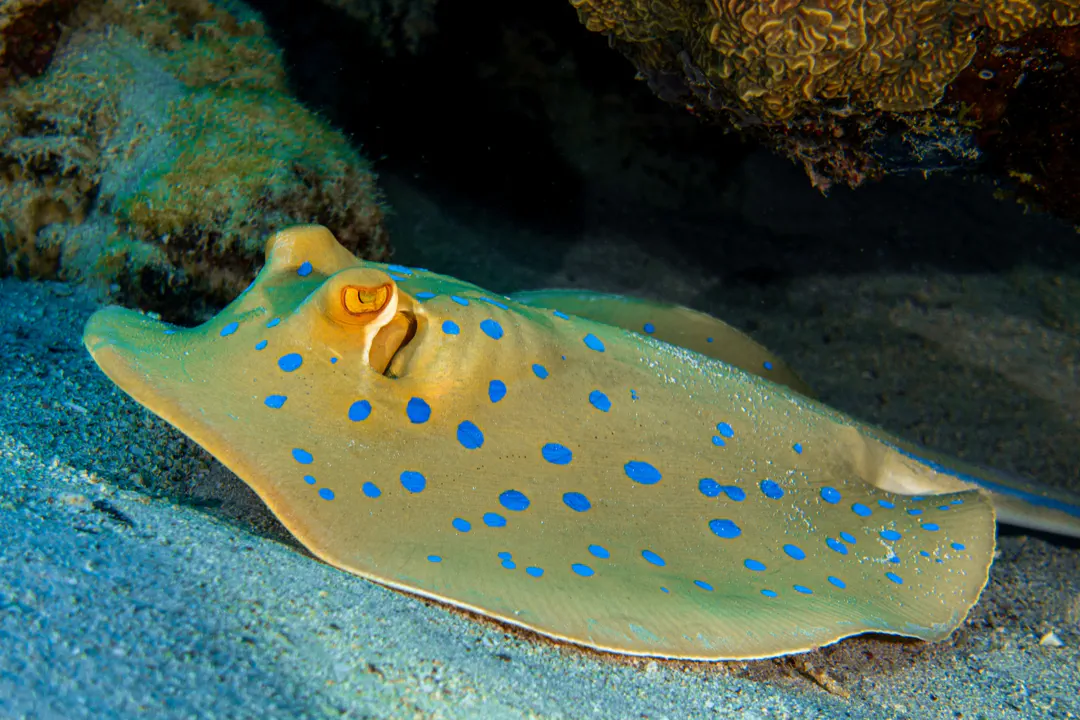 © Dirk FroebelCC BY 4.0 · iNaturalist
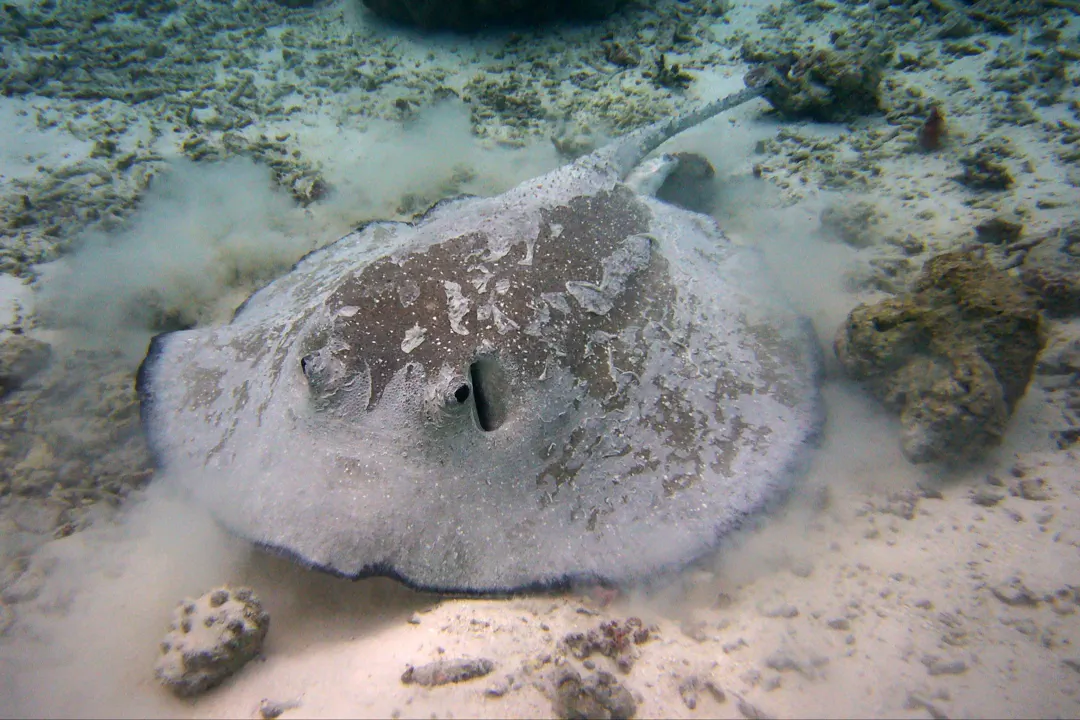 © Daniel BenákCC BY 4.0 · iNaturalist
Common Skate Species Divers Encounter
Skates dominate cold temperate seas, mud basins, and deep ocean slopes where temperatures remain low. The thornback skate, Raja clavata, is one of the most frequently observed species in the eastern Atlantic, named for the heavy bucklers scattering its back and tail. In deeper northeastern Atlantic waters, the common skate, Dipturus batis, represents a large-bodied species that has historically faced population declines due to benthic trawl fishing.
In the cold coastal waters of the western North Atlantic, divers meet the little skate, Leucoraja erinacea, and the clearnose skate, Raja eglanteria, both resting on mixed shell and sand bottoms. Further north toward subarctic regions, the thorny skate, Amblyraja radiata, thrives in frigid temperatures down to several hundred meters depth. Deep-water habitats of the North Pacific house the broad-foot skate, Bathyraja spinosissima, an elusive species adapted to abyss-like benthic conditions.
Observing skates in their natural habitat requires careful scanning of gravel beds and kelp forest margins. Their mottled countershading makes them nearly invisible until they shift position or pump water through their spiracles. Divers exploring temperate dive sites often spot these bottom-dwellers resting motionless on dark silt, relying on camouflage rather than flight to avoid detection.
How to Safely Observe Rays and Skates Underwater
Safe interaction with benthic batoids requires maintaining proper buoyancy and maintaining a stationary position at least 2 to 3 meters away. Approaching a buried stingray or skate from directly above can startle the animal, triggering a defensive tail lash or sudden flight. Divers should hover horizontally, avoiding settling onto sandy patches where concealed tail spines or delicate skin denticles might lie hidden.
Bright lights should never be aimed directly into the eyes of resting rays or skates, as this disrupts their vision and causes unnecessary stress. When photographing an individual, approach slowly from the front or side, ensuring the animal has a clear, unobstructed escape route toward open water. Never attempt to touch, restrain, or chase an individual, as stingray spines can easily penetrate neoprene wetsuits and cause severe puncture wounds.
Environmental stewardship extends to preserving substrate habitats and respecting egg cases attached to seaweeds or rocky outcrops. If an anchored mermaid's purse is spotted, avoid touching or detaching it, as embryonic skates require months of undisturbed water flow to complete development. Following these practical guidelines protects both divers and marine life, ensuring sustainable encounters across temperate and tropical dive sites alike.
Questions
Are skates dangerous to divers?
Skates do not possess venomous tail spines like stingrays, making them non-hazardous to divers who maintain distance. However, their dorsal thorns and rough denticles can cause minor skin scratches if handled.
Do all rays have stingers?
No, not all rays have stingers. Manta rays and devil rays in the family Mobulidae lack functional tail barbs entirely, relying on speed and size, while electric rays use electric organs for defense.
Where can you find skate egg cases?
Skate egg cases, known as mermaids' purses, are found attached to seaweed, kelp, or rocks on temperate seabeds, and frequently wash onto sandy beaches after coastal storms.
Can rays and skates breathe while buried in sand?
Yes, both groups draw oxygenated water through spiracles located directly behind their eyes. This adaptation allows them to ventilate their gills while resting completely buried in sand.
What is the largest species of ray?
The oceanic manta ray (Mobula birostris) is the largest species, with disc widths reaching up to 700 cm in large specimens.
Sources
- Shark Cousins: the Skates and Rays | Smithsonian Ocean · 2023-09-29
- Skates & Rays FAQ · 2018-05-09
- Skates & Rays - The Shark Trust · 2026-10-11
- The IUCN Red List of Threatened Species™ · 2025-07-17
- Oceanic Manta Ray (Mobula birostris) Species Guide · 2026-10-04

