
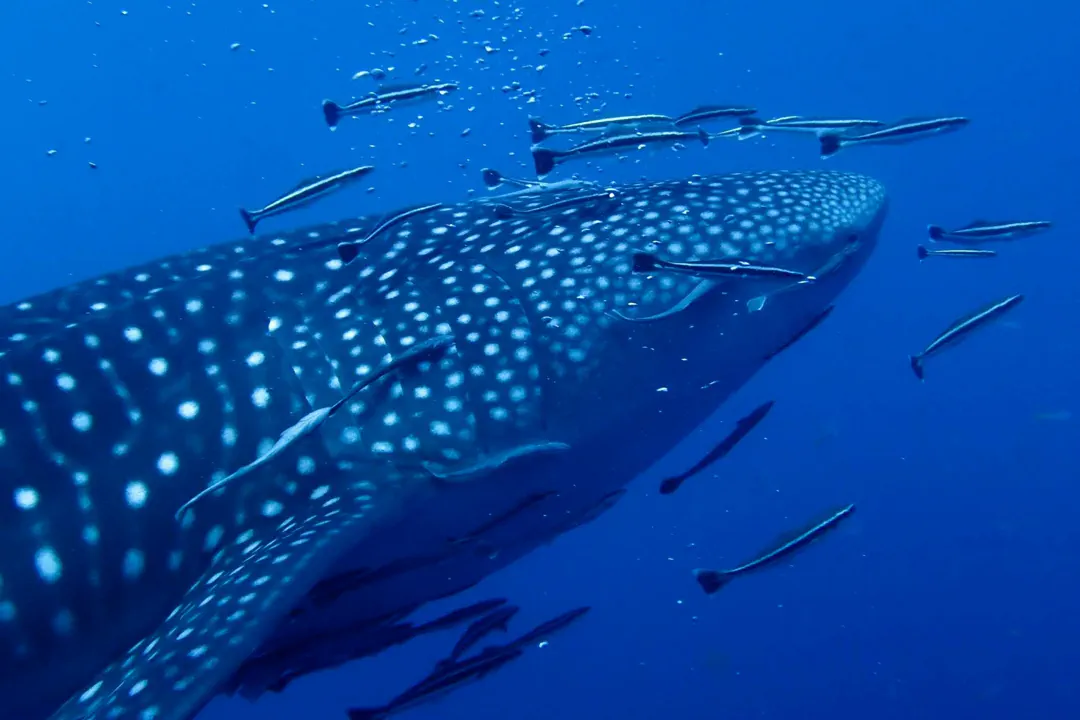
At Maamigili Beru along the southern rim of South Ari Atoll, midday rays slice through six meters of blue water to light up a pattern of pale spots against dark grey skin. A eight-meter juvenile whale shark coasts along the reef shelf at two knots, its wide flat head swaying gently side to side as it filters plankton through black gill slits. A remora rides below its pectoral fin while fusiliers scatter before its path.
Knowing where to swim with whale sharks requires matching oceanic seasonal cycles with specific geographical bottlenecks. Peak aggregation windows vary across the globe, with water temperatures typically hovering between 22°C and 29°C and visibility ranging from 10 to 30 meters. These plankton-rich zones draw the world's largest fish to shallow coastal waters during predictable months.
Key interaction hubs include the outer reefs of the Maldives, Australia's Ningaloo Reef, Mexico's Caribbean coastline, the remote oceanic pinnacles of the Galapagos, West Papua's sheltered bays, and coastal bays in the Philippines. Encounters accommodate both surface snorkelers and certified scuba divers, depending on local marine park rules and the depths at which the animals feed.
What Is Swimming with Whale Sharks Like?
Sighting a whale shark underwater presents a study in peaceful scale. Despite growing up to 18 meters long, these carpet sharks maintain an effortless cruising velocity of roughly three kilometers per hour. Their pectoral fins extend like gliders, steadying a body that moves with slow lateral sweeps of a massive vertical tail.
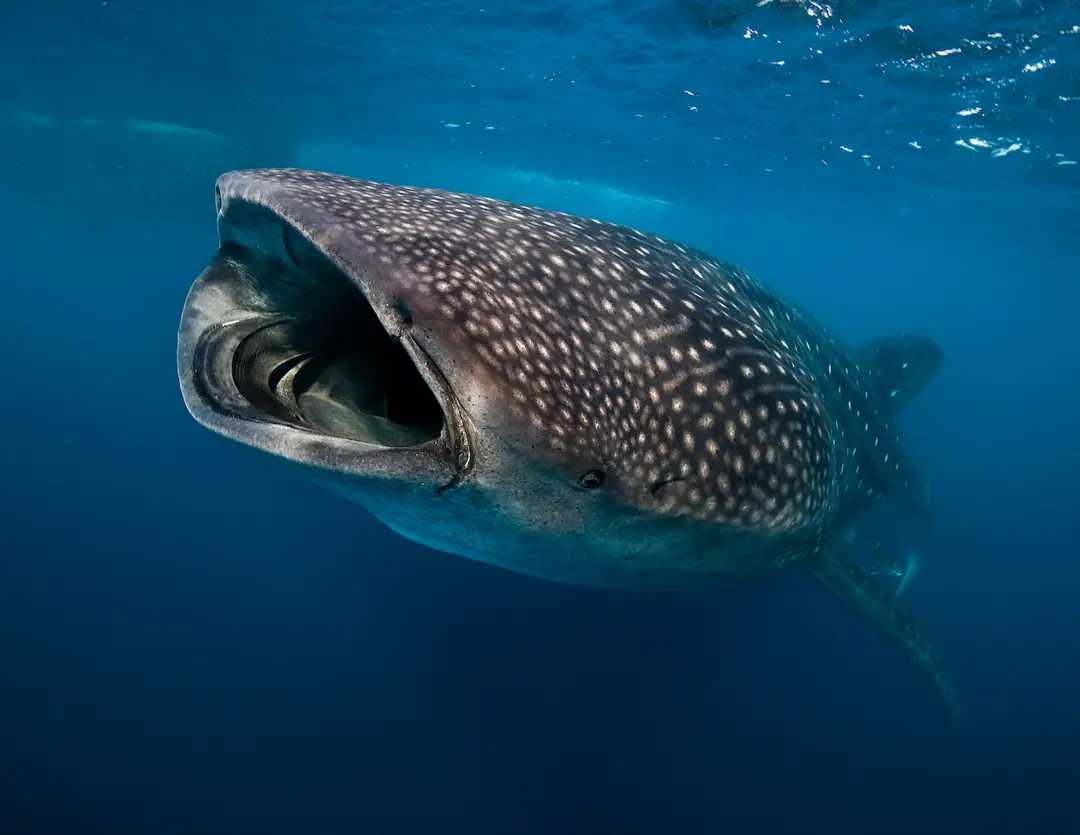
Because whale sharks are filter feeders, they lack the biting teeth of predatory requiem sharks, relying instead on over 300 rows of tiny, non-functional teeth and specialized spongy gill plates. As they funnel thousands of cubic meters of water per hour, surface swimmers and divers can observe their gill slits rhythmically opening and closing to strain micro-crustaceans, fish eggs, and larval crabs.
Being in the water alongside an animal weighing up to 20 metric tons demands calm observation rather than fast swimming. The shark's slow cadence is deceiving; human swimmers often find themselves swimming hard to keep pace with a passive creature taking only a few tail strokes per minute.
South Ari Atoll (Maldives): Year-Round Whale Shark Sightings
South Ari Atoll serves as a primary nursery ground for juvenile whale sharks, which remain along the outer reef edge throughout the year. The southern point of Maamigili island features a shallow drop-off where ocean currents bring deep-water nutrients close to the surface reef shelf.
These resident individuals average between four and eight meters in length, making regular feeding patrols in depths ranging from three to 15 meters. Surface visibility around the outer reef edge consistently reaches 15 to 25 meters, allowing clear tracking of their white-spotted contours against the sandy seafloor.
Because the waters remain protected from extreme swell, the site provides accessible conditions for both snorkelers and divers navigating the soft currents along the reef boundary.
Depth: 3-30 m. Access: boat, 15 minutes from Sun Island. Level: Open Water / Snorkel. Best months: Year-round (peak December-April).
 © seabook.appAll rights reserved
 © seabook.appAll rights reserved
 © Daniel BenákCC BY 4.0 · iNaturalist
 © seabook.appAll rights reserved
 © Matteo BellucciCC BY 4.0 · iNaturalist
Ningaloo Reef (Australia): Coral Spawning and Aggregations
Following the full moon in March and April, Ningaloo Reef undergoes a massive coral spawning event that triggers a vast surge in planktonic productivity. Hundreds of whale sharks gather along this 300-kilometer fringing reef off Western Australia to feed on the abundant food supply.
Spotter planes scout the turquoise waters outside the main reef break, guiding tour vessels directly to cruising individuals. Swimmers enter the ocean in small, organized groups under strict distance regulations, sharing the top five meters of the water column with sharks that routinely measure up to eleven meters.
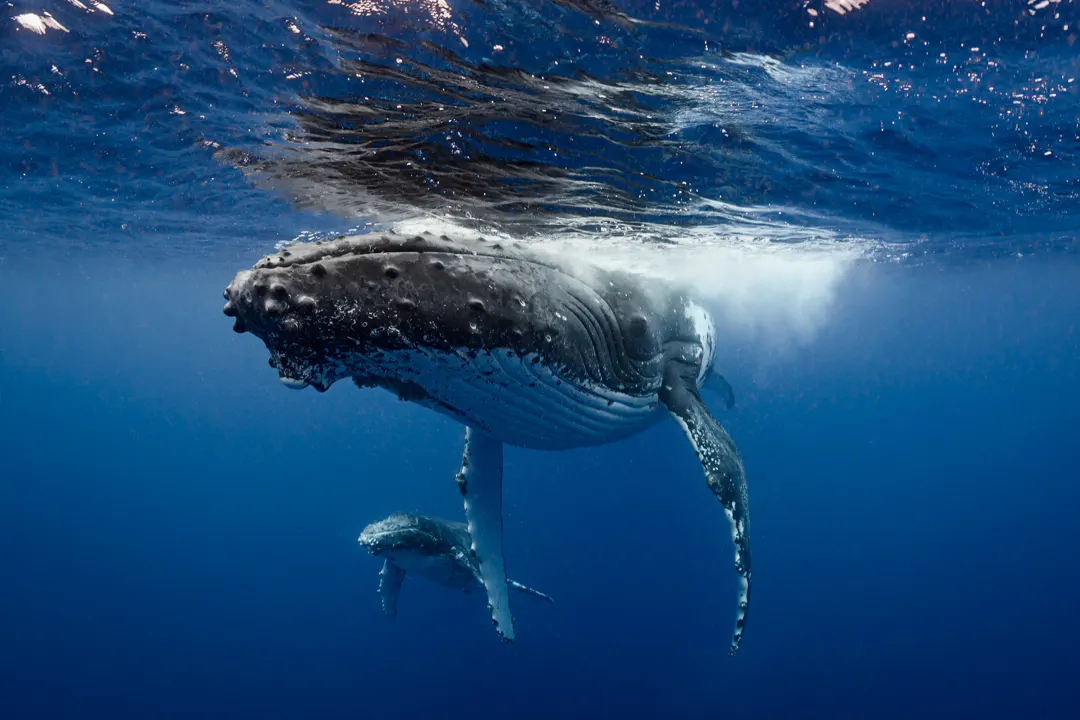
Water temperatures along the reef shelf sit around 24°C to 26°C with visibility often stretching to 20 meters. Humpback whales, manta rays, and green sea turtles frequently cross paths with the feeding sharks during the autumn surge.
Depth: 2-15 m. Access: day boat from Exmouth or Coral Bay. Level: Snorkel. Best months: March-July.
 © seabook.appAll rights reserved
 © Daniel BenákCC BY 4.0 · iNaturalist
 © seabook.appAll rights reserved
Isla Mujeres (Mexico): Summer Snorkeling Aggregations
In the open Caribbean waters north of Isla Mujeres and Holbox, upwelling currents bring dense concentrations of little tunny eggs and copepods to the surface between June and September. This seasonal phenomenon forms the largest recorded gathering of whale sharks on Earth, known locally as the Afuera.
Researchers have documented over 400 individuals feeding in a single area simultaneously. The water in this offshore zone reaches depths of 20 to 30 meters, but the sharks spend their energy directly at the surface, gulping water with open mouths in a behavior known as ram-filtering.
Marine park laws prohibit scuba gear during these encounters to preserve water clarity and reduce noise stress, requiring participants to observe the animals strictly via snorkeling equipment in warm, 28°C surface waters.
Depth: 5-20 m. Access: boat, 45 minutes from Isla Mujeres dock. Level: Snorkel. Best months: June-September.
 © R VasconcellosCC BY 4.0 · iNaturalist
 © seabook.appAll rights reserved
 © seabook.appAll rights reserved
Galapagos Islands (Ecuador): Massive Pregnant Females
The oceanic realm surrounding Darwin and Wolf Islands in the northern Galapagos hosts a distinct demographic of whale sharks. Unlike the juveniles found in shallow coastal nurseries, the vast majority of individuals passing through these cold, nutrient-dense volcanic waters are fully grown females exceeding 12 meters in length.
Ultrasound research at the site indicates that many of these heavy females are pregnant, utilizing the deep Humboldt and Equatorial currents as a migratory navigation highway. Divers drop into deep water sweeps near current-washed volcanic ledges where visibility ranges from 10 to 20 meters.
Water temperatures fluctuate rapidly between 18°C and 23°C, demanding thick wetsuits and confident buoyancy control to navigate the powerful oceanic surges while watching these massive pelagics pass overhead.
Depth: 12-35 m. Access: liveaboard vessel from San Cristóbal. Level: Advanced Open Water. Best months: June-November.
 © R VasconcellosCC BY 4.0 · iNaturalist
 © seabook.appAll rights reserved
Cenderawasih Bay (Indonesia): Unique Bagan Fishing Encounters
Deep within Cenderawasih Bay in West Papua, local fishermen operate floating wooden lift-net platforms known as bagans. Over decades, a symbiotic relationship has developed between these local crews and the resident whale shark population.
Sharks congregate directly beneath the platforms to feed on tiny baitfish (ikan puri) slipping through the nets or discarded by fishermen. Rather than staying on the move, these individuals often hang vertically in the water column, sucking food directly from the net surface just meters below the hull.
Because the bay remains sheltered from ocean swells, water conditions stay exceptionally calm with temperatures resting at a warm 29°C. Divers can remain stationary at five to fifteen meters depth, watching multiple sharks loop repeatedly beneath the wooden beams.
Depth: 5-25 m. Access: liveaboard or local boat from Nabire. Level: Open Water. Best months: Year-round (peak April-November).
 © Dan SchofieldCC BY 4.0 · iNaturalist
Donsol and Southern Leyte (Philippines): Coastal Feeding Grounds
The Philippines presents two distinct operational styles for encounters with these carpet sharks. In Donsol Bay, interactions focus entirely on surface snorkeling guided by trained local spotters known as BIOs (Butanding Interaction Officers), who locate sharks feeding on the river outflow nutrients.
Further south in Southern Leyte's Sogod Bay, divers encounter whale sharks along steep underwater walls and coral slopes. Water visibility in Sogod Bay frequently exceeds 20 meters, offering clear underwater perspectives of feeding animals alongside reef slopes.
Divers tracking marine fauna across these sites can log their sightings in the Seabook app to map individual spot patterns and record dive logs. Leyte offers deeper scuba profiles where reef sharks and eagle rays patrol the slope limits.
Depth: 3-25 m. Access: boat from Donsol or Padre Burgos. Level: Snorkel (Donsol) / Open Water (Leyte). Best months: November-May.
Best Month to Dive with Whale Sharks Worldwide
Timing a expedition to swim with whale sharks depends on regional oceanic productivity, temperature shifts, and wind patterns. From January to April, the Indian Ocean offers ideal conditions, with the Maldives presenting calm seas and high encounter rates while the Philippines opens its seasonal bay feeding windows.
From May through July, focus shifts to Western Australia and Central America. Ningaloo Reef experiences peak numbers as coral spawning events feed large aggregations, while Mexico's Caribbean coastline begins to see the first wave of plankton-seeking sharks moving through the Yucatan Channel.
Between August and November, the eastern Pacific peaks. The Galapagos Islands witness passage of mature pregnant females amidst cool upwellings, while the Caribbean aggregations at Isla Mujeres remain active through September before animals disperse into open pelagic zones.
By December, global migratory patterns shift back toward sheltered, warm equatorial nurseries, making the sheltered atolls of the Indian Ocean and the inner bays of West Papua the most reliable destinations.
Code of Conduct for Swimming and Diving with Whale Sharks
Responsible encounters rely on strict adherence to international marine park rules to prevent disturbing these slow-moving animals. Swimmers and divers must maintain a minimum distance of three meters from the head and four meters from the powerful tail fin to prevent injury and avoid altering the shark's swimming path.
Touching, riding, or using underwater scooters near a whale shark is strictly illegal across all regulated marine sanctuaries. Touching removes the protective mucous coating on the shark's skin, leaving the animal vulnerable to bacterial infections and skin parasites.
Flash photography is prohibited, as sudden light bursts startle surface-feeding sharks and prompt them to dive into deeper water. Swimmers should enter the water quietly without splashing and avoid swimming directly ahead of the shark's heading.
Vessels must obey restricted speed zones within interaction sectors, maintaining a slow gear idling speed of under five knots to eliminate boat propeller strikes, which remain a primary threat to surface-dwelling pelagics worldwide.
Questions
Can you dive with whale sharks or only snorkel?
Regulations depend on the specific location. In places like Isla Mujeres and Donsol, encounters are restricted exclusively to surface snorkeling to safeguard surface-feeding sharks. However, locations like the Galapagos Islands, Cenderawasih Bay, and South Ari Atoll permit scuba diving encounters.
Are whale sharks dangerous to humans?
Whale sharks pose no predatory threat to human beings. They are passive filter feeders that consume plankton, krill, and small baitfish, using tiny, non-functional teeth that cannot bite or chew.
What month is best to see whale sharks globally?
The ideal month depends entirely on the destination: March through July is best for Ningaloo Reef, June through September for Isla Mujeres, June through November for the Galapagos, and December through April for the Maldives.
How close can you get to a whale shark?
Marine park interaction codes require swimmers to keep a distance of at least 3 meters from the shark's body and 4 meters from its tail to prevent stress and accidental contact.
Do I need an advanced diving certification to see whale sharks?
An advanced certification is not mandatory for many regions. Numerous encounters occur near the surface while snorkeling or during shallow reef dives accessible to Open Water divers, though sites like the Galapagos require advanced training due to heavy currents.