
At a depth of four meters along the concrete pilings of Blue Heron Bridge in Florida, a juvenile threadfin jack sweeps past a sponge-covered beam, its long, silvery dorsal filaments trailing like delicate whip silk through the gentle tidal current. Afternoon sunlight shafts through the shallow green water, illuminating a quick glint of silver and dark bars before the creature vanishes into the shadows. You raise your underwater camera, press the shutter just in time, and freeze a single side-profile image of the passing silhouette.
Learning how to identify fish from photo records transforms a quick underwater snapshot into a precise biological record. By evaluating diagnostic body shapes, fin counts, and regional depth data, divers and snorkellers can accurately pinpoint an unknown species within minutes. Color alone can be deceiving beneath the surface, but structural silhouette and anatomical markings provide bulletproof evidence for visual identification.
Successful photographic identification relies on systematic observation: matching outline silhouettes first, examining fin structures second, and cross-referencing habitat coordinates third. Whether you are analyzing a shallow reef damselfish or a deep-water pelagic predator, combining clear profile photography with ecological context guarantees fast identification. This guide outlines the exact features to analyze in your photos to identify marine species with confidence.
What Body Features Help Identify a Fish from a Photo?
When analyzing an underwater photograph, body silhouette and structural anatomy serve as your most reliable starting point. Fish families possess distinctive profile shapes that immediately rule out broad taxonomic groups regardless of lighting conditions. For instance, high-bodied jacks like the African pompano (Alectis ciliaris) and streamlined hunters like the almaco jack (Seriola rivoliana) display sharply compressed flanks and deeply forked tail fins, whereas open-water pelagics like the albacore (Thunnus alalunga) feature spindle-shaped bodies flanked by tiny rigid finlets near the caudal peduncle.
Fin arrangement and ray counts provide critical diagnostic details for narrowing down closely related species. Counting dorsal fin spines and soft rays alongside body proportions creates a reliable fin formula that distinguishes lookalike genera across major families. Deep-water species like the splendid alfonsino (Beryx splendens) showcase large eyes and short, steep dorsal fins, while small reef inhabitants such as Alexander's damsel (Pomacentrus alexanderae) and the Ambon chromis (Chromis amboinensis) possess single, continuous dorsal fins extending across their backs.
Beyond fin structure, observing head profile, mouth orientation, and lateral line curvature yields crucial diagnostic proof. A mouth pointing upward signals a surface-oriented feeder, while a downward-turned mouth indicates a bottom-dwelling grazer or sifter. Inspecting the lateral line—the sensory channel running along the flank—reveals whether it arches dramatically over the pectoral fin or extends in a straight path to the tail, helping confirm difficult species identifications when original color patterns fade.
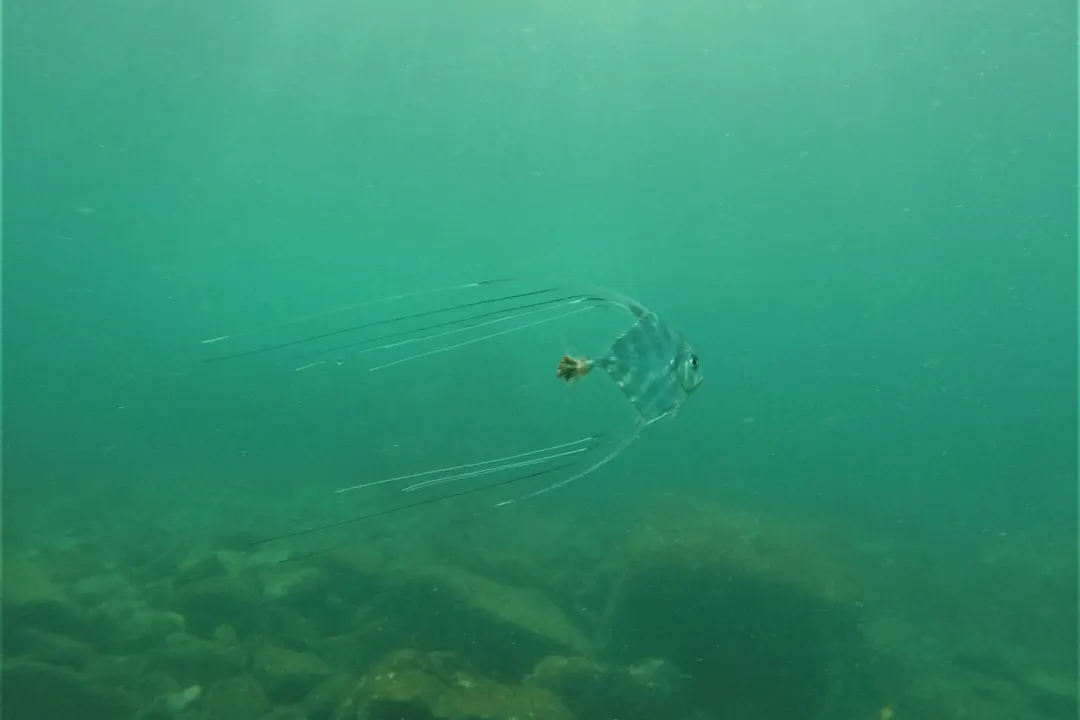 © Alberto AlcaláCC BY 4.0
 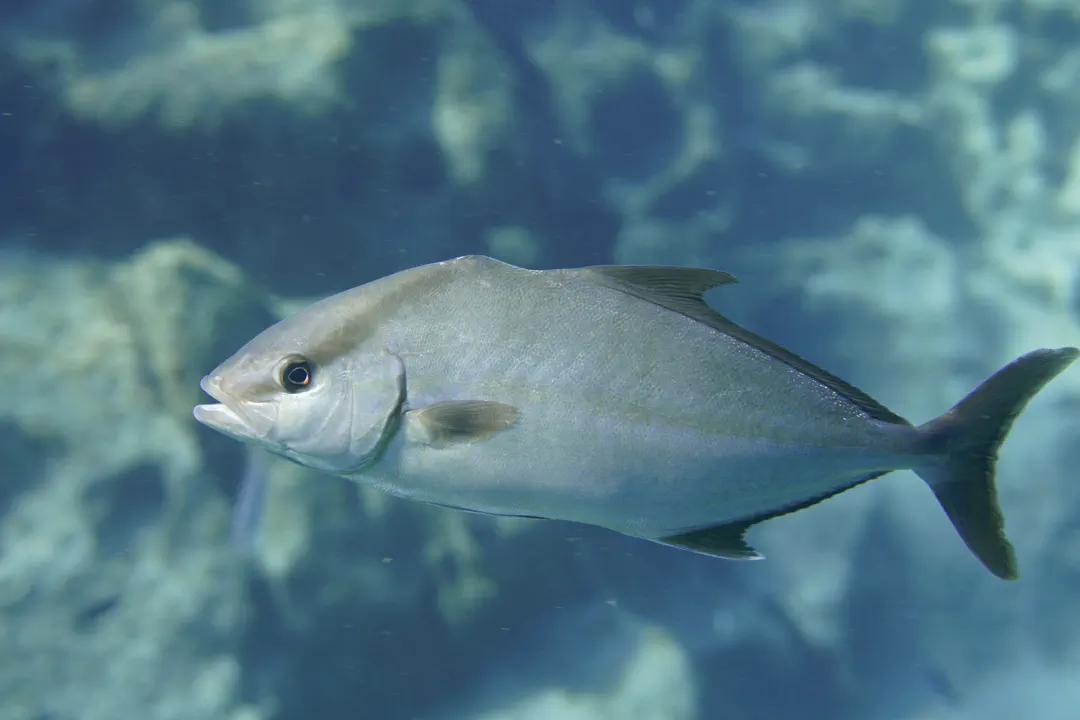 © Michael BommererCC BY 4.0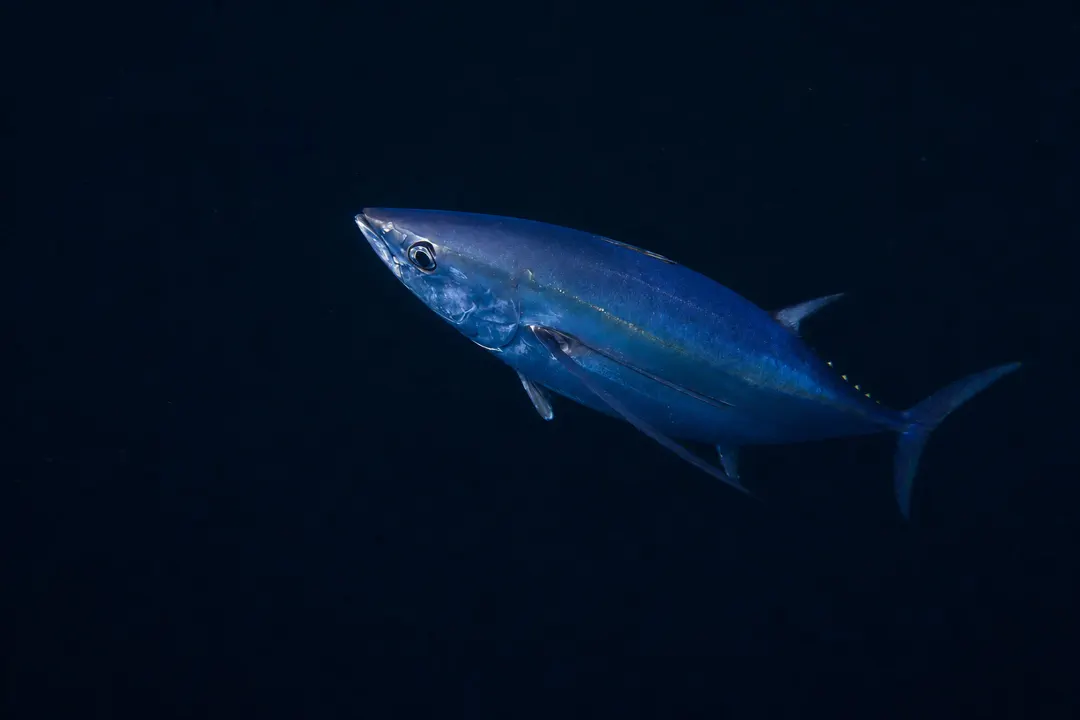
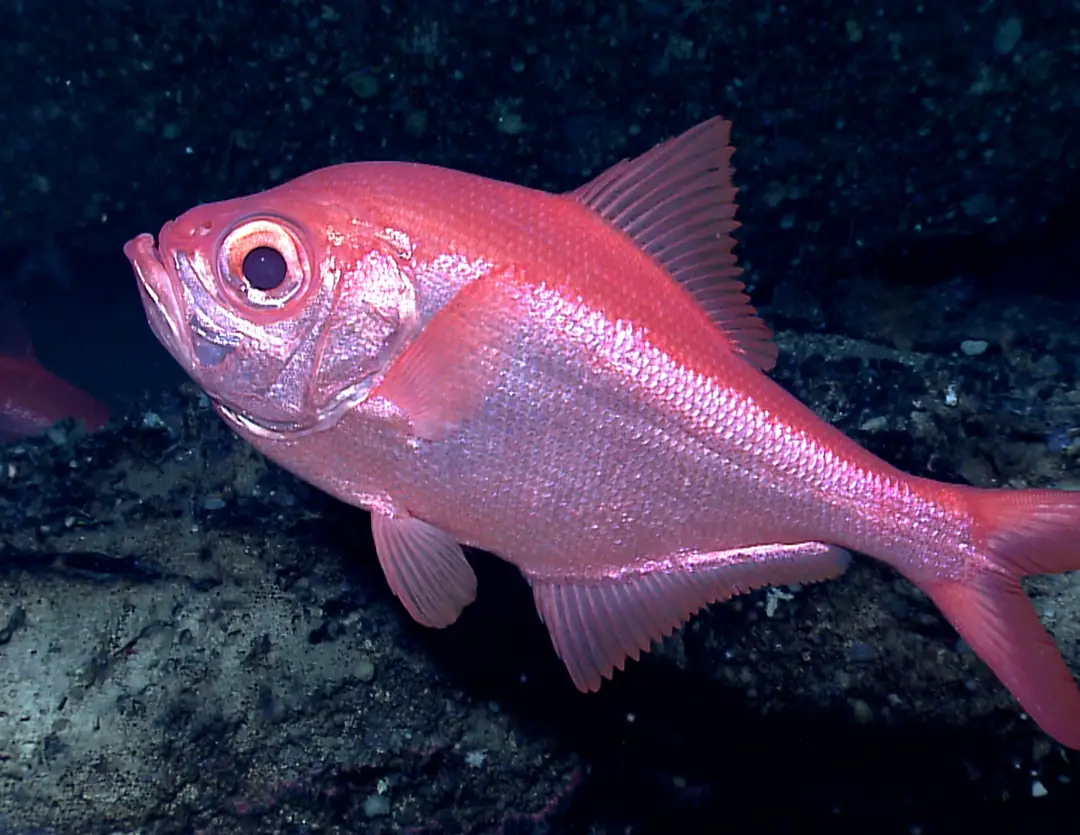 © NOAA Photo LibraryCC BY 4.0
 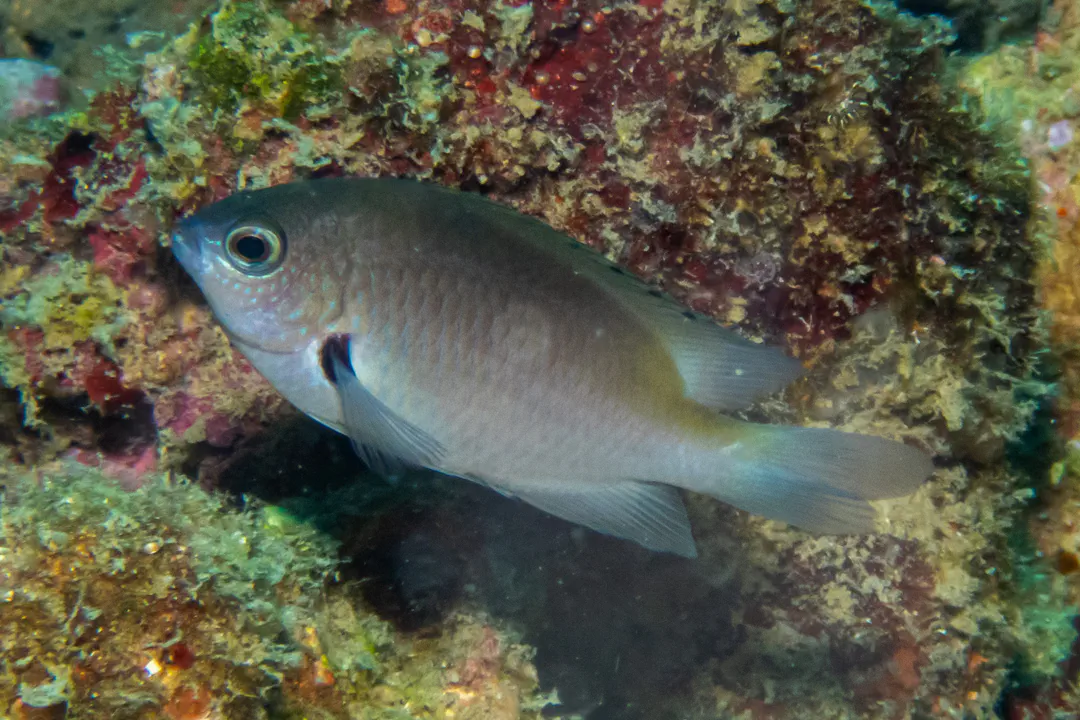 © portioidCC BY 4.0
 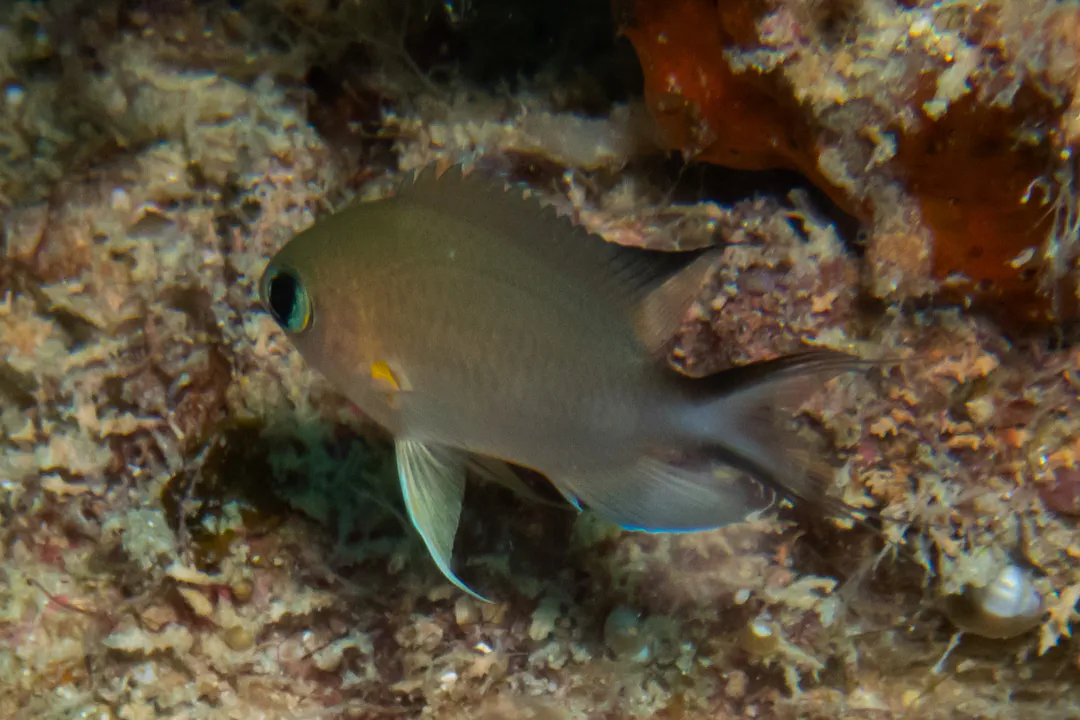 © portioidCC BY 4.0
 How Do Color, Patterns, and Markings Assist Identification?
Visible color patterns and contrast markings offer powerful identification clues when evaluated alongside body anatomy. Look specifically for persistent visual markers such as dark eye bars, vertical body bands, horizontal stripes, and false eye spots, or ocelli, on the dorsal or tail fins. Species like the threadfin butterflyfish (Chaetodon auriga) display prominent diagonal chevron markings and a dark black eye bar, while the regal angelfish (Pygoplites diacanthus) displays bold vertical blue and yellow body bars bordered in brilliant white.
Underwater lighting dramatically alters how colors appear in digital photographs taken below the surface. Longer red wavelengths attenuate rapidly in water, causing noticeable color distortion at subject distances greater than roughly one meter. Because depth turns warm oranges and reds into muted grays or blues, relying on bright red bands without artificial strobe lighting often leads to mistaken identifications in ambient-light photos.
Life stage transitions add another layer of complexity when interpreting color patterns in underwater images. Juvenile damselfishes like the Ambon damsel (Pomacentrus amboinensis) feature bright blue spots on the head and a dark spot on the soft dorsal fin that vanish as they mature into uniform yellow adults. Venomous predators such as the red lionfish (Pterois volitans) maintain distinctive banded pectoral fans throughout life, but juveniles feature translucent fin membranes that obscure diagnostic markings to unpracticed observers.
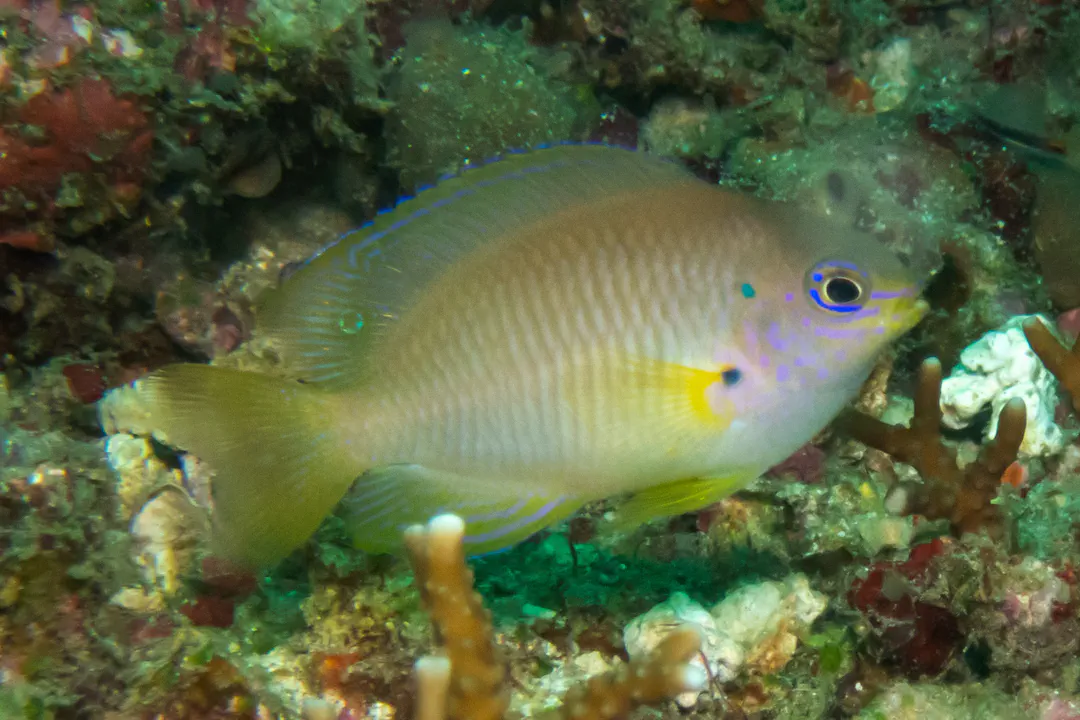 © portioidCC BY 4.0 · iNaturalist
 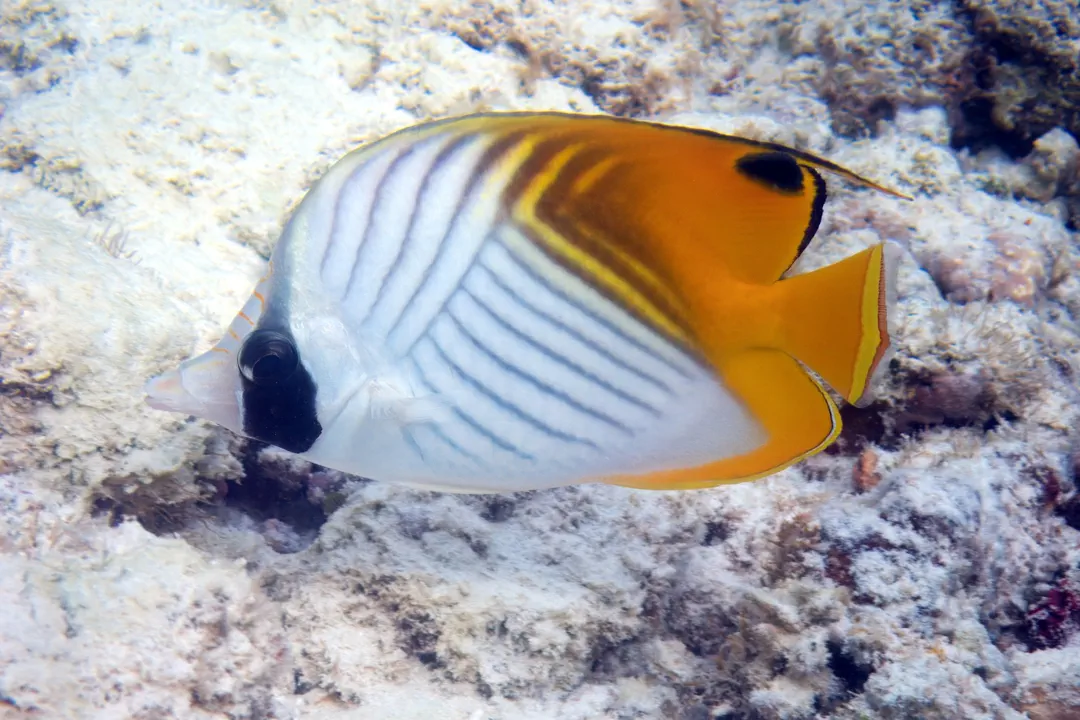 © Darren ObbardCC BY 4.0 · iNaturalist
 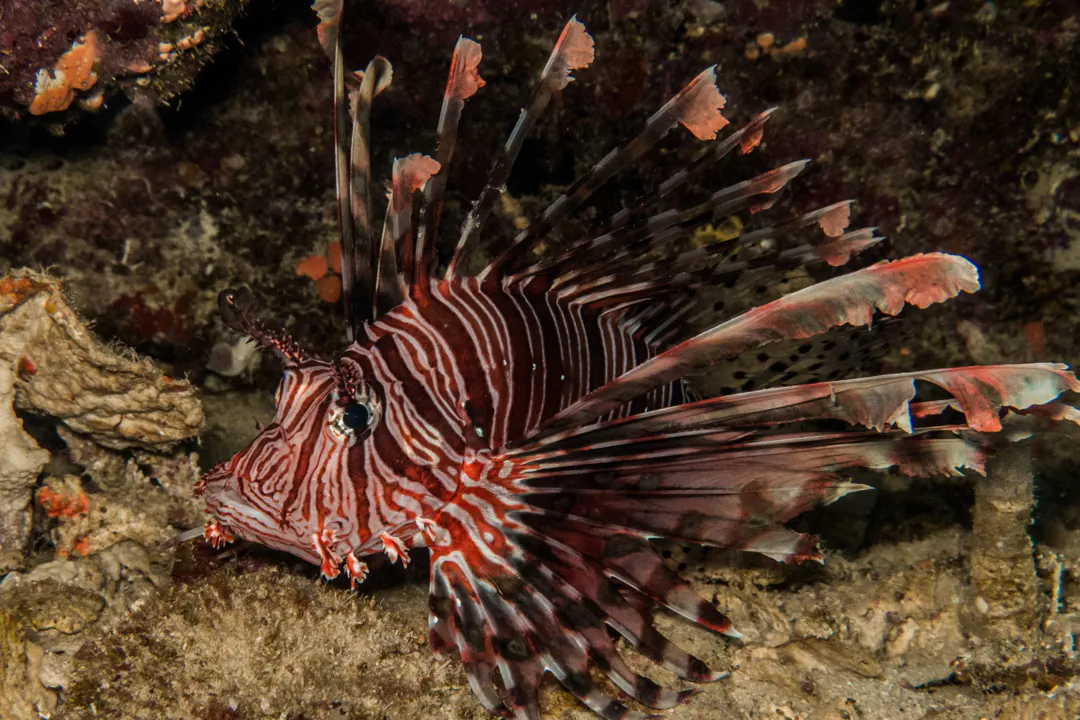 © João D'AndrettaCC BY 4.0 · iNaturalist
 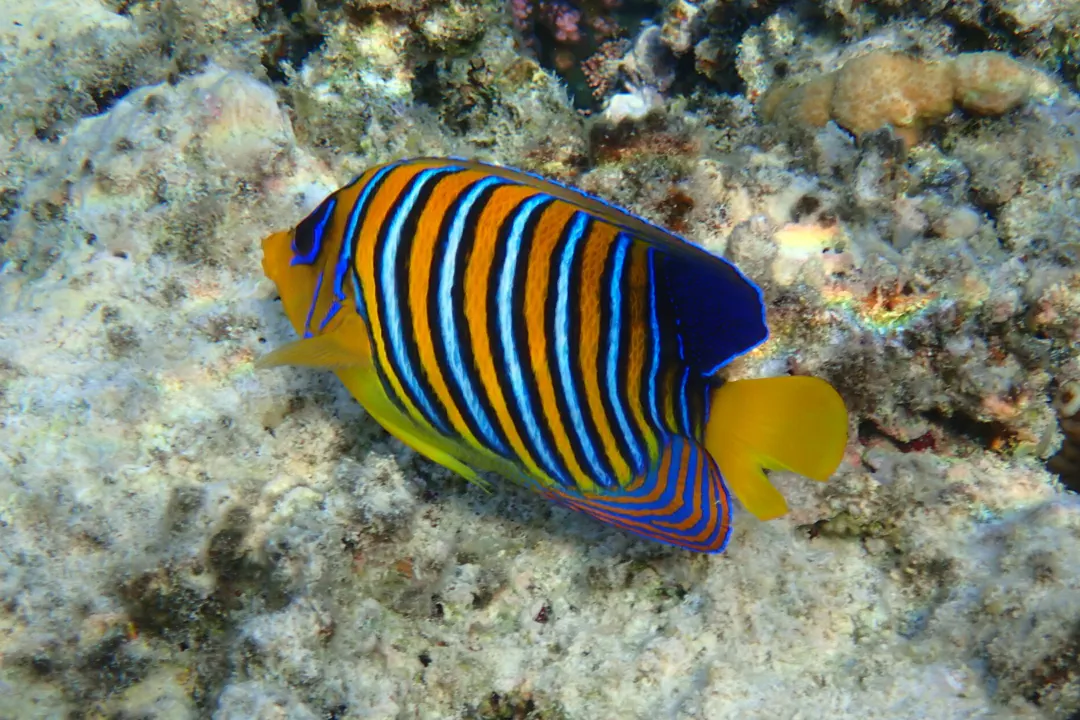 Andrew DeaconCC0 · iNaturalist
 Why Are Location and Depth Crucial for Photo Identification?
Exact geographic coordinates and water depth act as strict natural filters that narrow down candidate species lists instantly. Marine fishes occupy distinct ocean basins, coral triangles, and temperature zones, meaning a snapshot captured in the Red Sea will feature an entirely different set of endemic lookalikes than one taken off Southern California. Logging your precise dive location prevents you from misidentifying a local reef inhabitant as a distant ocean relative.
Depth ranges act as equally decisive ecological barriers when separating visually similar marine species. Shallow coral reef dwellers spend their lives in light-filled waters between one and twenty meters, whereas deep-slope species like the splendid alfonsino reside below one hundred meters in dark, cooler waters. Knowing whether your photo was taken at five meters on a lagoon bommie or forty meters down a vertical wall immediately eliminates hundreds of shallow-water lookalikes.
Micro-habitat details recorded alongside depth provide the final clues needed for accurate photographic matching. Take note of whether the animal was hovering above staghorn coral, resting on coarse sand, hiding within a barrel sponge, or swimming through open blue water. These specific environmental preferences separate closely related species that share overlapping geographic ranges but occupy distinct ecological niches on the reef.
How to Take Better Fish Photos for Quick Identification?
Capturing a clear lateral side profile is the single most important rule for taking identification-quality fish photos. Position your camera perpendicular to the animal so that the head, pectoral fin, lateral line, and tail appear in flat, uncompressed proportions across the frame. Avoid photographing fish from directly above or behind, as steep perspective angles distort critical body proportions and hide dorsal fin spine counts.
Proper lighting techniques dramatically improve the clarity of fine anatomical details in underwater shots. Bring underwater strobes or video lights close to your subject and angle them slightly outward to minimize backscatter from floating particles while illuminating hidden color patterns. Setting a fast shutter speed around 1/250 second freezes quick fin movements and ensures razor-sharp focus on diagnostic features like scales, teeth, and lateral line pores.
Taking a quick series of complementary shots provides invaluable backup evidence when primary features are obscured. Follow your main lateral profile shot with a close-up angle of the head profile and a secondary shot of the tail fin shape or caudal peduncle. Maintaining neutral buoyancy while taking these photos protects fragile coral habitats and ensures calm, controlled framing without distressing the marine life you are photographing.
What Tools and Apps Help Identify Fish from Photos?
Modern digital identification tools combine advanced computer vision algorithms with massive biological image databases to suggest species matches instantly. Uploading a clean, perpendicular side profile into specialized marine databases allows recognition software to analyze silhouette curves, fin proportions, and eye placements against thousands of cataloged biological specimens. Combining these digital suggestions with verified regional field guides gives divers high confidence in their final identification.
Opportunistic photographs uploaded by recreational divers complement structured scientific reef-fish surveys by logging species occurrences across regional ecosystems. Community-reviewed platforms enable divers to contribute valuable occurrence records while receiving verification from experienced marine naturalists and fellow enthusiasts worldwide.
Dedicated marine tools simplify this verification process directly from your mobile device while traveling between dive sites. Using the Seabook app allows you to log your dive depth and site location alongside your photos, immediately matching physical traits against an extensive catalog of tropical and temperate marine species. Combining automated image matching with regional field logs ensures every mystery fish in your photo gallery is accurately identified and documented.
Questions
Can I identify a fish from a blurry underwater photo?
A blurry image may allow identification to a broad group, such as damselfish, wrasse, jack, or snapper, if the silhouette and behavior are clear. Species-level identification is often unsafe when the dorsal fin, mouth, tail, or diagnostic markings are obscured, so record the location, depth, habitat, and additional views whenever possible.
Why does fish color look different in underwater photos?
Water absorbs longer wavelengths more strongly than shorter wavelengths, so red and orange light diminish first and ambient-light photographs progressively shift toward blue or green. Color can become unreliable when the subject is more than roughly 1 m from the camera; a close strobe or video light restores illumination, while a red filter is mainly useful for shallow ambient-light photography.
What is the best camera angle for identifying fish?
A perpendicular lateral view is usually best because it shows body proportions, the full dorsal and anal fins, lateral line, markings, and caudal-fin shape without perspective compression. Add head and rear-quarter images when possible, since mouth structure, teeth, finlets, keels, scutes, or tail spots may be hidden in a strict side view.
How do I distinguish juvenile fish from adult fish in photos?
Compare body size and proportions, fin shape, coloration, and behavior with a regional life-stage guide. Juveniles may have eye spots, brighter bands, blue accents, or elongated filaments that change or disappear with growth, so an apparent mismatch with an adult photograph does not automatically indicate a different species.
Are fish identification apps accurate?
They can provide useful candidate species from clear, well-framed images, but accuracy varies with the model, region, species, life stage, and image quality. Treat the result as provisional and confirm it with a regional field guide, FishBase or another curated database, the photograph’s depth and habitat, and an experienced human reviewer when the record is unusual.